Daming Lake
Daming Lake
North of Jinan, Daming Lake spreads across 46 hectares with nine islets, Taoist temples, Qing ancestral halls and six traditional gardens.
The Daming Lake, whose name literally means « Great Splendor », stretches north of the old city of Jinan, capital of Shandong Province. This 46-hectare body of water, dotted with nine islets and bordered by traditional gardens, is one of three emblematic sites in the city alongside the Baotu Springs and the Thousand Buddha Mountain.
Why visit Daming Lake
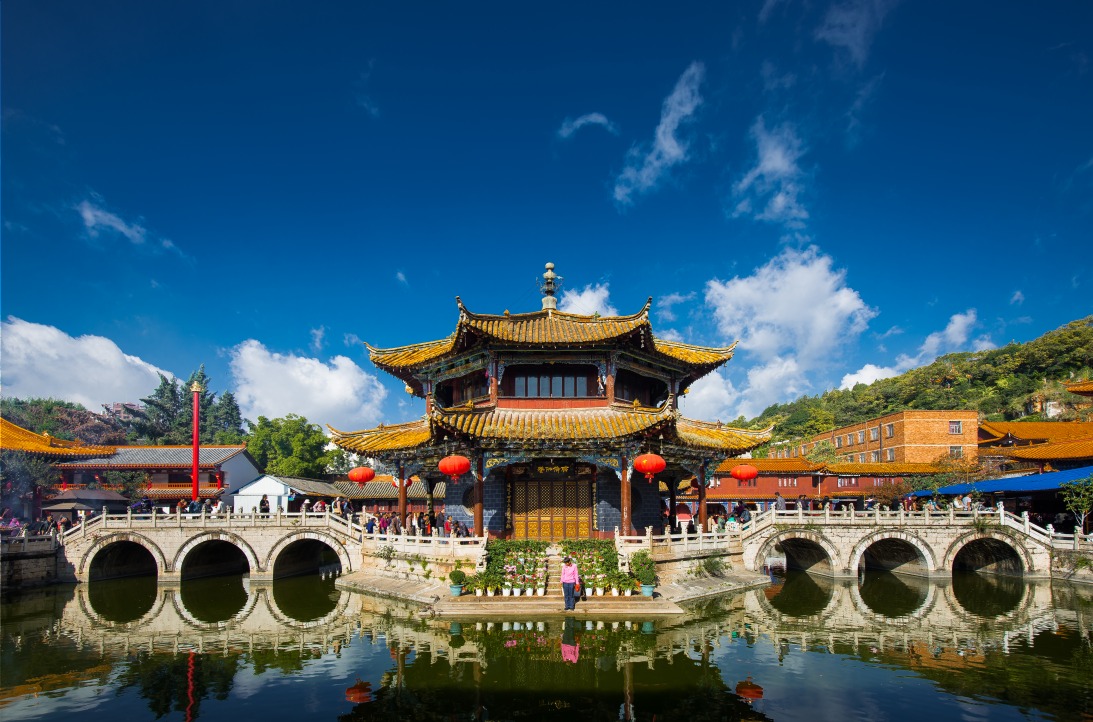
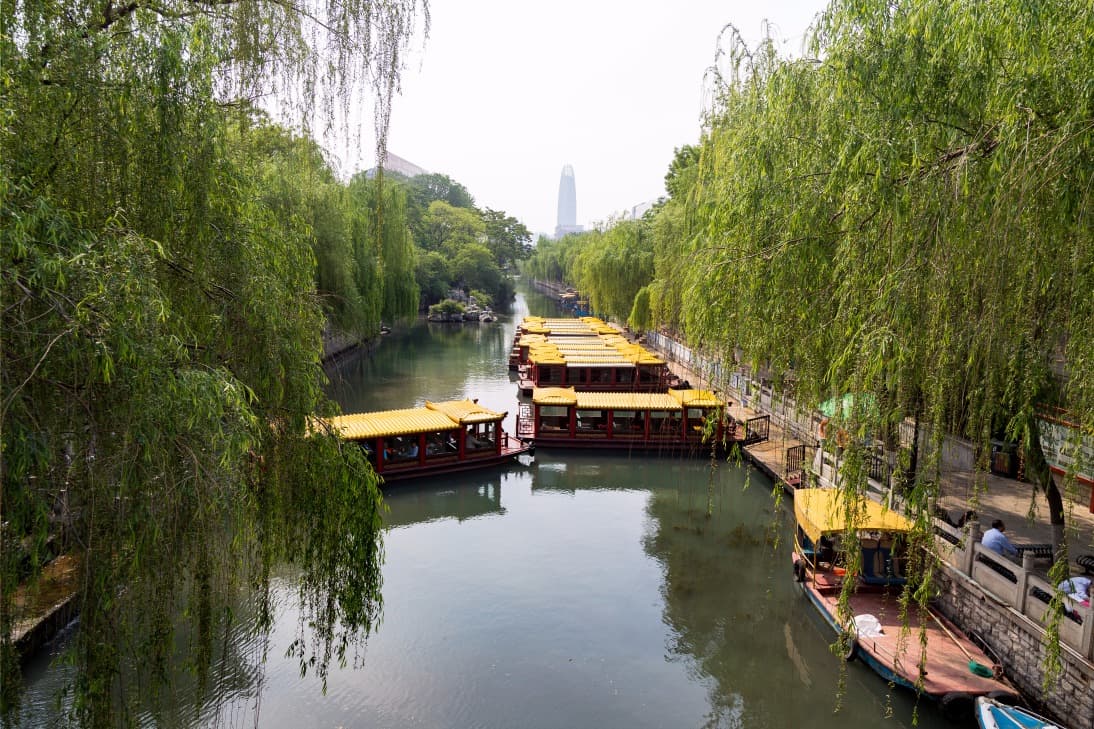
Daming Lake combines scenic beauty, architectural heritage and historical depth. For 1,500 years, it has inspired Chinese poets and writers, becoming a recurring motif in classical literature. Its park brings together Taoist temples, wooden pavilions, ancestral halls and six traditional gardens, all structured around nine islands connected by bridges. Walking along the shores or traveling by boat, you can move between the islets with ease.
History of Daming Lake
The lake appears in ancient Chinese geographical writings. The Shu Jing Zhu (« Commentary on the Classic of Waters ») describes the traditional design of waterways and canals that feed the site. This work was later taken up by Li Daoyan during the Wei Dynasty (386-534), a period when the lake became a cultural landmark.
Central to Jinan, the lake witnessed several significant episodes. During the rebellion against the Mongols, Governor Li Tan attempted suicide there; rescued by his adversaries, he was later executed. Much later, during the Battle of Jinan of the Chinese civil war, Nationalist general Wang Yaowu established his command post on one of the shores, facing the People's Liberation Army.
The park underwent major renovation and expansion between March 2006 and April 2007, which improved accessibility and restored several buildings.
What to see in the park
The lake is fed by Jinan's springs through a network of moats and ditches, as well as by the Xiaoqing River. Its water level is renowned for remaining constant year-round. This hydraulic stability enabled the gradual development of gardens, temples and pavilions across the nine islets and surrounding shores.
Beiji Temple
On the northern shore, this 1,078 m² Taoist temple was built during the Yuan Dynasty (1271-1368) and restored several times. It houses a golden statue of Zhenwu, the Taoist deity of the North, surrounded by 18 clay statues representing the gods of wind, rain and thunder. A drum tower and great bell complete the ensemble.
Lixiating Pavilion
Located on the lake's largest island, this wooden pavilion with red pillars and grey tiles once served as a gathering place for scholars during the Qing Dynasty. Destroyed and then restored under Emperor Kangxi, it preserves several calligraphic inscriptions left by the emperor.
Huibolou Tower
Situated northeast of the lake, this tower once hosted banquets and literary circles. Destroyed during the wars preceding liberation, it was reconstructed in 1982 based on historical plans.
Tiegongci Ancestral Hall
Built in 1792 under Emperor Qianlong, this courtyard covering over 6,000 m² occupies the western side of the northern shore. A walkway adorned with tortoises leads to three ancestral halls and a granary, testifying to Qing ceremonial architecture.
Xiaocanglang and Xia Gardens
The Xiaocanglang Garden, adjacent to Tiegongci, also dates from the Qing Dynasty. It stands out for its lotus-covered pond. South of the lake, the Xia Garden covers 9,600 m² and houses the former provincial library of Shandong, accompanied by small pavilions and open terraces overlooking the water.
Practical information
The park is open year-round, with extended hours during warm seasons (April to October) compared to winter. Various ticket levels are available: simple entry, combined entry with the theater, or packages including the stone hall. Rates remain moderate and are paid at each park entrance. Allow 2 to 3 hours for a comfortable visit, longer if you wish to explore each pavilion.
When to visit
Late spring and summer are the most photogenic periods: lotus ponds typically flower from June to August, transforming the shores and gardens into a sea of blooms. Autumn, drier and clearer, offers favorable light for walks. Winter, more austere, allows you to avoid crowds and showcases the pavilions' architecture.
How to get there
The park has three main entrances (south, east and north), all served by Jinan's urban bus network and BRT Line 5 for the east and north entrances. A taxi ride from the city center remains quick and affordable. Jinan's metro, currently under expansion, is progressively serving neighborhoods around the lake.
Nearby attractions
Daming Lake fits naturally into a cultural circuit around Jinan's historic center, which includes the Baotu Springs and Thousand Buddha Mountain. To extend a cultural journey through Chine, you can then reach the Great Wild Goose Pagoda in Xi'an or the Great Wall at Juyongguan, accessible from Beijing.
Frequently asked questions
Frequently asked questions
Allow 2 to 3 hours for a complete walk around the lake and a visit to the main pavilions. Half a day is needed if you wish to explore the six traditional gardens and ancestral halls in detail.
Lotus flowers typically bloom from June to August, peaking in July. The ponds of Xiaocanglang Garden and the lake's shores are particularly spectacular during this time.
Yes, boats allow you to travel between the nine islets and offer another perspective on the pavilions and riverside vegetation.
« Daming » literally translates to « Great Splendor ». The name evokes the lake's place in Chinese scholarly culture, which it has inspired for 1,500 years through poetry and classical literature.
Prepare your trip
Daming Lake naturally fits into a cultural itinerary in Shandong and beyond. To build a tailor-made journey including Jinan and the country's major heritage sites, explore our Chine travel ideas.
Interested in this visit?
We can include it in your personalised itinerary.