Daxu Ancient Village
Daxu Ancient Village
Former river port founded under the Northern Song dynasty, 20 km south of Guilin: 2.5 km of cobbled street, thirteen historic wharves, Qing temples and century-old mosque.
About twenty kilometers south of Guilin, in the Zhuang Autonomous Region of Guangxi, the ancient village of Daxu lines its wooden houses and cobbled lanes along the Li River. Founded in the early Northern Song dynasty, this borough of over a thousand years was one of the four principal ports of the region. Today it preserves a commercial street of 2.5 km, thirteen historic wharves, Qing temples and a century-old mosque, in a setting still largely sheltered from mass tourism.
Why visit Daxu
Daxu offers a useful counterpoint to the karst landscapes of the Li River: here, the appeal is heritage and urban rather than natural. The village stands out for three elements rarely found together elsewhere in southern Chine:
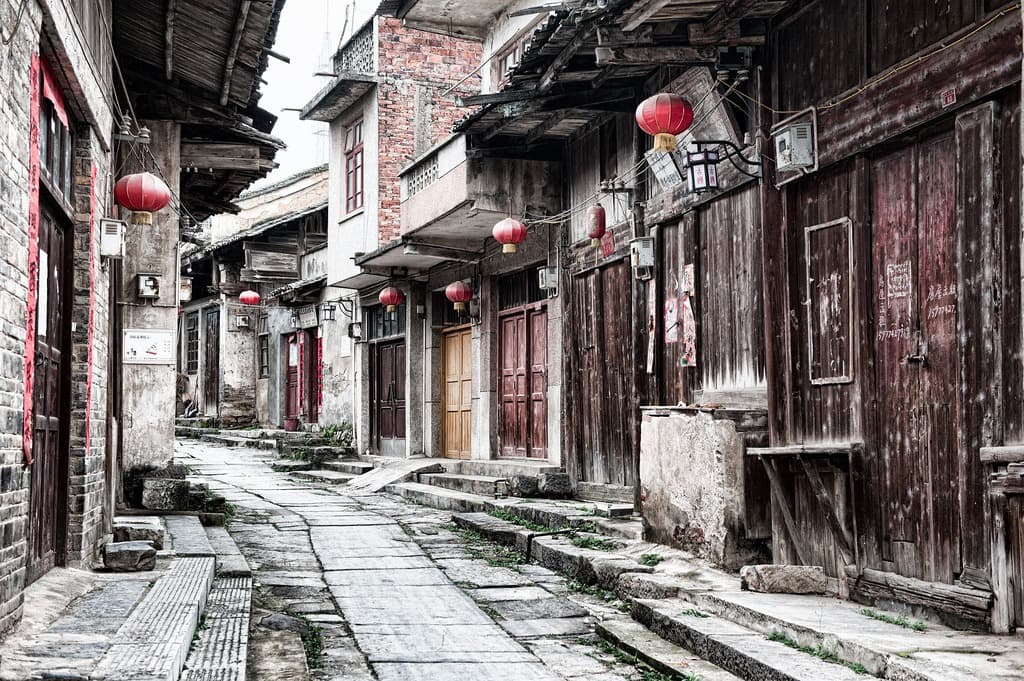
- An ancient blue-stone cobbled street stretching 2.5 km, lined with wooden shop-houses with black tile roofs, still widely inhabited.
- A singular urban layout, with a lower southern section than the north: facades face onto the commercial street while the rear of the houses open directly onto the river wharves.
- Marked cultural diversity, centered on the Hui community gathered near the mosque and around the Taoist temples Gaozu and Hanhuang.
The atmosphere remains that of an active market village, not a site reconstructed for visitors. The walk typically takes half a day, making it an ideal excursion from Guilin.
History of Daxu
Daxu was founded in the early Northern Song dynasty, over a thousand years ago. Its prosperity stemmed from its position along the Li River: the town ranked among the four principal river ports of the region, at a strategic location on the commercial axis linking southern Chine to the rest of the empire.
This axis owes much to the Ling Canal, dug much earlier under Emperor Qin Shi Huang (around 214 BCE) to link the Xiang River, the Yangtze River and the Li River. Though the village itself did not yet exist at that time, the hydraulic infrastructure durably shaped regional commerce and conditioned Daxu's later flourishing under the Song, then Ming and Qing dynasties. The thirteen wharves dotting the old street bear witness to this period of intense activity, when merchandise transited by junks between the hinterland and Yangtze markets.
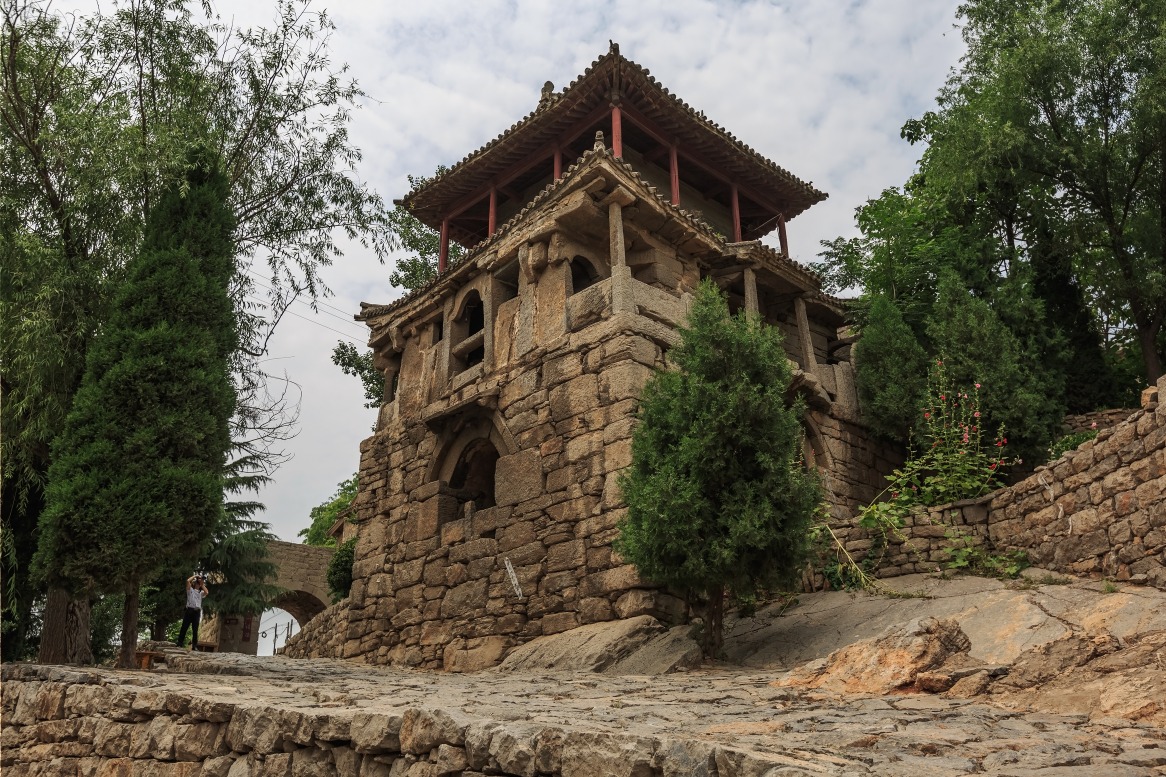
The Gaozu and Hanhuang temples, dating from the Qing dynasty, as well as the Wanshou Bridge—called the Bridge of Longevity, erected under the Ming and Qing—rank among the most eloquent architectural vestiges of this golden age.
What to see in the village
The ancient cobbled street
Paved with blue stones worn smooth by time, the main street stretches for approximately 2.5 km. It is lined with arcades, artisanal shops and shop-houses. The calligraphed couplets (often stamped with the character "Fu" for fortune) adorning traditional doorways give a good sense of local domestic culture.
The Wanshou Bridge
Erected under the Ming and Qing dynasties, the Bridge of Longevity spans an adjacent watercourse and offers an open perspective over the banks and roofs of the village. It is one of the most recognizable photographic viewpoints in Daxu.
The Daxu Mosque
Built in 1904, the mosque sits just across the bridge. It still serves a Hui community estimated at around 300 families. Visits remain discreet and respectful of worshippers.
The wharves and ancient houses
The thirteen wharves aligned along the old street are accessible from the rear of the houses. Several are still in use. Southern Chine's characteristic architecture is evident in the wooden frameworks, black tiles and interior courtyards arranged on the second floor, where flowers and aromatic plants are cultivated.
The temples and Seven Stars tombs
The Gaozu and Hanhuang temples illustrate the wealth of the Qing dynasties. Nearby, the so-called Seven Stars tombs are arranged according to the constellation of the Big Dipper, a ritual arrangement that intrigues visitors interested in Chinese cosmology.
Practical information
Village entry is free and circulation in the lanes is not regulated by opening hours. Allow two to four hours for a comfortable visit, longer if you wish to take time chatting with artisans or eating on site. The traditional market offers regional cuisine and a small selection of local crafts. Strawberry picking, sometimes highlighted in nearby farms, remains a seasonal activity (generally between late winter and early spring) best confirmed locally.
Wear good shoes for the cobblestones, and prefer the morning to avoid crowds from excursions departing Guilin.
When to go
The climate is subtropical, with mild winters and hot, humid summers. The most pleasant period extends from April to November. One caveat, however: the Li River can overflow once a year, generally during the rainy season, and flood the low-lying areas of the village. It is wise to avoid the days following a flood. Spring and autumn offer the best conditions, with moderate temperatures and light favorable for photography.
How to get there from Guilin
Daxu is located approximately 19 to 24 km south of Guilin, or 40 to 50 minutes by car depending on traffic. Three main options:
- Direct bus from Guilin bus terminal: approximately 40 minutes, this is the simplest public transport solution.
- Local buses with connection: less costly but longer, allow approximately two hours.
- Private car or taxi: the most flexible option, particularly convenient for returning at day's end.
To combine nearby
Daxu works well as a stop on a full-day itinerary integrated into a stay in Guilin. Several logical extensions suggest themselves:
- A cruise on the Li River to Yangshuo, which complements the river dimension glimpsed from Daxu's wharves.
- The terraced rice fields of Longji, accessible on a day trip from Guilin.
- For sharper contrasts with other Chinese heritage sites, consider sites such as the Great Wild Goose Pagoda in Xi'an or the Great Wall at Juyongguan near Beijing.
Frequently asked questions
Frequently asked questions
Two to four hours are sufficient to walk down the old street, cross the Wanshou Bridge, see the mosque and stroll along the wharves. Visitors interested in photography or temples can easily spend a half-day there.
Daxu is far less visited than Yangshuo and retains the character of a lived-in village rather than a tourist site. The appeal is primarily heritage: southern Chine architecture, a historic river port and the presence of the Hui community. It complements a Li River cruise well.
Yes, access to the village and its streets is free. Certain individual sites may apply a modest entrance fee, to be paid on site.
A direct bus connects Daxu to Guilin bus terminal in approximately 40 minutes. This is the simplest option for independent travelers.
April to November, ideally avoiding the days following a Li River flood. Spring and autumn offer the best visiting conditions.
Prepare your visit
Daxu fits naturally into an itinerary combining Guilin, the Li River and Yangshuo. To build a complete stay in southern Chine, consult our Chine travel suggestions.
Interested in this visit?
We can include it in your personalised itinerary.