Double Dragon Bridge
Double Dragon Bridge
Five kilometres from Jianshui in Yunnan, the Double Dragon Bridge spans 17 stone arches and three pavilions above the confluence of the Lujiang and Tachong rivers.
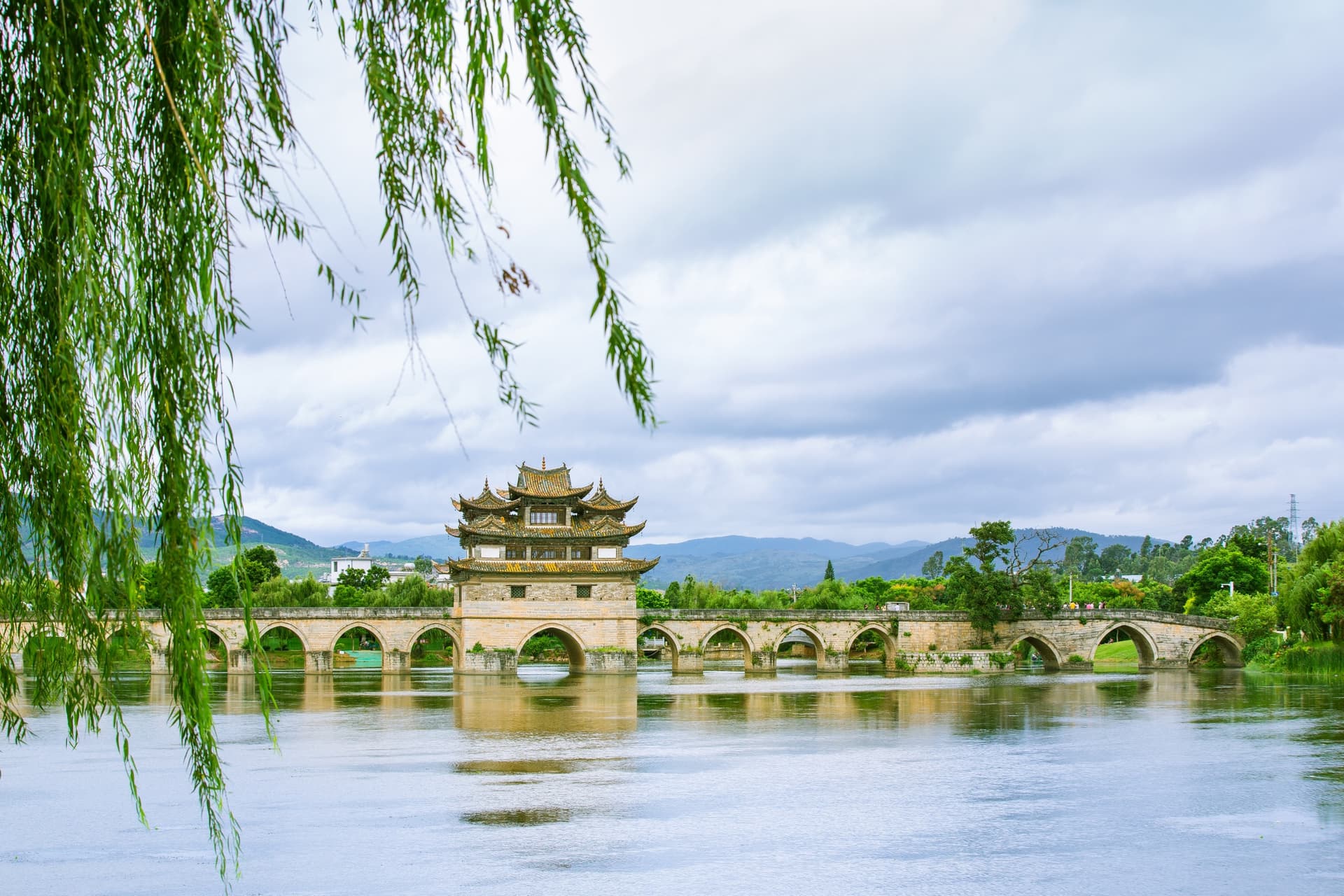
Five kilometres west of the old town of Jianshui in Yunnan, the Double Dragon Bridge spans the confluence of the Lujiang and Tachong rivers with its 17 blue stone arches. Stretching 148 metres and punctuated by three wooden pavilions, it ranks among China's officially recognized ancient stone bridges, acknowledged in 1965.
Why visit the Double Dragon Bridge
The bridge attracts fewer visitors than major Yunnan sites, making it a serene and photogenic stop on the outskirts of Jianshui. Its zigzag silhouette, which inspired its name (the curves evoke two dragons), and its sculpted pavilions offer a rare testament to Chinese hydraulic engineering from the eighteenth and nineteenth centuries. A visit combines easily with the old town of Jianshui and its surroundings in a half-day excursion.
History of the bridge
Construction began during the Qing dynasty, between 1735 and 1796, with an initial version comprising only three arches. Between 1820 and 1850, under Emperor Daoguang's reign, the structure underwent major renovation to reach the seventeen arches seen today, responding to the widening of the river bed and growing traffic needs in Jianshui County, at the heart of the Honghe Hani and Yi Autonomous Prefecture.
A further restoration took place in 1898: a square pavilion with triple eaves was added, completing the architectural ensemble visible today. Recognized in 1965 among China's ancient stone bridges, the site is now protected as provincial heritage in Yunnan, ensuring its maintenance and limiting modern interventions.
What to see on site
The 17 arches and blue stone
Walking across allows you to observe the regularity of the arches and the coursing of local blue stone slabs. The structure measures 3 to 5 metres wide depending on sections, leaving room to linger over details without impeding other visitors.
The three pavilions
Three traditional pavilions punctuate the walk, including the large central pavilion and the square pavilion with triple eaves added in the late nineteenth century. Their sculpted timberwork and upturned roofs reward close inspection, especially in raking light.
The river confluence
The bridge spans the meeting of the Lujiang and Tachong rivers. From the banks, you better grasp the logic of the zigzag layout, designed to cross a flood-prone low point and stabilize the structure against high waters.
Surrounding rice paddies
The agricultural lands encircling the bridge form a backdrop typical of southern Yunnan. The walk extends easily along dirt paths, on foot or by bike.
Practical information
The site is freely accessible and can be visited in one to two hours, longer if you take time to walk the surroundings. Bring water, a hat, and comfortable shoes: there is little shade on the bridge itself. The pavilions are accessed from the deck without complex ticketing. Any entry fee remains modest.
When to go
The most pleasant periods span March to June and September to November, with mild temperatures and light favourable for photography. Summer is hot and more crowded, winter cooler but noticeably quieter. During the day, early morning and late afternoon offer the best conditions: oblique light on stone, water reflections, and reduced foot traffic.
How to get there
Jianshui is now connected by high-speed rail to Kunming, Dali, and Lijiang, making the town accessible in a few hours from major Yunnan tourist hubs. From Jianshui railway station, count on a short taxi ride or local bus journey to reach the bridge, located five kilometres west of the old town. Another appealing option is the historic narrow-gauge railway, which serves a stop in the immediate vicinity of the bridge and provides a travel experience in itself.
Nearby attractions
- Old town of Jianshui: historic centre over 1,200 years old, featuring temples, towers, and well-preserved traditional dwellings.
- Zhu Family Garden: vast late-Qing residence-garden, representative of classical Chinese architecture.
- Swallow Cave: karst network known for its rock formations and swallow colonies.
- Tuanshan Village: traditional village with old houses typical of southern Yunnan.
To broaden your itinerary in the country, also explore the wealth of Chinese Buddhist sites or the landscapes of the Hexigten Geopark.
Frequently asked questions
Frequently asked questions
The bridge is situated approximately 5 kilometres west of the old town of Jianshui, in Jianshui County, Honghe Hani and Yi Autonomous Prefecture, in southern Yunnan.
Allow one to two hours to cross the bridge, observe the pavilions, and photograph the surroundings. With a walk along the rivers, you can easily spend a half-day here.
The zigzag layout of the structure, which follows the confluence of the Lujiang and Tachong rivers, evokes the silhouette of two entwined dragons, hence its name.
High-speed trains connect Kunming to Jianshui in a few hours. From the railway station, taxi or local bus allow you to reach the bridge quickly.
The current structure results from the enlarged seventeen-arch version between 1820 and 1850, completed by the 1898 restoration with the addition of a square pavilion with triple eaves. It is now protected as provincial heritage in Yunnan.
Extend your experience in Chine
The Double Dragon Bridge fits naturally into a Yunnan itinerary combining Kunming, Jianshui, Yuanyang, and Lijiang. To build a complete stay, explore our journeys in Chine, which emphasize ancient architecture and rural landscapes of the country's south.
Interested in this visit?
We can include it in your personalised itinerary.