Guanlu Historic Village
Guanlu Historic Village
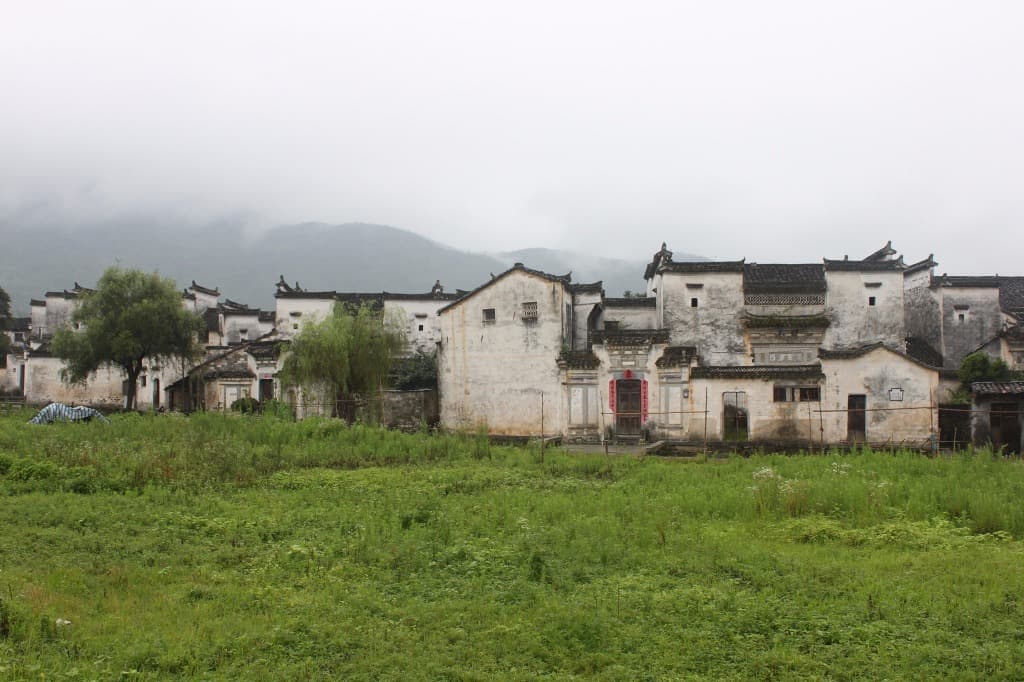
Eight kilometres from Yixian, nestled at the foot of Huangshan mountain, Guanlu preserves an authentic ensemble of Hui architecture, dominated by the Badajia of the eight Wang brothers.
Eight kilometres west of Yixian, at the foot of Huangshan mountain, the historic village of Guanlu preserves a largely unrestored ensemble of Hui architecture, having escaped the heavy hand of modern restoration. Located in the southern region of Anhui, this village founded during the Song dynasty owes its present character to the Wang family, who built their finest mansions here during the Qing period.
Why visit Guanlu
Unlike its UNESCO-listed neighbours Xidi and Hongcun, which draw substantial tourist crowds, Guanlu remains an inhabited village, minimally restored and largely removed from major tourist flows. Here you observe Huizhou architecture in its lived-in state: aged wooden beams, latticed window screens, original painted ceilings, inner courtyards where some 400 inhabitants still live, the majority descendants of the Wang family.
The village also preserves the Badajia, an ensemble of eight mansions built by the eight Wang brothers, representing a rare example of large-scale Qing residential architecture.
The village's history and the Wang family
Guanlu was founded during the Song dynasty (960–1279). Yet it was under the Qing dynasty (1644–1911) that the village assumed its present form, thanks to the wealth accumulated by the Wang family through the candle-wax trade. This prosperity financed the construction of nearly all the ancient buildings still visible today.
Within the clan, the eight Wang brothers built a cohesive ensemble of eight large mansions connected to one another, the Badajia, nicknamed "The Big Eight." This complex now forms the monumental heart of the village.
Long closed to visitors, the village was officially opened to the public in 2003. Since then, it has welcomed measured tourism without undergoing heavy restoration campaigns.
What to see in Guanlu
The Badajia, ensemble of eight mansions
Built by the eight Wang brothers, the Badajia forms the village's central structure. It exemplifies the Huizhou architectural style: central light wells, paved inner courtyards, communal halls, finely carved wooden panels, and private gardens. The eight mansions interconnect via interior doors and corridors, an arrangement typical of grand patriarchal families across southern Anhui.
Domestic interiors
Most buildings feature an inner courtyard framed by robust wooden pillars. Windows overlooking these courtyards are shielded by carved lattice screens. Ceilings are painted with scenes of daily life, which have retained much of their original pigmentation thanks to the absence of aggressive restoration.
Traditional living patterns
The layout of the dwellings reflects ancient family hierarchy: children occupied the second floor, while wives and concubines inhabited separate quarters. This arrangement remains legible in the room distribution, making the visit valuable for understanding the domestic life of Hui merchant families.
The village fabric
Ancient buildings cover approximately 65,000 m², more than two-thirds of the village. With roughly a hundred households and over 400 inhabitants, Guanlu remains a living community: you encounter residents in the lanes, distinctly setting this experience apart from neighbouring museum-villages.
Practical information
- Duration of visit: allow 1.5 to 2.5 hours to explore the village and visit the Badajia.
- Admission fee: a modest entrance fee is requested at the village entrance (lower than Xidi and Hongcun).
- Best time: early morning or late afternoon, when light enhances the aged timber and inner courtyards.
- Tip: wear sturdy shoes; the ancient paving is uneven.
What to see near Guanlu
Guanlu lends itself well to a circuit through the Hui villages of southern Anhui:
- Xidi and Hongcun, inscribed on the UNESCO World Heritage List, more extensively restored and more frequented, yet essential for grasping Huizhou architecture at its finest expression.
- Nanping, a neighbouring village renowned for its labyrinthine lanes and clan temples.
- Huangshan mountain, an iconic range inscribed on the UNESCO World Heritage List, accessible from Yixian for a multi-day excursion.
How to reach Guanlu
From Yixian, several options provide access to Guanlu:
- Long-distance buses: buses linking Yixian to Tunxi stop at the village entrance. Service runs throughout the day with regular departures.
- Taxi: from Yixian, taxis readily serve Guanlu, Xidi, and Hongcun, a practical option if combining multiple villages.
- Local minibus: a direct service connects Nanping and Guanlu, situated on the same transport corridor.
Yixian itself is accessible by bus from Tunxi (Huangshan City), the region's primary transport hub with rail and air connections.
Frequently asked questions
Frequently asked questions
Guanlu sits eight kilometres west of Yixian, at the foot of Huangshan mountain, in the southern region of Anhui province in eastern Chine.
Xidi and Hongcun are UNESCO-listed and have undergone extensive restoration for tourism. Guanlu has remained more authentic, minimally restored, with a local population still living there.
The Badajia, or "The Big Eight," is an ensemble of eight grand mansions built by the eight Wang brothers during the Qing dynasty. It forms the village's central structure and exemplifies Huizhou residential architecture.
Allow approximately 1.5 to 2.5 hours to walk the lanes, visit the Badajia, and observe the traditional interiors with their courtyards and painted ceilings.
Yes, Guanlu pairs excellently with Xidi, Hongcun, and Nanping over one to two days departing from Yixian, via taxi or local transport.
Planning your trip
Guanlu village integrates naturally into a circuit dedicated to the architecture and landscapes of southern Anhui. To build your itinerary across Chine and combine Huangshan with other major sites, consult our trips to Chine.
Interested in this visit?
We can include it in your personalised itinerary.