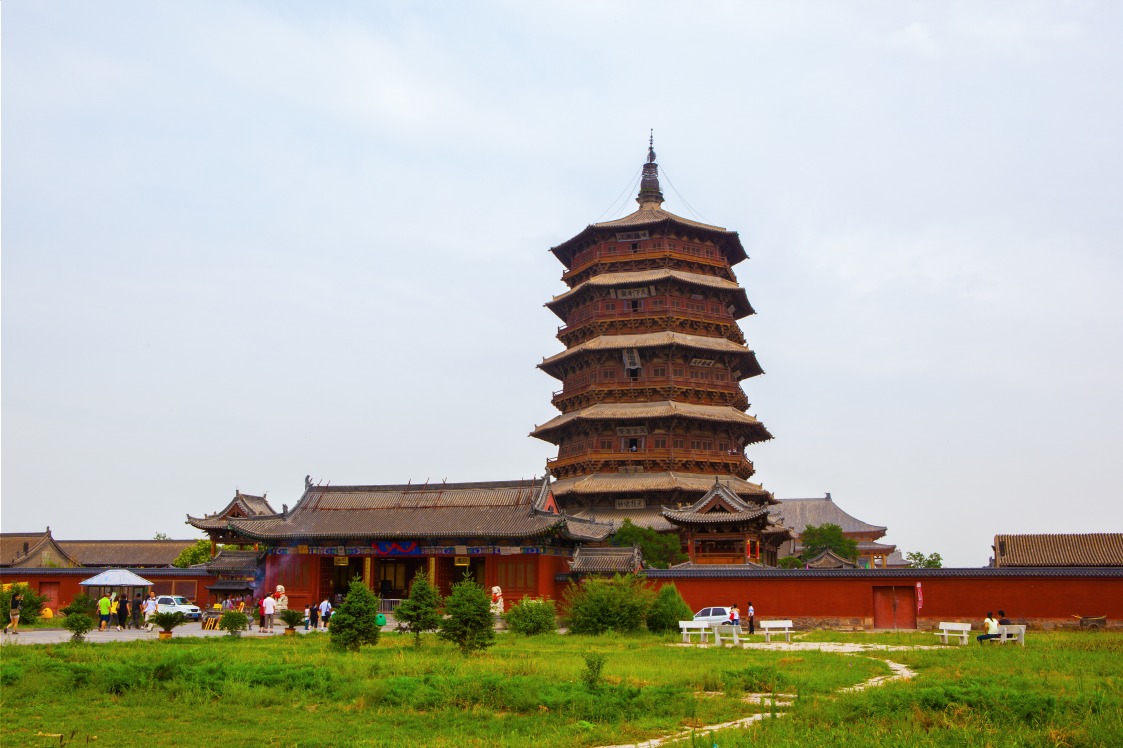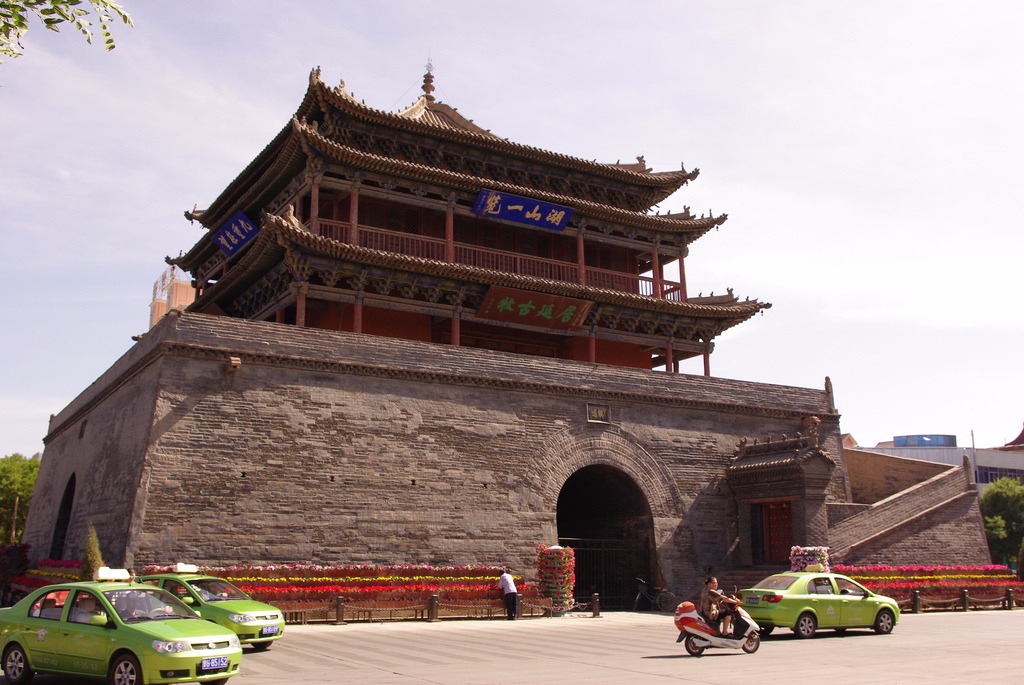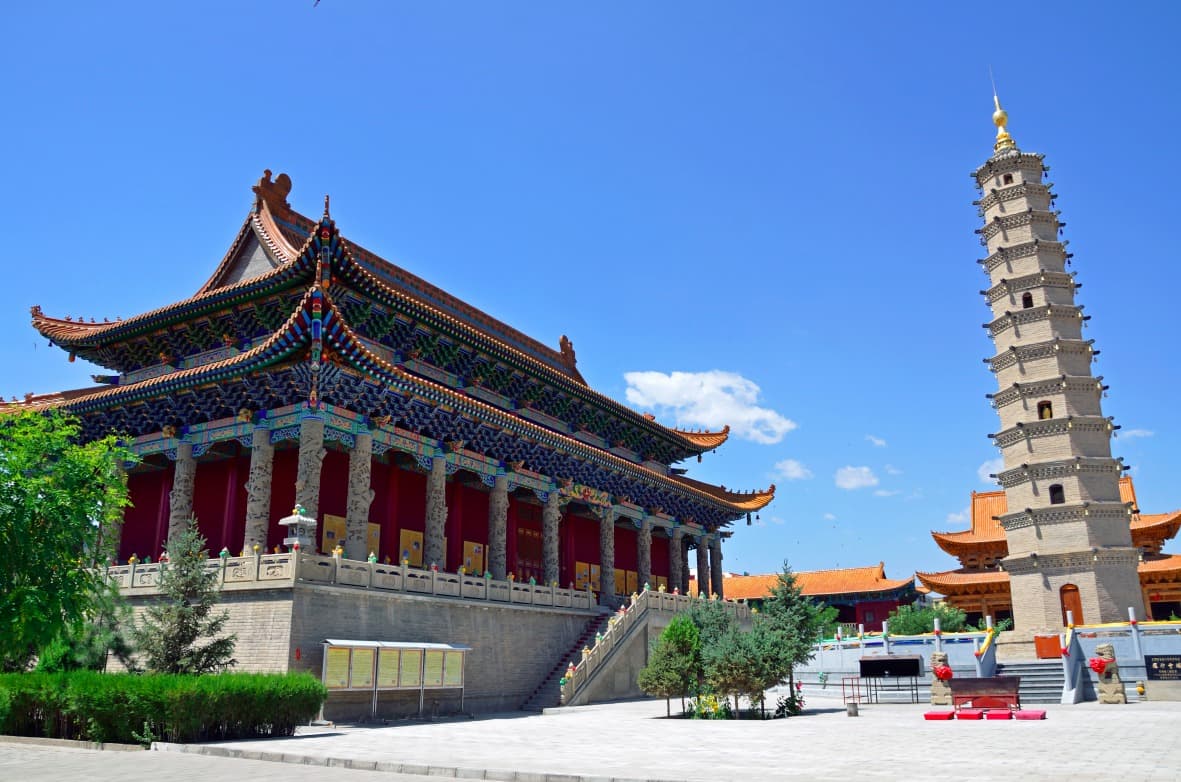
Kumarajiva Pagoda
Kumarajiva Pagoda
Twelve-story octagonal tower in Wuwei, dedicated to the translator monk Kumarajiva, a key figure in Chinese Buddhism. Regional architecture and preserved sculptural decoration.
The Kumarajiva Pagoda rises in Wuwei, in Gansu province, approximately 400 meters north of the city's main square. An octagonal brick tower of twelve stories reaching more than 32 meters in height, it preserves the memory of Kumarajiva, one of the greatest translators of Chinese Buddhism, and retains remarkable sculptural decoration despite twentieth-century reconstructions.
Why visit the Kumarajiva Pagoda
Three compelling reasons justify a detour for travelers journeying through the Hexi corridor, the historic Chinese section of the Silk Road:
- A Buddhist memorial: the pagoda is dedicated to Kumarajiva (344-413), a monk born in the kingdom of Kucha (present-day Xinjiang), regarded as the transmitter of Indian Buddhism to Chine. His ashes are, according to tradition, preserved on the site.
- A singular regional architecture: the inverted-cone silhouette, characteristic of Gansu pagodas, and nearly a hundred wind bells hung from the eaves make it a distinctive edifice among Chinese Buddhist towers.
- Preserved sculptural decoration: polychrome jade engravings, lotus-shaped base, celestial dancers and golden Buddha statues testify to the care taken in the 1934 reconstruction on ancient ruins.
History of the pagoda
The pagoda's foundation is traditionally dated to 488, under the Northern Wei dynasty, a period of rapid Buddhist expansion in northwestern Chine. It was erected to honor the memory of Kumarajiva, who lived nearly seventeen years in the Wuwei region under the Later Qin dynasty (384-417), before being taken to Chang'an (present-day Xi'an).
A translator and scholar, Kumarajiva mastered Vedic literature, the Pali canon, and Mahayana texts. He is credited with translating nearly twenty-four works from Sanskrit into Chinese, among which are foundational scriptures of Chinese Buddhism. His work established Wuwei as one of the historic centers of Buddhist text transmission.
The original structure did not survive the centuries. The 1927 earthquake, which devastated much of Gansu, caused the pagoda to collapse. It was reconstructed in 1934 according to ancient plans and today remains closely associated with the Caotang temple in Xi'an, the other great sanctuary dedicated to the monk.
What to see on site
The tower's architecture
The pagoda adopts an octagonal plan and comprises twelve brick stories stacked vertically. Its silhouette flares slightly toward the top, creating that inverted-cone form typical of temples in the Hexi region. Doorways pierce the eastern façade at the 1st, 3rd, 5th, and 8th stories. The summit roof is crowned with a copper spire in the shape of a gourd, a recurring motif in Chinese Buddhism associated with longevity.
At each story, the eaves corners bear wind bells — nearly a hundred in total — that chime at the slightest breeze. This sonic detail is an essential part of the visit experience.
The sculptural decoration
The main enclosure displays a series of jade engravings in varied hues: white, greenish, black, yellow, reddish, and light blue. The pagoda's base is carved in a lotus flower motif, adorned with stylized wave patterns.
On the doors, latticed windows, and eaves, celestial dancers — feminine heavenly figures from Hindu and Buddhist mythology — animate the décor. Above the doorways of the 5th and 12th stories, two small golden Buddha statues watch over the whole.
Practical information
- Hours: open during the day, generally 8 a.m. to 6 p.m. Verify on site in low season.
- Admission: modest entrance fee, payable in cash or via Chinese payment apps.
- Visit duration: allow 45 minutes to 1 hour to walk around the pagoda and its enclosure.
- Dress code: shoulders and knees covered, as at all active Buddhist sites.
How to get there
The pagoda is located approximately 400 meters north of Wuwei's main square, making it easily accessible on foot from the city center.
- By city bus: from the East station on Nan Dajie, several lines serve the pagoda quarter.
- By minibus: Wuwei railway station, about 3 km south of the center, offers shuttles and shared minibuses to the site.
- On foot or by taxi from the center: the simplest option if you're staying downtown.
Nearby
The pagoda visit fits naturally into a broader stop in Wuwei, a crossroads city of the Hexi. Travelers often extend with:
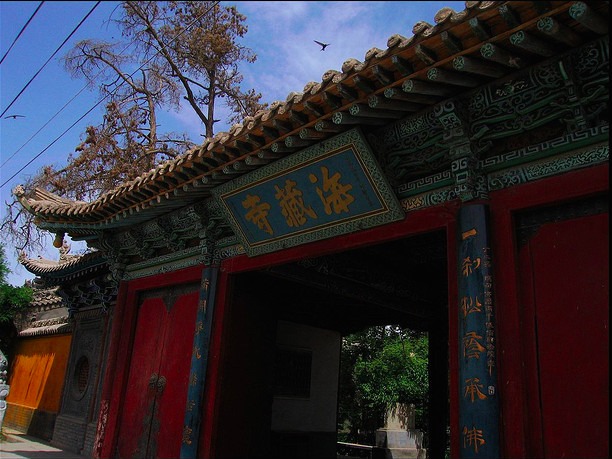
- The Haizang Temple in Wuwei, another major Buddhist site in the city.
- The Mount Maiji Shan and its carved grottos, further south in Gansu.
- The Labrang Monastery, a major center of Tibetan Buddhism in Amdo.
- For travelers continuing to Xi'an, the Great Wild Goose Pagoda offers another perspective on the transmission of Buddhist texts in Chine.
Frequently asked questions
Frequently asked questions
Include Wuwei in your trip
The Kumarajiva Pagoda fits into a long itinerary along the Chinese Silk Road, between Lanzhou, Zhangye, and Dunhuang. To build a journey combining Buddhist heritage, Gansu landscapes, and historic cities, explore our Chine travel ideas.
Interested in this visit?
We can include it in your personalised itinerary.