Erhai Lake
Erhai Lake
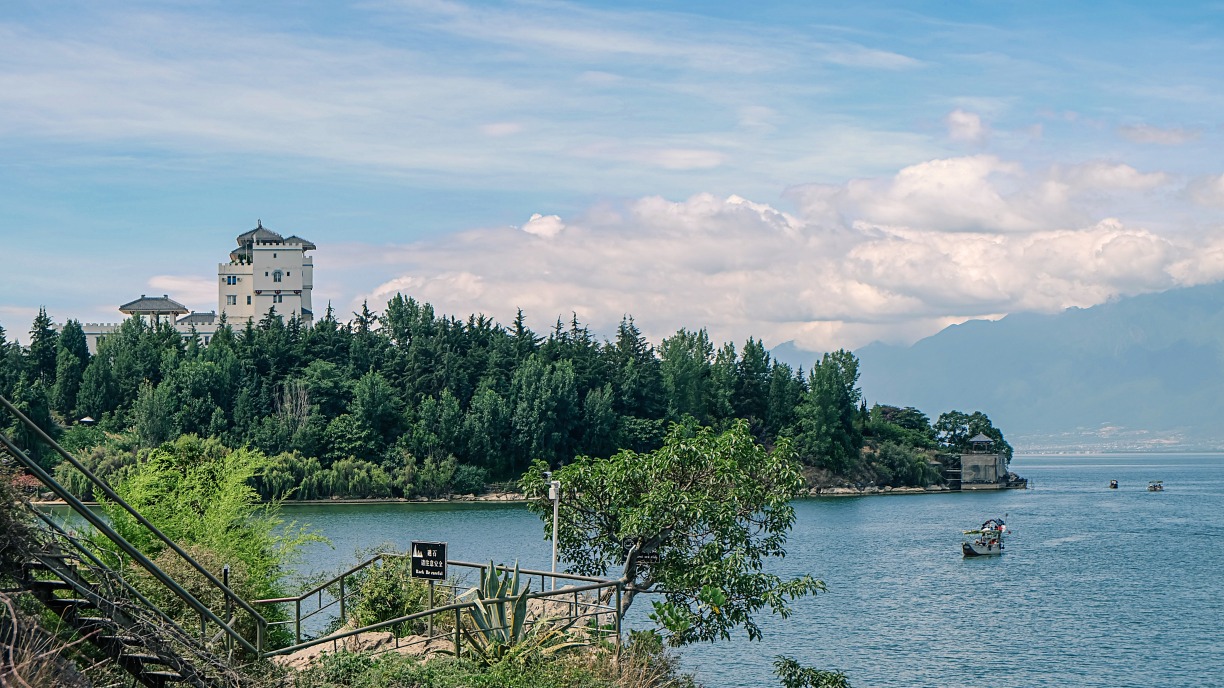
China's seventh-largest freshwater lake, Erhai Lake stretches across 252 km² at the foot of the Cangshan Mountains in Dali, the historic heart of Bai culture.
At the foot of the Cangshan Mountains, east of the old town of Dali, Erhai Lake extends its 252 km² of freshwater across northwestern Yunnan. China's seventh-largest freshwater lake, it takes its name — "ear-shaped sea" — from its elongated silhouette. Its four islands, Bai villages and the reflection of the Three Pagodas make it one of Yunnan's major attractions.
Why visit Erhai Lake
Erhai Lake offers several compelling reasons to spend a full day, or even two, exploring its waters.
- A striking natural setting: 252 km² of freshwater framed to the west by the snow-capped peaks of the Cangshan Mountains, which rise above 4,000 meters.
- Living Bai heritage: lakeside villages, traditional architecture, cormorant fishing still practised by some fishermen.
- A historical legacy: former centre of the Nanzhao kingdom, the lake appears in Chinese historical sources dating back to antiquity.
- The reflection of the Three Pagodas of Chongsheng, visible from the western shore, one of Dali's most photographed viewpoints.
Historical landmarks
Erhai Lake is a natural lake, formed by the tectonic collapse of the valley. The earliest written records date back to the historian Sima Qian (2nd-1st century BC), author of the Shiji. Under the reign of Emperor Wu of the Han Dynasty, the lake was integrated into the expansion strategy towards the Yunnan plateau and was briefly known as Kunming Lake in Chinese sources.
The lake reached its height under the Nanzhao kingdom (8th-9th century), and later under the Dali kingdom, of which it formed the economic and cultural heart. The poet Feng Shike, during the Ming Dynasty, described it as a body of water so clear that the sun, moon and stars were reflected with particular intensity. This image has remained associated with the site ever since.
What to see
The four islands
The lake has four main islands, each with its own character:
- Guanyinge Island: a small rocky island associated with the cult of the bodhisattva Guanyin.
- Jinsuo Island: the most populated, home to a significant Bai community living primarily from fishing.
- Xiaoputuo Island ("Little Putuo Island"): a tiny rocky islet bearing a temple dedicated to the bodhisattva Guanyin. The building exemplifies traditional Chinese Buddhist architecture, with its tiered eaves with upturned edges.
- Nanzhao Island: located in the north of the lake, it is a heritage site dedicated to Bai culture, featuring reconstructed houses and pavilions tracing the ancient way of life.
Erhai Park
South of the lake, Erhai Park occupies a former peninsula that once served as a hunting reserve for the sovereigns of the Nanzhao kingdom. Developed as a public park in 1976, it now hosts experimental cultivations of local species: camellias, azaleas and snow lotus. There is also a zoo and family leisure facilities.
Bai villages and cormorant fishing
The shores and islands of the lake are inhabited by the Bai ethnic group, whose identity remains strongly marked. On Jinsuo Island, several hundred Bai households still depend on the lake for their livelihood. Cormorant fishing, an ancestral technique where birds bring fish back to the fisherman, is still practised, mainly as a demonstration for visitors today.
The three-tea ceremony
Bai culture is also discovered through the San Dao Cha ceremony, or "three-tea ceremony". Three infusions are served successively: a bitter tea, a sweet tea, then a blend of the two. Each cup holds symbolic value, evoking the stages of life. The ceremony is often offered during visits to Bai villages around the lake.
When to visit
Erhai Lake can be visited year-round, but some periods are more favourable:
- Spring (March to May): camellia and azalea blooms in Erhai Park, mild temperatures.
- Autumn (September to November): clear skies, excellent visibility of the Cangshan Mountains, ideal light for photography.
- Summer: more humid season, but vegetation at its peak. Full moon evenings offer a particularly clear reflection on the lake.
- Winter: cool temperatures but often clear skies, snow-capped peaks to the west.
Practical information
- Duration of visit: allow a half-day for the park and a short cruise; a full day if you combine several islands.
- Fees: modest entrance fee for Erhai Park; additional charge for cruises and island access. Budget extra if you wish to attend the three-tea ceremony.
- Hours: the park is open during daytime, generally from morning until late afternoon. Boat departures cease mid-afternoon.
- What to bring: clothing suitable for the wind that often picks up on the lake, sun protection, water.
How to get there
Erhai Lake is accessible from Dali town centre:
- By bus: line 6 towards Xiaguan serves the Erhai Park station.
- By taxi or ride-sharing: short and affordable journeys from Dali's old town or Xiaguan.
- By bicycle: a partial cycle tour of the lake has become a popular activity, with cycling paths set up on several sections of the eastern shore.
- By cruise: boats connect the main islands from several landing points.
Nearby
Erhai Lake is part of a cluster of major sites around Dali:
- The Three Pagodas of Chongsheng Temple, whose reflection appears in the lake.
- Dali's old town, a few kilometres away, with its Ming ramparts and historic Bai centre.
- The Cangshan Mountains, accessible by cable car for panoramic views over the lake.
- Xizhou village, to the north, known for its traditional Bai architecture.
Frequently asked questions
A half-day is enough for Erhai Park and a short cruise. To combine several islands, the tea ceremony and a shoreline tour, allow a full day, or even two if you wish to cycle around the lake.
Erhai literally means "ear-shaped sea" in Chinese, referring to the lake's elongated and curved silhouette, which resembles the outline of a human ear.
Yes, this ancestral technique is still practised by some Bai fishermen on the lake, mainly as a demonstration for visitors. Sessions typically take place in the late afternoon.
Boats serve the main islands from several landing points distributed around the shores. Cruises often combine a visit to Nanzhao Island, cormorant fishing demonstration and the three-tea ceremony.
Autumn and spring offer the best light and visibility of the Cangshan Mountains. Clear mornings are ideal for capturing the reflection of the Three Pagodas, and full moon evenings for night-time atmospheres.
To integrate Erhai Lake into a complete itinerary across Yunnan and beyond, consult our journeys in Chine.

Nearby

Interested in this visit?
We can include it in your personalised itinerary.