Emin Minaret
Emin Minaret
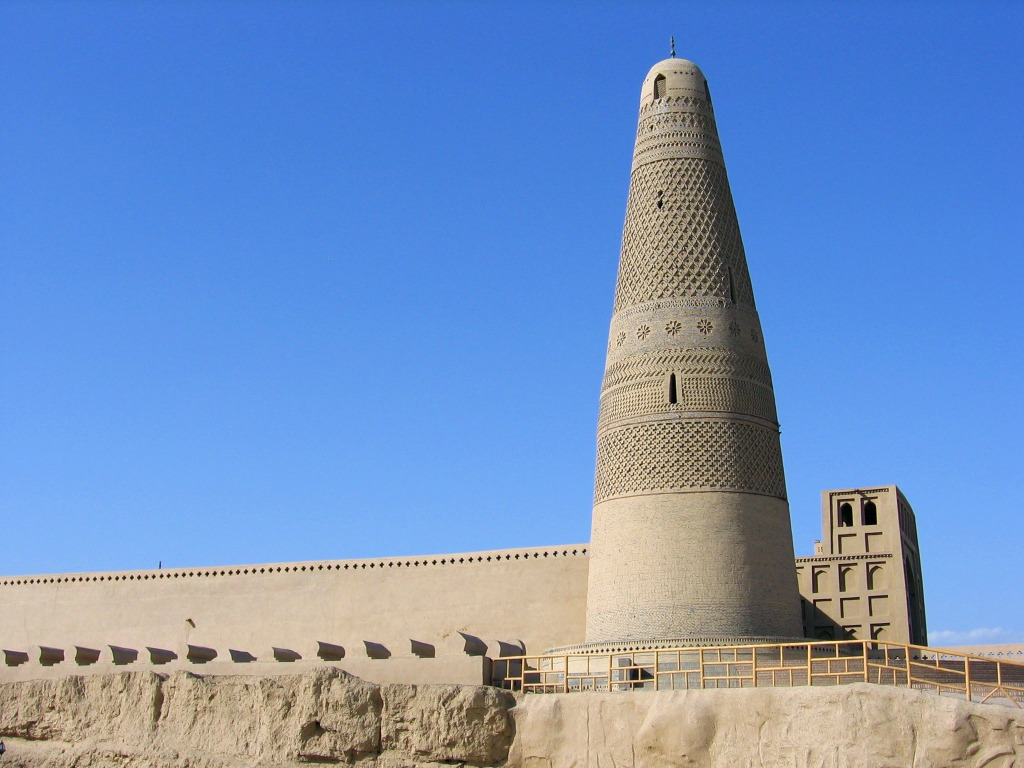
Located 2 km from Turpan, the Emin Minaret (1778) is China's tallest minaret, a testament to Uyghur Islam along the Silk Road.
The Emin Minaret, also known as Sugong Tower, rises 2 km east of Turpan in Xinjiang Province. Built in 1778, it is China's tallest minaret and one of the most significant architectural testimonies to Uyghur and Muslim presence on the ancient Silk Road.
Why visit the Emin Minaret
- China's tallest minaret, with its distinctive conical silhouette standing approximately 44 meters high.
- Rare architectural syncretism, blending Iranian, Afghan influences with Chinese motifs.
- A site linked to 18th-century Uyghur history and the Qing dynasty.
- A complete complex with an adjoining mosque, still active for local worshippers.
History of the minaret
The minaret is named after Emin Khoja, a Uyghur ruler of Turpan under the Qing dynasty (1644-1911). In a Xinjiang marked by conflict, Emin Khoja repelled Dzungar rebels and rallied Uyghur populations to Qing authority, earning him official recognition from the imperial court.
In 1778, his second son, Suleman, funded and commissioned the minaret's construction as a tribute to his father, with the support of local notables. The structure thus embodies both an Islamic religious tradition and a dynastic memorial purpose, at a time when Uyghur Islam was consolidating in the Turpan basin.
The site borders a section of the Silk Road, an axis of exchange between ethnic groups and faiths, which partly explains the monument's stylistic richness.
What to see on site
Minaret architecture
The minaret adopts a conical form: its base measures approximately 10 meters in diameter, while its tapered summit reduces to 2.8 meters. Inside, spiral staircases lead through 72 superimposed levels. For safety reasons, interior access is now closed to visitors; the structure is therefore appreciated from the outside.
The decoration blends two worlds: yellow geometric mosaics of Middle Eastern inspiration, and floral and wave motifs distinctly Chinese in character. Above the entrance, two Muslim inscriptions frame the portal and are dedicated to Allah.
The Su Gong Ta Mosque
Adjacent to the minaret, the Su Gong Ta Mosque is a rectangular building with a white façade, equipped with an iwan and a mihrab oriented northwest. Its prayer hall can accommodate approximately 1,000 worshippers. Visiting both buildings is complementary: together, they provide a coherent reading of 18th-century Uyghur Islamic architecture.
The surroundings
The minaret stands at the edge of an oasis, in a desert landscape dotted with orchards, karez irrigation channels, and barren hills. The site offers an open perspective across the entire architectural complex.
Practical information
- Duration of visit: allow 1 to 1.5 hours for the minaret and mosque.
- Admission: paid entry at a moderate rate, to be settled on site.
- Hours: daytime opening with extended hours during peak season. Check locally or with your guide for current hours.
- Dress code: as the mosque is an active place of worship, wear clothing that covers shoulders and legs, and remove your shoes before entering the prayer hall.
- Photography: permitted outside; inside the mosque, ask permission before photographing worshippers.
When to visit
The Turpan basin presents an extreme desert climate: very hot summers, with temperatures regularly exceeding 40°C in July-August, and cold, dry winters. The best times to visit are spring (April-May) and autumn (September-October), which are more temperate. In summer, prioritize early morning or late afternoon visits, and bring a hat, water, and sunscreen.
How to get there
The minaret is located 2 km east of Turpan's city center. Several options:
- Taxi from downtown: quick journey, the simplest option.
- Public bus: local lines serve the area; ask your accommodation for the current route.
- Bicycle or tuk-tuk: possible outside periods of extreme heat.
Turpan is connected to Ürümqi by high-speed train (approximately 1 hour) and by highway.
What to see in the region
The minaret fits into a broader itinerary around Turpan and Xinjiang:
- Aiding Lake, one of the globe's lowest points, south of the Turpan basin.
- Mogao Caves, a major Buddhist complex on the Silk Road, near Dunhuang.
- Haizang Temple in Wuwei, a cultural stop along the Hexi corridor.
- Wudangzhao Lamasery, a Tibetan monastery in Inner Mongolia.
Frequently asked questions
Frequently asked questions
Include the Emin Minaret in your journey
The Emin Minaret fits naturally into an itinerary through Xinjiang, between Ürümqi, Turpan, and the northern branch of the Silk Road. To build a tailor-made trip including this site and its surroundings, explore our Chine journeys.
Interested in this visit?
We can include it in your personalised itinerary.