Huangshan Mountains (Yellow Mountain)
Huangshan Mountains (Yellow Mountain)
Granite peaks, ancient pines and sea of clouds: your complete guide to hiking Huangshan, a jewel of Anhui classified by UNESCO.
Huangshan, or Yellow Mountain, is a celebrated mountain range in Anhui Province. Its mesmerizing beauty draws thousands of visitors each year, making it one of China's most sought-after destinations.
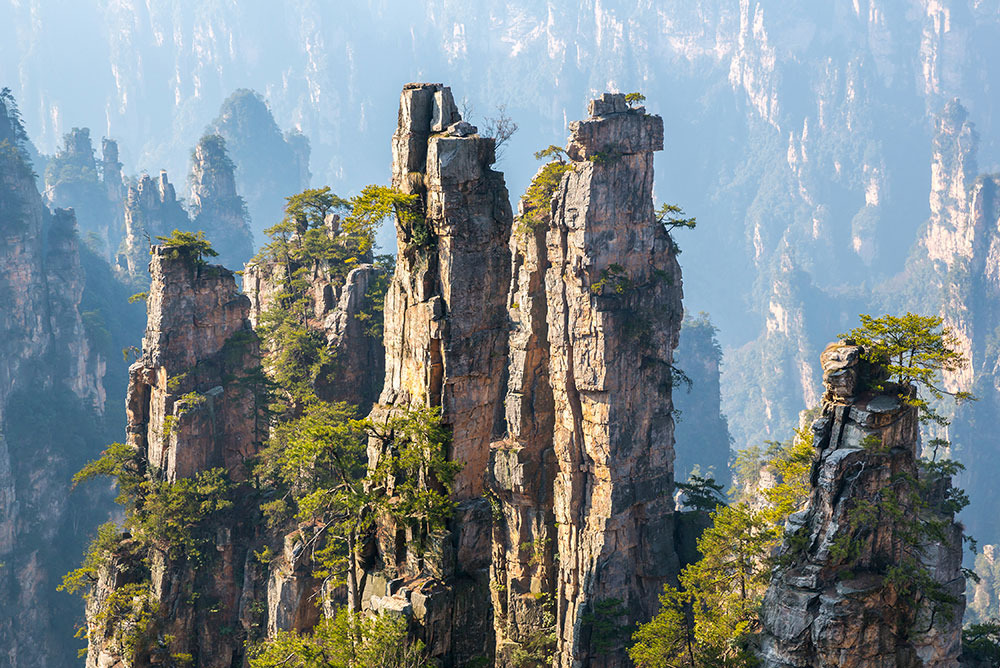
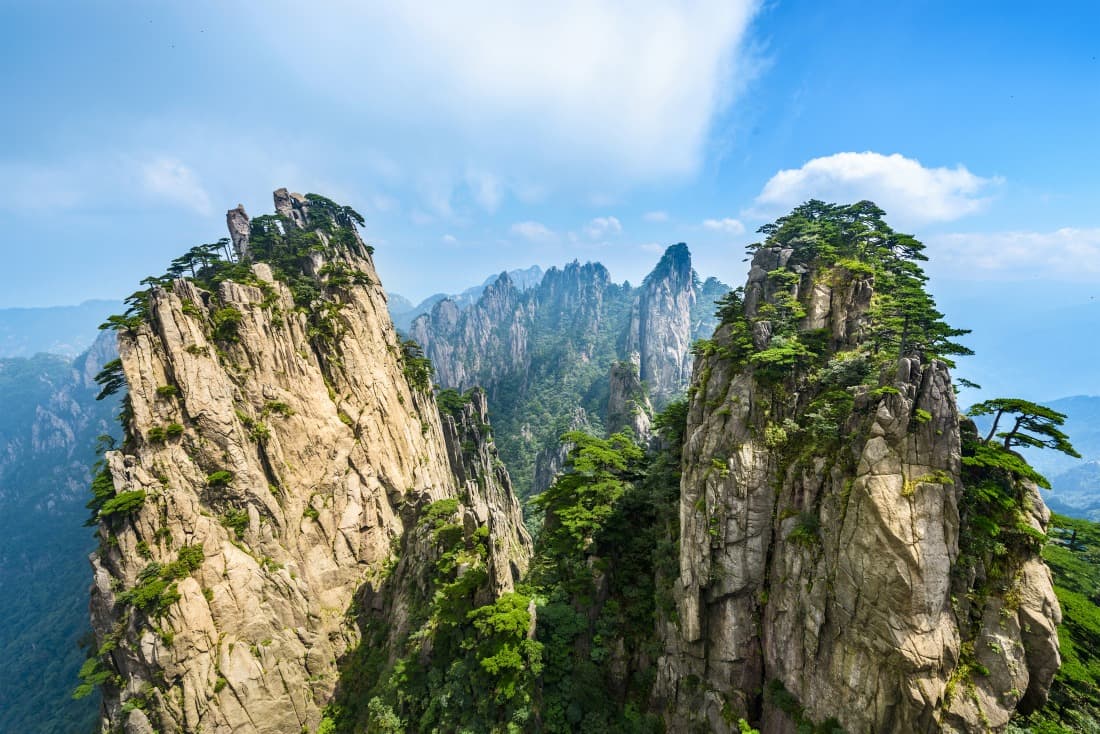
Adventurers, hikers and photographers alike will relish tackling the steep—sometimes perilous—trails among granite peaks crowned with ancient pines beneath an enchanting mist.
History
The Huangshan range is believed to have formed approximately 100 million years ago, its distinctive rock formations shaped by successive glacial periods.
During the Qing Dynasty, Huangshan was called Yishan. It wasn't until 747 that the mountain acquired its current name in honour of the Yellow Emperor (Huang Di), the legendary ancestor of the Han Chinese. Legend has it that it was from Mount Huang that the Yellow Emperor ascended to paradise.
In 1982, the State Council of the People's Republic of Chine designated Huangshan as a "site of extraordinary beauty and historical significance".
In 1990, Yellow Mountain was inscribed on the UNESCO World Heritage List for its spectacular landscape and exceptionally rich flora.
Characteristics of Huangshan
Huangshan is a mountain range composed of granite peaks spanning 154 km² with a buffer zone of 142 km².
The main scenic area stretches 6 km from west to east and 12 km from south to north across a valley. Its highest peak, known as the Lotus Peak, rises to 1,864 metres above sea level. The range encompasses hundreds of summits ranging from 500 metres to over 1,800 metres, 72 of which are officially recognized, including Lotus Peak, Heavenly Capital Peak (1,810 metres) and Bright Summit (1,860 metres).
The scenic zone is formed primarily of granite rock but also hosts 2 lakes, 3 waterfalls, 16 natural springs and roughly twenty streams, adding to the landscape's extraordinary beauty.
Yellow Mountain is home to numerous plant species, some of which are threatened globally by climate change. Beyond its exceptionally rich flora, the natural landscape shelters over 300 animal species including 48 mammal species, 170 bird species, 38 reptile species, 20 amphibian species and 24 fish species. Several of these are now state-protected, including the clouded leopard and the Oriental stork.
Why Visit Mount Huang?
The imposing Mount Huang range has long inspired Chinese painters, poets and architects with its spectacular natural beauty.
Considered one of China's most beautiful mountains, visitors flock to discover the majestic landscapes that stretch endlessly before them.
Hiking trails wind through lush vegetation and stone steps carved into the mountainside, following the terrain to summits that unveil a breathtaking sea of clouds pierced by granite peaks. A true paradise for photographers and hikers, Huangshan boasts no shortage of attractions to seduce adventurers seeking nature and outdoor pursuits.
Steeped in history, the mountain is dotted with ancient temples and inscriptions carved into rocks, discovered along meticulously maintained trails.
Beyond its paths and panoramic vistas, the mountain conceals charming waterfalls, streams and hot springs hidden within dense forests. These natural springs are most welcome after a day or two of hiking.
Hiking on Yellow Mountain
Yellow Mountain is exceptionally well-equipped for hikers. It offers clean, well-maintained trails, remarkable viewpoints with restaurants and even several hotels. At the mountain's base lie hot springs and two waterfalls—save their exploration for the end of your trek as a well-earned reward.
Two main southern routes allow you to tackle the mountain: in the west, the Yupin trail reaches Lotus Peak before continuing more easily towards the Grand Canyon of the Western Sea. To the east, the Yungu trail leads first to White Goose Ridge. Both routes feature cable cars that ascend in mere minutes. The rest of the site is explored on foot through the valleys.
A hike up Yellow Mountain is the perfect opportunity to witness sunrise from Bright Peak (Guangmingding), Danxia Peak or Lion Peak—the three finest vantage points for this spectacle. Although it requires rising before dawn and beginning your ascent in darkness, your efforts will be swiftly rewarded by sublime panoramas showcasing a palette of yellows and reds worthy of a master painter.
Despite the challenges encountered during treks, each viewpoint merits the effort. Certain extraordinary trails can prove perilous if you're not careful with your footing, yet their uniqueness creates unforgettable memories. These passages, which can be circumvented, have nonetheless earned the trek status as one of the most dangerous.
Some trails prove busier than others, particularly those near points of interest. Yet you can still enjoy long stretches of peaceful hiking immersed in nature.
When to Visit?
Each season offers Mount Huang its own share of surprises and natural beauty.
In spring, everything seems reborn; vibrant green hues emerge, plants display themselves at their finest, accompanied by the melodious songs of birds delighted to see fine weather return. Abundant precipitation during this season feeds the waterfalls, making them more spectacular than ever.
During summer, Mount Huang reveals a completely different aspect. Simply calmer and more peaceful, vegetation thrives magnificently from spring rains, asserting itself exuberantly across valleys and weathered rocks. Clear blue skies and strong sunlight occasionally erupt into dramatic storms that only enhance this lush nature. However, this period is high season and consequently much busier. Be wary of heavy rains that can strike the site. In fact, hiking during thunderstorms is strongly discouraged.
In autumn, colours become more vivid with orange hues. The atmosphere rivals springtime but with a more mature natural beauty. The sea of clouds visible from the summits is more impressive than in summer.
While winter sees the Grand Canyon site closed due to potentially extreme cold, Mount Huang loses none of its animation. The sea of clouds appears more frequently than in autumn, and rocks blanketed in snow and ice sparkle like jewels.
Winter is ideal for budget-conscious travellers. Prices are roughly halved, and the mountain draws far fewer visitors, sometimes creating the sensation of having the world to yourself.
In any season, pack rain gear, warm clothing, sunscreen and sturdy hiking boots. Remember to stay hydrated regularly and don't hesitate to stop for meals.
Four cable cars are available to ascend easily and quickly: Yungu, Yuping, Taiping and Grand Canyon. They're welcome when fatigue sets in or time is limited.
The rest of the site is explored on foot. Carriers offer their services to transport you in handmade sedan chairs or carry your packs.
Several daily buses depart at regular intervals from Huangshan city to Tangkou, the small village at Huangshan's main entrance.
Tangkou is also accessible by long-distance bus from Shanghai, Nanjing, Hefei and Hangzhou.
From Tangkou, shuttles and taxis take you to the starting points for the Yuping cable car and Xinyungu cable car.
Rates
Admission costs 230 RMB from 1 March to 30 November and 150 RMB per person from 1 December to 29 February.
Students, children and seniors may qualify for discounts or free entry depending on circumstances.
The four available cable cars cost between 90 and 65 RMB one-way depending on the season. Prices are reduced for children. Cable cars operate from 6:00 to 16:30.
Want to discover this destination?
Our local advisors design your tailor-made trip.