Niujie Street
Niujie Street
The heart of Beijing's Muslim community, Niujie Street is home to the capital's oldest mosque, founded in 996, and a vibrant neighbourhood with halal flavours.
Niujie Street runs through the south-west of Beijing, in Xicheng district (formerly Xuanwu district, merged in 2010). It is the primary Muslim hub of the Chinese capital and is home to the city's oldest mosque, founded in 996. Around it lives a community of some 40,000 Muslims, predominantly from the Hui ethnic group, whose culture blends Islamic traditions with Han heritage.
Why visit Niujie Street
Niujie Street offers a lesser-known side of Beijing: that of Chinese Islam, present for over a thousand years. There are three main reasons to visit:
- see the Niujie Mosque, a unique architectural witness to Sino-Islamic syncretism;
- explore a vibrant neighbourhood where halal butcheries, restaurants and Muslim bakeries line the streets;
- taste a distinctive local cuisine, inherited from the introduction of beef by the first Muslims who settled here.
Everything can be explored in half a day and pairs well with a stay in Beijing centred on the Forbidden City or the Temple of Heaven.
History of the street and its mosque
The name of the place tells its own story. The street was originally called Liu Street, named after the pomegranate (liu in Chinese), as the area was once home to pomegranate orchards. With the arrival of Muslim merchants and craftsmen, who introduced beef-based dishes, the neighbourhood gradually took the name Niu Street, or the "street of oxen".
The Niujie Mosque was built in 996, during the Liao Dynasty, by Nazaruddin, the son of an imam. It was destroyed during campaigns by Genghis Khan's army (1155-1227), then rebuilt twice by Muslim eunuchs of the court, in 1443 and 1496, during the Ming Dynasty. Emperor Kangxi (1661-1722) of the Qing Dynasty later had it expanded. Three major renovations followed, in 1955, 1979 and 1996, preserving its historic wooden structure.
What to see
The Niujie Mosque
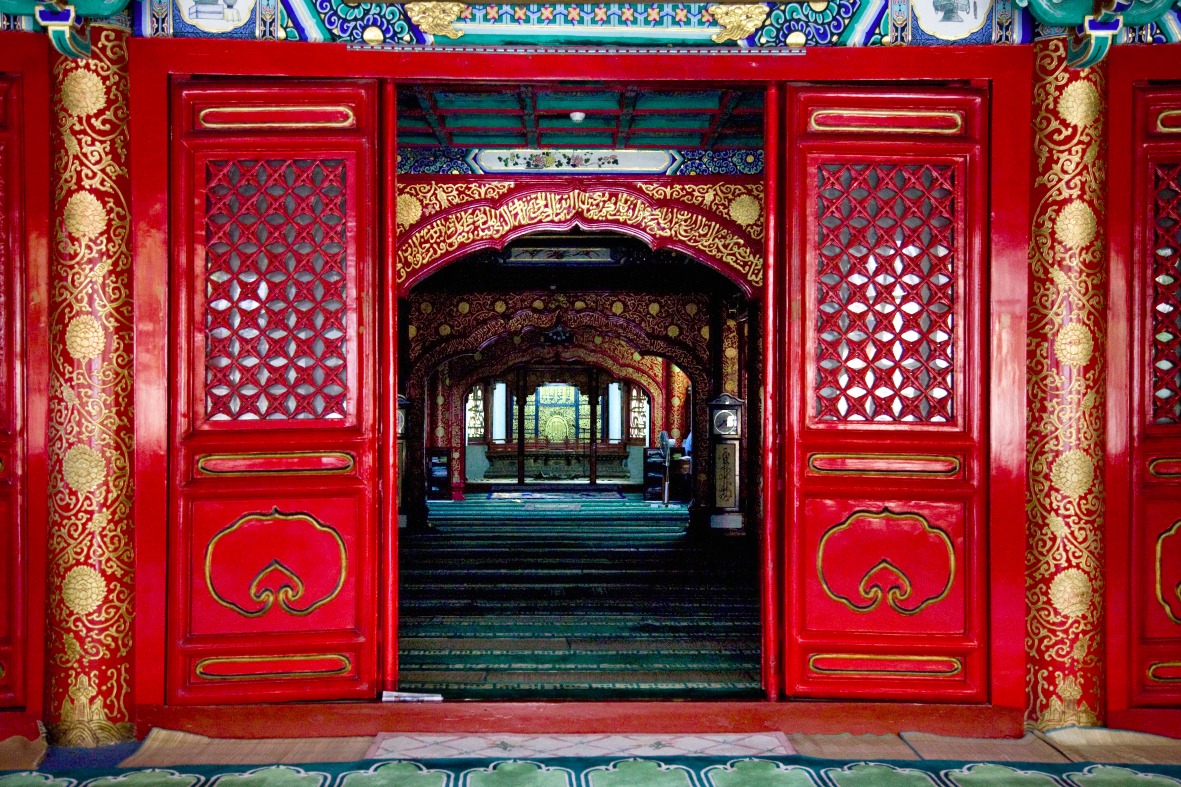
The complex covers approximately 10,000 m². A notable feature: the mosque is oriented towards the west, facing Mecca, which reverses the traditional axis of Chinese religious buildings. Its wooden architecture follows the codes of the Chinese temple—curved roofs, painted wooden frames, successive courtyards—but the decorative motifs exclude any human or animal representations, in accordance with Islamic tradition.
The prayer hall
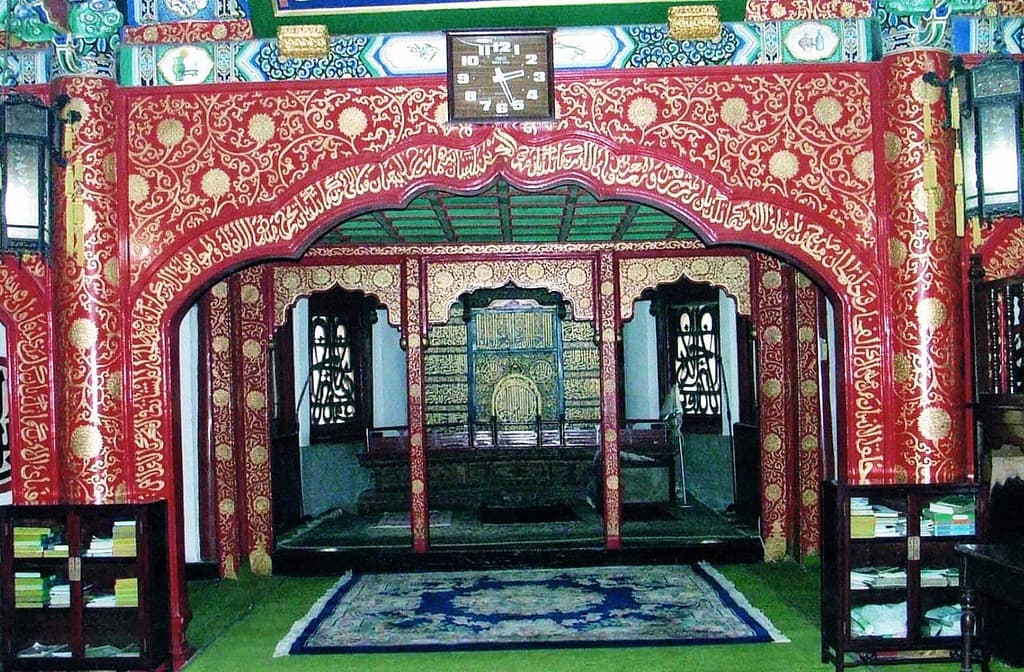
The main building of the complex, it measures 700 m² and can accommodate over 1,000 worshippers. Reserved for Muslims, it is distinguished by its calligraphy in Al-Kufi Arabic script, an ancient form of writing that preceded modern Arabic, interspersed with Quranic poems and floral motifs. Coloured glass bead chains and two pavilions with stelae frame the space.
The Moon Tower
A hexagonal structure two storeys high reaching over 10 metres, this tower served as an astronomical observatory. The imams would use it to determine the lunar calendar essential for calculating fasting periods, particularly that of Ramadan.
Relics and tombs
The mosque preserves an imperial decree tablet from 1694, dating from the Qing Dynasty. South-east of the prayer hall lie the tombs of two imams from the Yuan Dynasty, built in black bricks of Shaykhs and decorated with ancient inscriptions tracing the history of Islam in Chine.
The neighbourhood's cuisine
The street concentrates butcheries, delicatessens and small strictly halal restaurants. Some specialities to try: wheat tea, bean soup, soybean jelly, as well as Muslim pastries and sweets sold to take away.
When to visit
Niujie Street can be visited year-round. Beijing's climate is continental and marked by hot, humid summers (July-August), dry and cold winters, and pleasant in-between seasons. Spring (April-May) and autumn (September-October) offer the best visiting conditions.
To experience the neighbourhood's atmosphere, two moments are particularly lively:
- Friday midday, the time of the great prayer, when the community gathers;
- During Ramadan and Eid, when the streets come alive in the evening. Dates vary each year according to the lunar calendar.
Practical information
- Access to the street: free, at all times.
- Mosque: open to visitors during the day, closed in the evening. Modest entry fee for non-Muslims, free for worshippers. Check opening hours and prices in advance, as they may vary.
- Dress code: smart casual required (shoulders and legs covered). The prayer hall remains reserved for Muslims.
- Duration of visit: allow 1 to 2 hours for the mosque and a walk along the street.
How to get there
By metro: lines 4 or 7, station Guang'anmennei, exit C2, then a few minutes' walk to the street.
By bus: several lines serve the Niujie stop. Routes change regularly, so it's best to check a transport app on site.
By taxi or ride-hailing app: tell the driver "牛街礼拜寺" (Niujie Mosque).
Nearby
The neighbourhood lends itself to an extended tour of Beijing and its surroundings:
- Beijing — Forbidden City, Temple of Heaven and hutongs in the heart of the city;
- The Great Wall at Juyongguan — an accessible section for a day trip;
- The Great Wild Goose Pagoda — another major Buddhist site in Chine, in Xi'an.
Frequently asked questions
Frequently asked questions
Yes, the mosque complex can be visited for a small entrance fee. However, the prayer hall remains reserved for Muslim worshippers. Smart casual dress covering shoulders and legs is required.
Like all mosques, it is oriented towards Mecca. From Beijing, this corresponds to a westward orientation, which contrasts with traditional Chinese temples oriented south.
Allow 1 to 2 hours to visit the mosque and stroll along Niujie Street while sampling some local specialities.
Spring and autumn offer the most pleasant climate in Beijing. To experience the neighbourhood's buzz, aim for a Friday midday or the Ramadan period.
Wheat tea, bean soup, soybean jelly and Muslim pastries are among the classics. The neighbourhood's butcheries and restaurants offer strictly halal cuisine.
Prepare your trip
Niujie Street naturally fits into a stay in Beijing centred on the history and religious heritage of Chine. To build a complete itinerary, consult our Chine travel suggestions.
Nearby
Interested in this visit?
We can include it in your personalised itinerary.