Qingjing Mosque
Qingjing Mosque
Founded in 1009 in Quanzhou, Qingjing Mosque is one of the rare Song-dynasty mosques in Chine, a testament to Sino-Arab maritime trade.
The Qingjing Mosque, located in Quanzhou in Fujian Province, ranks among the rare Song-dynasty mosques still standing in Chine. Founded in the early 11th century, it bears witness to the Sino-Arab maritime trade that made Quanzhou Chine's leading port city in the Middle Ages.
Why Visit Qingjing Mosque
- A Muslim religious building over a thousand years old, exceptional in Chine.
- Stone architecture of Syrian inspiration, with no Chinese influence in its oldest section.
- Material evidence of the commercial routes connecting Quanzhou to the Arab world under the Song and Yuan dynasties.
- A short visit (plan 30 minutes to 1 hour) that's easy to fit into exploring Quanzhou's historic centre.
History of Qingjing Mosque
Qingjing Mosque is believed to have been erected in 1009 by Arab-Muslim merchants settled in Quanzhou, then Chine's largest port city. According to tradition, its layout draws inspiration from a mosque in Damascus, Syria—an architectural choice rarely seen throughout the Chinese empire, making it almost unique. The building was restored in 1309 under the Yuan dynasty, a period of strong Muslim presence in the region.
Under the Ming (1368–1644), a five-storey pagoda was added to the complex. It collapsed during the 1607 earthquake, which also damaged parts of the prayer structures. The mosque long served as a place of worship for Muslim travellers and foreign merchants passing through Quanzhou's port, and today remains a testament to cultural and religious exchange between Asia and the Arab world.
What to See
The mosque spans approximately 2,500 m² and retains several original elements, despite successive destruction.
The South Gate
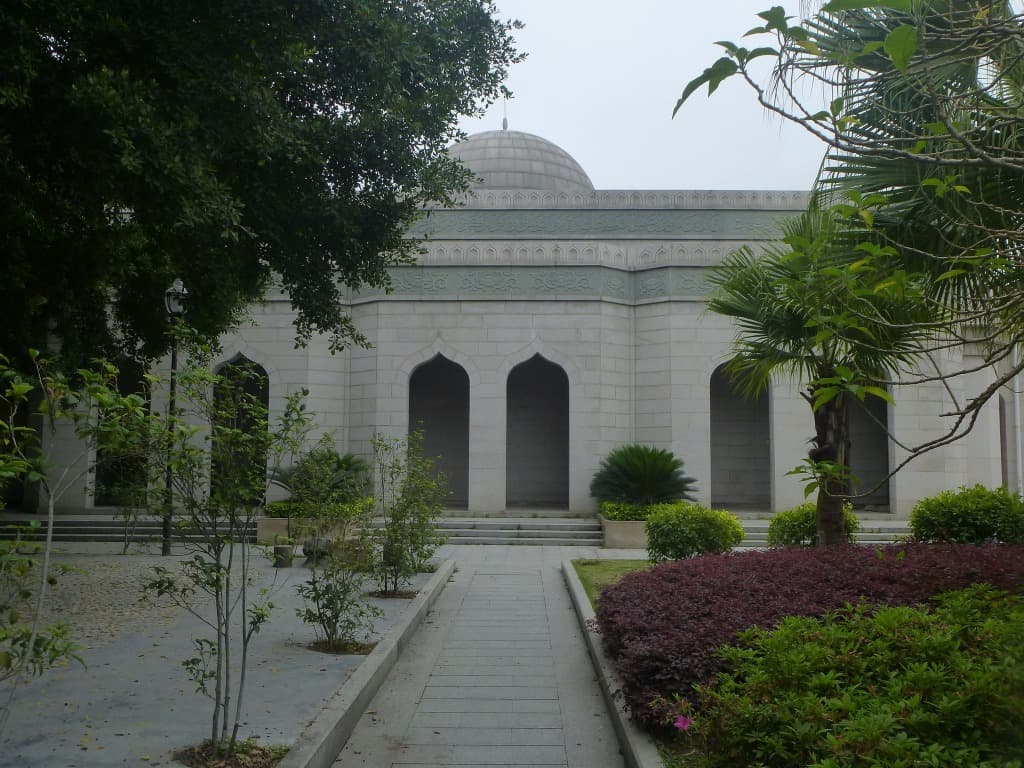
Facing due south, the monumental entrance consists of four adjoining arcades roughly 20 metres high and 4 metres wide, built entirely in stone. On the gate, a platform was used to observe the moon to determine the first day of Ramadan. Niches carved into the outer south wall and the altar wall bear inscriptions of Quranic passages in Arabic.
Fengtian Hall
This prayer hall follows the style of Islamic buildings from before the 10th century. Its roof has collapsed, but the granite walls remain intact. The open-air structure provides a good sense of the original layout, with its mihrab oriented toward Mecca.
Mingshan Hall
Located in the northwest section and smaller in size, Mingshan Hall stands out for its Chinese-style architecture. Its stone walls bear Arabic inscriptions dating from the Song and Yuan dynasties. After Fengtian Hall collapsed, it became the main prayer hall, still used by the local Muslim community today.
The Exhibition Hall
Behind the complex, an exhibition hall documents the development of Islam in Quanzhou: maritime trade, foreign communities, Arab funerary stelae discovered in the region. Panels are mainly in Chinese, with some English translations.
Practical Information
- Visit Duration: 30 minutes to 1 hour is sufficient to tour the buildings and exhibition.
- Admission: Modest entrance fee (to be confirmed on site).
- Hours: Open during daytime, generally from morning until late afternoon.
- Dress Code: Modest clothing recommended (shoulders and legs covered), as it is an active place of worship.
- Photography: Permitted in courtyards and on ruins; avoid during prayers.
When to Visit
Fujian has a humid subtropical climate. Spring (March–May) and autumn (October–November) offer the most pleasant conditions for visiting Quanzhou, with mild temperatures and less rain than summer. Summer (June–September) is hot, humid, and exposed to typhoons. Since the mosque is partly open to the sky following Fengtian Hall's collapse, it's best to avoid days of heavy rain. An early morning visit lets you enjoy the site's tranquility before tour groups arrive.
How to Get There
Qingjing Mosque stands on Tumen Street in Quanzhou's historic centre, within easy walking distance of Guandi Temple and Kaiyuan Temple. From downtown, you can reach it on foot in just a few minutes. Several urban bus lines serve the Guandimiao and Qingzhensi stops nearby; since line numbers change regularly, it's best to check locally or use a local navigation app. Taxis and ride-sharing are also practical and affordable options in Quanzhou.
Nearby
A visit to Qingjing Mosque fits naturally into a broader discovery of Quanzhou, once the eastern terminus of the maritime Silk Routes. Kaiyuan Temple, the maritime museum, and Tumen Street are all within walking distance. To extend a cultural itinerary through Chine, other sites illuminate the country's religious and architectural history, such as the Giant Wild Goose Pagoda in Xi'an or the Bezeklik Thousand Buddha Caves in Xinjiang.
Frequently Asked Questions
Frequently asked questions
Include Qingjing Mosque in Your Journey
Quanzhou and Fujian are rarely included in standard Chine itineraries, yet the region offers a different perspective on the country: historic ports, Hakka communities, and tulou landscapes. To build a tailor-made itinerary that includes Qingjing Mosque and Quanzhou's maritime heritage, explore our Chine travel ideas.
Interested in this visit?
We can include it in your personalised itinerary.