Hongshan Park
Hongshan Park
Emblematic park of Urumqi, the Red Hill is home to the Zhenlong Qing pagoda, landscaped gardens and panoramic views over the center of Xinjiang.
The Hongshan Park, or Red Hill Park, is one of the emblematic green spaces of Urumqi, capital of the Xinjiang Uygur Autonomous Region in Chine. It sits atop and along the slopes of a hill of reddish-brown rock, at the intersection of Hongshan Street and Hetan Street, right in the city center. Its name comes from the hue the rocks take on at sunset, when the low light turns them red.
Why visit Hongshan Park
The park combines several attractions in one location: an urban panorama of Urumqi from the summit, an 18th-century Qing pagoda, landscaped gardens with water features, and a founding legend that is part of the local oral heritage. It's also a place much frequented by residents, making it an excellent spot to observe daily life in Urumqi, particularly in the late afternoon.
- Panoramic views over the city center and Yamalike Hill, located 1 km across.
- Historic Zhenlong Pavilion, erected under the Qing dynasty.
- Free admission, in the city center, easy to combine with other attractions.
- Shaded walking paths ideal during the intense summer heat.
History and the red dragon legend
The Red Hill and Yamalike Hill, which faces it a kilometer away, are linked by the same legend. A red dragon, fleeing from the sacred lake Tianchi, was caught by the Queen of Heaven and cut in two with a sword stroke. The two halves of its body formed the two hills; the sword, thrown to the ground, transformed into a river flowing between them. This tale, still told locally, anchors the park in Urumqi's cultural imagination.
Historically, the Zhenlong Pavilion was built in 1788 by Shang Hang, an officer in the army of Emperor Qianlong (reign 1736-1796), under the Qing dynasty. The building served a symbolic protective function for the site. The landscaping around the pagoda, with its pathways, gardens and secondary pavilions, came later: it dates to 1958, and it was at this time that the hill became the public park we visit today.
What to see on site
The Zhenlong Pagoda
The nine-tiered Zhenlong Pagoda with octagonal roofing crowns the summit of the hill. It is the park's central architectural element. From its upper levels, views sweep over downtown Urumqi, the People's Park and the neighboring Yamalike Hill.
Gardens and water features
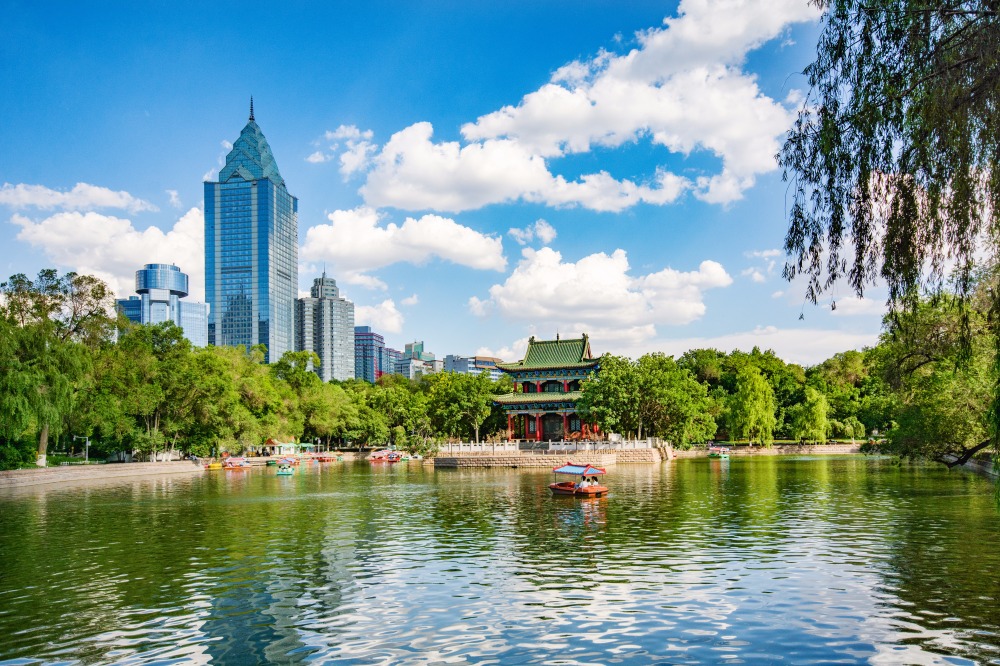
Around the pagoda, the park unfolds shaded walkways, several ponds, painted wooden pavilions and small Buddhist temples. The whole is dotted with leisure areas, including a Ferris wheel and some family attractions, frequented mainly on weekends.
The climb to the summit
The ascent is made on foot, via stairs and marked trails. The slope is steep in places but short; allow about an hour round-trip with photo stops, longer if you explore inside the pagoda.
Practical information
- Address: intersection of Hongshan Street and Hetan Street, central Urumqi.
- Admission: free entry.
- Hours: open during the day and early evening; hours may vary by season, check locally.
- Visit duration: 1 to 2 hours depending on pace and stops.
- What to bring: comfortable walking shoes for the climb, water in summer, a windbreaker in shoulder seasons.
When to go
Urumqi experiences a marked continental climate, with long, cold winters (well below freezing from December to February) and hot, dry summers. The best times to visit the park are late spring (May-June) and early fall (September-October), when vegetation is lush and light is favorable. Late afternoon remains the ideal time: this is when the rocks take on their characteristic red hue.
Nearby attractions
- People's Park: about 300 meters to the south, a space much frequented by residents, notably for outdoor music and dance.
- Xinjiang Uygur Autonomous Region Museum and Urumqi History Museum: about 3 km away, essential for understanding the region's history and peoples.
- Yamalike Hill: visible from the pagoda, it complements your understanding of the urban landscape and the dragon legend.
To further explore Xinjiang, the Bezeklik Thousand Buddha Caves near Turpan offer major cultural interest. Further afield in Chine, the Great Wild Goose Pagoda in Xi'an allows you to compare two Buddhist architectures from different periods.
How to get there
The park is located right in central Urumqi, walking distance from several major hotels. Several bus lines serve it, notably lines 1, 2, 7, 17 and 52. Taxis and ride-sharing remain a simple and inexpensive option in the city. The main entrance opens directly onto Hongshan Street.
Frequently asked questions
Frequently asked questions
Plan your trip
Hongshan Park makes a logical urban stop before heading off to explore Xinjiang and its more remote landscapes. To integrate this visit into a broader itinerary, check our Chine travel ideas and our Urumqi destination guide.
Interested in this visit?
We can include it in your personalised itinerary.