Shamian Island
Shamian Island
A former Franco-British concession on the banks of the Pearl River, Shamian Island preserves rare colonial architecture in the heart of Guangzhou.
Shamian Island, a former Franco-British concession located west of Guangzhou (Canton) on the banks of the Pearl River, preserves rare colonial architecture in China. Spanning less than half a square kilometre, its tree-lined streets, late 19th-century buildings and Catholic church form a distinctive urban ensemble within the Cantonese metropolis.
Why visit Shamian
Shamian sets itself apart from the rest of Canton through its urban character: no skyscrapers, minimal traffic, and neoclassical and Victorian facades inherited from European presence. The island offers a striking contrast to Guangzhou's density and provides insight into a particular chapter of 19th-century Chinese history—that of foreign concessions opened following the Opium Wars. The site can be explored entirely on foot, making it an easy addition to any urban itinerary.
Island history
Originally a simple sand bar on the Pearl River, Shamian was acquired by European powers following the Opium War. The Treaty of Tianjin formally ceded it to the French and British in 1859, who transformed it into a foreign concession. The French occupied the eastern part of the island, while the British settled in the west. Access was controlled by large gates that prevented free Chinese entry.
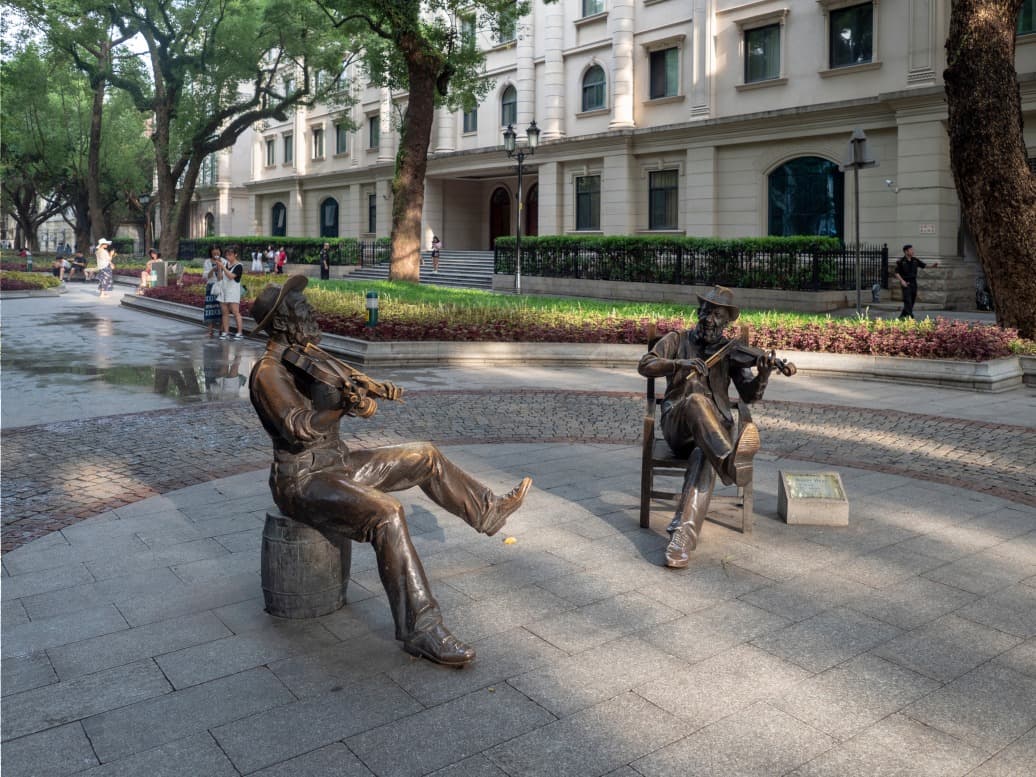
Banks, consulates, residences and places of worship were erected within this narrow perimeter, turning Shamian into a miniature European quarter at the heart of Canton. China officially regained control of the island from 1943 onwards, as foreign concessions came to an end, and the colonial architectural heritage was preserved. Today, bronze plaques scattered throughout the streets recount the history of the buildings and families that once resided here.
What to see on Shamian
Colonial architecture
Shamian brings together around a hundred buildings of European inspiration, restored over recent decades. Neoclassical, late Baroque and Neo-Gothic styles are readily identifiable. Several former consulates and banks are marked by explanatory plaques. The main streets, lined with century-old banyan trees, follow an orthogonal layout inherited from colonial urban planning.
Notre-Dame-de-Lourdes Church
Built by the French in 1892, the Catholic church Notre-Dame-de-Lourdes stands at the far end of the island. It is a modest Neo-Gothic structure, still in active use, that recalls the French community once established on Shamian.
Local life by the riverbanks
The waterfront welcomes Guangzhou residents who come to play mahjong, dice games or gather in the shade. Young couples frequently pose for wedding photographs, drawn by the historic facades and lush vegetation. Cafés and restaurants housed in renovated buildings offer places to rest without leaving the island's perimeter.
Practical information
- Duration: allow 1.5 to 3 hours for a complete walking tour, longer if you plan a café break or meal.
- Accessibility: the island is flat, largely pedestrianised, and easy to navigate for all walking abilities.
- Cost: free access—the island is an open neighbourhood.
- Best time to visit: Guangzhou has a humid subtropical climate. October to December offers the driest and most temperate conditions for visiting. Summer is hot and stormy; winter is mild but sometimes overcast.
How to get there
By metro
Take Guangzhou Metro Line 1 to Huangsha station (黄沙). Use exit D, then cross the small pedestrian bridge leading to the island.
By bus
Several lines serve Huangsha station, immediately adjacent to the island: buses 9, 38, 105, 208, 219, 236, 270 and 556. The stop is just a few minutes' walk from the access bridge.
Nearby and elsewhere in China
Shamian fits well into a Cantonese circuit: the Chen Family Temple, the Shangxiajiu pedestrian street and Pearl River cruises are all within easy reach. To further explore Chinese heritage, several major sites are worth visiting:
- The Great Wild Goose Pagoda in Xi'an, a 7th-century Buddhist monument.
- The Great Wall at Juyongguan, one of the most accessible fortified passes from Beijing.
- The Bezeklik Thousand Buddha Caves in Xinjiang, a rock-cut sanctuary on the Silk Road.
- Longgong Cave in Guizhou, a navigable karst network.
Frequently asked questions
Frequently asked questions
Plan your trip
Shamian fits naturally into a stay in Canton and can serve as an architectural pause between livelier phases of the city. To build a complete China itinerary, explore our bespoke travel packages in China.
Photos
Interested in this visit?
We can include it in your personalised itinerary.