Tianhou Temple
Tianhou Temple
In Quanzhou, Tianhou Temple is the first sanctuary dedicated to the goddess of the sea Mazu in Fujian province. Founded in 1196 and listed as national heritage.
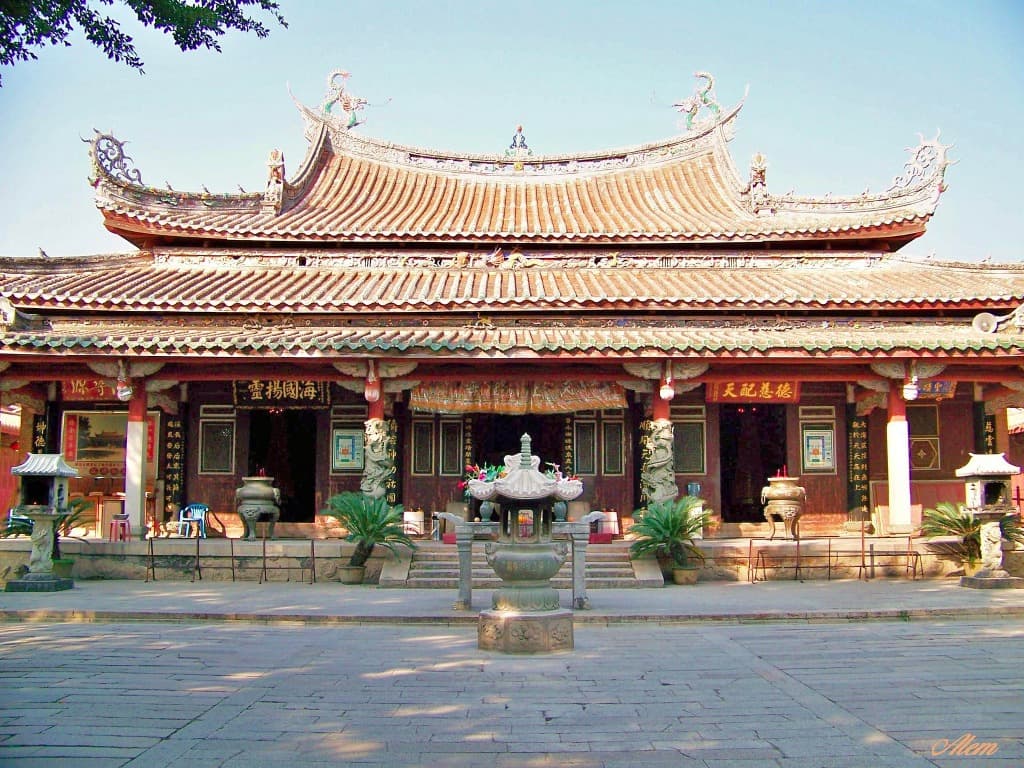
The Tianhou Temple in Quanzhou, in Fujian province, is the first sanctuary dedicated to Mazu, goddess of the sea also known as A-Ma. This site, also known as the Temple of the Queen of Heaven, occupies a 9,000 m² complex in southern China. It is protected at the national level as a Chinese cultural relic.
Why visit Tianhou Temple
Three reasons make this sanctuary compelling for those interested in the religious and maritime history of Fujian:
- It is the founding Mazu temple of the province, distinct from other Tianhou temples in China (Tianjin, Macau) or Taiwan.
- Its architecture combines original Song dynasty elements with a particularly refined Ming reconstruction.
- It remains an active place of worship, notably frequented by Taiwanese Taoist devotees during major celebrations.
History of the temple
Tianhou Temple was built in 1196, during the Song dynasty. The original structure was entirely wooden. Over the centuries, several buildings were destroyed and rebuilt; the galleries, entrance gate, opera hall, and Bell and Drum Tower were recently restored, while the main pavilion was rebuilt under the Ming dynasty (1368-1644).
According to tradition, Mazu was the daughter of a villager from Quanzhou County. Remaining unmarried, she devoted herself to the study of medicine to care for the sick. Touched by her devotion, the inhabitants erected a temple in her memory. Later, emperors of successive dynasties consecrated her as the goddess of the sea and celestial empress, a status that made her the protector of sailors and fishermen along the entire southeastern coast of China.
What to see on site
The entrance gate and commemorative archway
The entrance to the complex takes the form of a commemorative archway adorned with a decorative vault. The pillars bear sculptures of dragons and phoenixes, traditional motifs associated with protection and imperial harmony.
The main pavilion
Rebuilt under the Ming, the main pavilion covers approximately 636 m² and rests on a large granite base. Its doors and windows are finely carved with motifs depicting cranes, a giant horse, and lotus flowers, central symbols of Taoism. It is here that the statue of Mazu in camphor wood stands, 2.8 m tall, the central piece of the sanctuary.
The opera hall and its collections
The entrance to the opera hall is guarded by two lion statues, considered the protectors of the site. Inside are preserved ancient art objects, including two stone tablets recording the renovation of the temple during the Qing dynasty (1644-1911), as well as a collection of traditional calligraphy (brush, ink stick, ink stone, and paper).
The Bell and Drum Tower
Located near the opera hall, this annex tower once marked the rhythm of services. It completes the architectural ensemble without housing the main statue itself.
The ancient osmanthus tree
In the courtyard, an ancient osmanthus tree blooms in autumn and releases a characteristic sweet fragrance, much appreciated by local visitors.
When to visit
The most pleasant period extends from March to November, when Fujian's climate remains mild and most folk activities take place. The highlight of the year is Mazu's birthday, celebrated on the 23rd day of the 3rd lunar month (usually in April or early May). The temple then welcomes a large crowd of devotees, including many Taoist pilgrims from Taiwan. For a quieter visit, choose weekdays outside festival periods.
Practical information
- Duration of visit: allow 1 to 1.5 hours to explore the entire complex.
- Admission: moderate entrance fee, paid on site.
- Hours: open during the day, from morning until late afternoon (indicative hours, to be verified before your visit).
- Dress code: neat attire recommended, as the site remains an active place of worship.
How to get there
The temple is located in Quanzhou's historic center. From downtown, buses 05, 13, and 101 serve a stop in immediate proximity to the sanctuary. A taxi or rideshare is also a convenient option from Quanzhou railway station.
What to see nearby
Tianhou Temple is part of a larger heritage route in Quanzhou, a former major port on the Maritime Silk Road. The old town concentrates other Buddhist and Taoist temples, historic mosques, and traditional market streets, all accessible on foot from the sanctuary.
Frequently asked questions
Frequently asked questions
Mazu, also called A-Ma or Queen of Heaven, is a protective deity of sailors. According to tradition, she was originally the daughter of a villager from Quanzhou County, who devoted her life to caring for the sick before being deified by successive emperors.
Quanzhou's Tianhou Temple is the first Mazu sanctuary in Fujian province, founded in 1196. It serves as a historical reference for the many other Tianhou temples built later in Tianjin, Macau, Taiwan, and throughout the Chinese diaspora.
The main celebration falls on the 23rd day of the 3rd lunar month, typically in April or early May in the Gregorian calendar. The temple is particularly lively at this time.
One to one and a half hours is sufficient to explore the 9,000 m² complex. Allow more time if you attend a ceremony or wish to observe the carved details of the main pavilion.
Extend your discovery
Tianhou Temple is just one stop among Fujian and China's rich heritage. To incorporate Quanzhou and its sanctuaries into a broader itinerary, consult our tailor-made journeys in China.
Interested in this visit?
We can include it in your personalised itinerary.