Yingxian Wooden Pagoda
Yingxian Wooden Pagoda
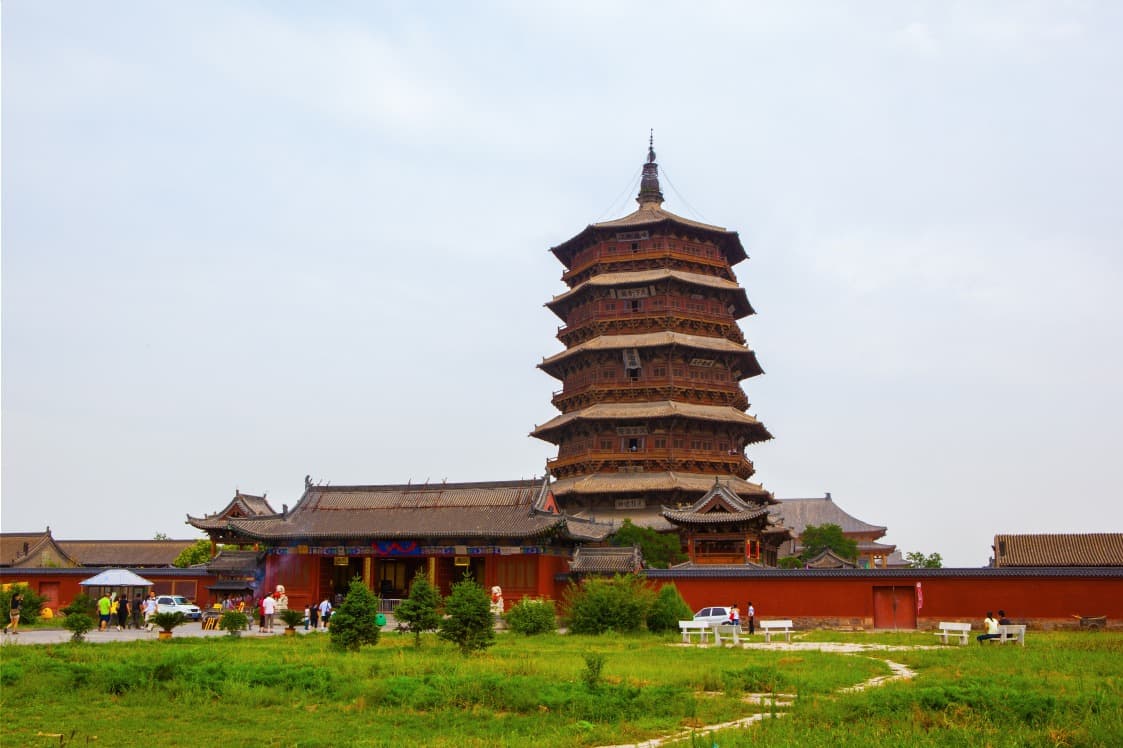
Located 70 km from Datong, the Yingxian pagoda is China's oldest surviving wooden pagoda. A Liao architectural masterpiece, 67 meters tall and standing since 1056.
The Yingxian Wooden Pagoda, also known as the Sakyamuni Pagoda, stands within the grounds of Fogong Temple, approximately 70 km south of Datong, in Shanxi Province. Built in 1056, it is the oldest entirely surviving wooden pagoda in Chine and one of the rare Buddhist structures from the Liao dynasty to reach us today.
Why visit the Yingxian pagoda
The pagoda presents three distinctive features that set it apart from other religious monuments in Shanxi:
- An architectural feat: 67 meters tall, constructed entirely from fir wood without visible nails, it has remained standing for nearly 970 years thanks to an ingenious system of interlocking wooden joints.
- Remarkable earthquake resistance: the structure has withstood some forty recorded earthquakes and multiple conflicts without collapse.
- Rare Liao heritage: its statues of buddhas and bodhisattvas date from its founding and represent a direct testament to the religious art of the 11th century.
History of the pagoda
The pagoda was erected in 1056, during the Liao dynasty, under the reign of Emperor Qingning. Its architecture draws from Tang-era design conventions, more than two centuries earlier, making it a later yet faithful testament to this tradition. Local legend holds that its construction stretched over 140 years—likely a symbolic duration reflecting the project's complexity.
Over the centuries, the building has endured numerous earthquakes—given the Shanxi region's seismic activity—as well as fires and armed conflicts. None of these events has caused its collapse, making it a case study for engineers specializing in ancient structures.
What to see on site
The exterior and structure
The pagoda rests on an octagonal base roughly 30 meters in diameter. From a distance, it appears to have five levels; in reality, the building also contains four hidden mezzanine floors between the visible levels, bringing the total internal structure to nine stories. This feature contributes significantly to its rigidity.
The summit is crowned with a 14-meter iron spire, the only metal component of the entire structure. It likely helped protect the building from lightning strikes over the centuries.
The Dougong system
The pagoda's mechanical secret lies in its extensive use of Dougong, an assembly of interlocking wooden brackets that transfer the weight of upper floors to the load-bearing pillars. More than fifty Dougong variations have been documented throughout the building. During an earthquake, these components absorb and dissipate energy rather than transmitting shocks to the entire structure.
Buddhist statues
Each accessible level houses statues of buddhas and bodhisattvas from the Liao dynasty. The ground floor features a large seated Sakyamuni surrounded by murals. The upper levels display different configurations, some inspired by mandala designs. Access to higher levels may be restricted to preserve the structure.
Practical information
- Duration of visit: allow 1 to 1.5 hours on site, longer if exploring the surrounding Fogong Temple.
- Admission: moderate entry fee, paid on location.
- Opening hours: daytime hours, with extended times during peak season (spring-autumn) and shorter hours in winter.
- Best time to visit: May to October, to avoid Shanxi's harsh winters.
- What to bring: comfortable shoes if access to the upper levels is available, as the interior staircase is steep.
How to get there
Yingxian is located approximately 70 km from Datong, the logical starting point for your visit.
- By long-distance bus: from Datong's main bus station, regular services connect to the Yingxian West Bus Station. Journey time approximately 1.5 to 2 hours.
- By taxi or private car: a more flexible option if you plan to combine visits with other Shanxi sites (Yungang Grottoes, Hengshan Hanging Monastery).
- Guided excursion: the pagoda is often combined in a day trip with the Hanging Monastery, located midway between Datong and Yingxian.
What to see in the region
The pagoda fits into a broader circuit of major Buddhist monuments across Chine:
- The Great Wild Goose Pagoda in Xi'an, another major reference in Chinese Buddhist architecture.
- The Bezeklik Thousand Buddha Grottoes, to further explore ancient religious art.
- The Great Wall at Juyongguan, accessible from Beijing if heading north.
Frequently asked questions
Frequently asked questions
Include Yingxian in your itinerary
The Yingxian pagoda fits naturally into a circuit dedicated to Shanxi and northern Chine. To build a custom itinerary including Datong, the Yungang Grottoes, and the pagoda, explore our Chine trips.
Interested in this visit?
We can include it in your personalised itinerary.