Zhaozhou Bridge
Zhaozhou Bridge
Forty kilometers from Shijiazhuang, the Zhaozhou Bridge (Anji Bridge) has spanned the Xiaohe River since 595. Over 1,400 years of history and a feat of Sui engineering.
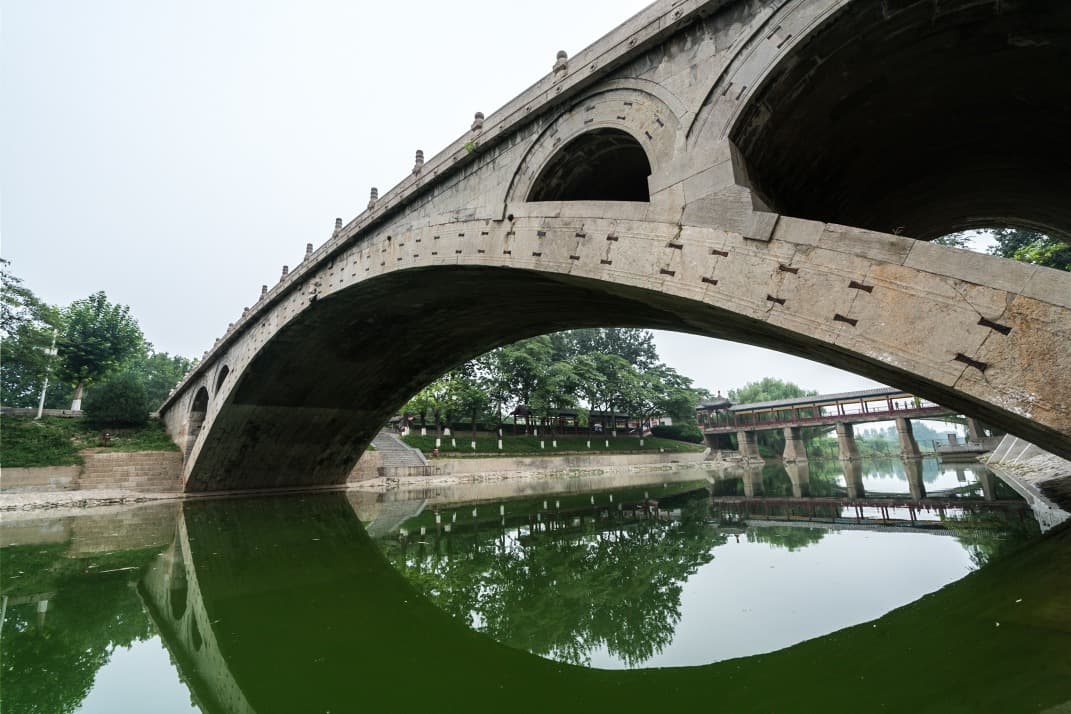
Also known as the Anji Bridge, Zhaozhou Bridge is one of the world's oldest stone bridges still standing. Located 40 km southeast of Shijiazhuang, in Zhao County (Hebei Province), it has crossed the Xiaohe River for more than fourteen centuries. Built in 595 under the Sui Dynasty, it testifies to exceptional architectural mastery for its time.
Why visit Zhaozhou Bridge
Zhaozhou Bridge is more than an ancient structure: it is the world's oldest known shallow segmental arch bridge, predating equivalent European constructions by several centuries. Its refined silhouette, dragon sculptures, and bold engineering make it an essential stop for anyone interested in the history of Chinese building techniques.
- Over 1,400 years of unbroken history
- The first documented shallow segmental arch bridge
- International recognition by ASCE in 1991
- A peaceful landscaped park away from urban hustle
History of Anji Bridge
The bridge was built in 595, during the Kaihuang era of the Sui Dynasty (581–618), to facilitate the movement of goods and travelers along a strategic terrestrial route. Its design is attributed to architect Li Chun, whose name remains inseparable from the structure.
With over 1,400 years of existence, it is considered the oldest and best-preserved bridge in Chine. Its robustness was spectacularly confirmed during the 1966 Xingtai earthquake (magnitude 7.2), which it weathered with no major damage.
A popular legend recounts that the bridge was built in a single night by a mythical architect. Oral tradition sometimes attributes its construction to Lu Ban, the legendary patron of Chinese builders.
The bridge fell into relative obscurity during the Qing Dynasty and was rediscovered in the twentieth century by Liang Sicheng, a professor at Tsinghua University, during his research campaigns on ancient Hebei architecture. His surveys rekindled scientific interest in the structure. In 1991, the American Society of Civil Engineers (ASCE) designated it a historic milestone in civil engineering. It also benefits from national heritage protection status in Chine.
What to see on site
Nicknamed the "great stone bridge," the structure is built entirely of assembled stone blocks. It is a shallow segmental arch bridge whose main vault spans 27 meters. The bridge measures approximately 50 meters long by 9.2 meters wide, and rises 7.3 meters above the Xiaohe River.
A technical marvel
On either side of the main arch, two hollow spandrels were created. This innovation serves a dual purpose: to lighten the overall structure and to allow rapid water drainage during floods. This principle influenced other structures in the region, including Yongtong Bridge.
Sculptural decoration
The balustrades and flanks of the bridge are adorned with sculptures of dragons, mythical creatures, and floral motifs. These ornaments, some restored, testify to the aesthetic care lavished on the structure beyond its purely utilitarian function.
Zhaozhou Bridge Park
A landscaped park has been developed around the bridge. Several pavilions house exhibition halls dedicated to the bridge's history and associated archaeological artifacts. The entire setting invites a peaceful stroll away from urban commotion.
Practical information
- Visit duration: allow 1 to 2 hours for the bridge and park
- Hours: open during the day, generally from morning until late afternoon
- Admission: moderate, with slight seasonal variation (peak season spring-summer, low season autumn-winter)
- Best time to visit: spring and autumn offer the most pleasant conditions; winters in Hebei can be severe
How to get there
The bridge is located approximately 40 km southeast of Shijiazhuang, the Hebei capital. From downtown, several tourist bus lines (2, 26, 30, 35, and 106) serve the Nanjiao station, the departure point for Zhao County. A taxi or ride-sharing service significantly reduces travel time.
Shijiazhuang itself is connected to Beijing by high-speed train in just over an hour, making the excursion feasible from the capital.
What to see in the region
A visit to Zhaozhou Bridge fits easily into a broader itinerary around northern Chine and its historic sites:
- Shijiazhuang: the stopover city, with its temples and museums
- The Great Wall at Juyongguan: one of the most accessible sections from Beijing
- Great Wild Goose Pagoda: another masterpiece of ancient architecture, in Xi'an
Frequently asked questions
Frequently asked questions
Plan your trip
Zhaozhou Bridge fits naturally into an itinerary devoted to ancient architecture and the history of Chinese building techniques. To design a custom itinerary incorporating Shijiazhuang, Beijing, and Hebei, explore our Chine travel packages.
Nearby
Interested in this visit?
We can include it in your personalised itinerary.