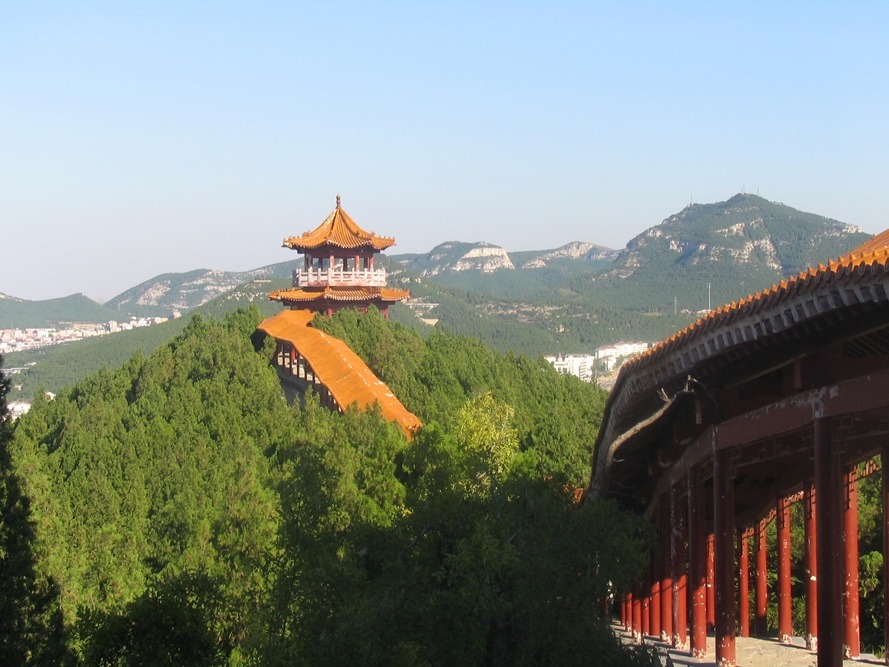
Beijing and the North
From the Forbidden City to the Ming ramparts of Pingyao, via the Great Wall at Jinshanling: the imperial thread of continental Chine in 4 to 7 days.
Beijing and the North cover a band stretching from the Hebei plains to the foothills of the Loess Plateau in Shanxi. This is continental Chine, arid, marked by harsh winters and heavy summers. The landscapes alternate between agricultural basins planted with corn and sorghum, bare hills where the Great Wall winds its way, and ancient cities structured by Ming ramparts still standing. Our team based in the capital has worked this territory for over fifteen years and considers it the most coherent entry point to understanding the country's historical narrative.
Beijing itself cannot be reduced to the Forbidden City. North of Houhai Lake, the hutongs of the Gulou and Nanluoguxiang quarters retain a grid of alleyways where you travel by rickshaw between square courtyards (siheyuan), noodle shops where noodles are hand-cut, and opera theatres. The Temple of Heaven, to the south, still serves early in the morning as a gathering place for retirees practicing tai chi, diabolo, or water calligraphy on the paving stones. To the west, the Fragrant Hills and the Summer Palace offer a landscape respite that many travellers underestimate, especially in October when the maples turn red.
The Great Wall lies approximately two hours' drive from the centre. We systematically avoid Badaling, overwhelmed by tour buses, in favour of sections at Jinshanling, Simatai or Gubeikou. The walk from Jinshanling to Simatai can be completed in a day of 10 to 12 km, across partially restored watchtowers that follow a ridgeline at 700 metres altitude. Gubeikou, wilder, requires a local guide as some passages are unstable. It is on these stretches, mid-week, that the Wall reclaims its military significance: a frontier against the northern steppes.
Further west, Shanxi extends the region with a very different character. Pingyao, the former banking capital of the Qing, preserves within its 6 kilometres of ramparts an urban fabric of about 4,000 courtyard houses, some of which have been transformed into guest houses with kang (heated beds). Datong, further north, provides access to the Buddhist grottoes of Yungang, carved in the 5th century, and to the hanging monastery of Hengshan, clinging to a vertical cliff. Between the two, villages perched on the loess plateau, around Lijiashan, display troglodytic dwellings still inhabited, with their raw brick façades and oiled-paper windows.
At table, the North favours wheat over rice. Beijing cuisine goes well beyond Peking duck: there are jianbing (savoury morning pancakes) bought at the street corner, zhajiangmian (noodles with fermented soy paste), steamed jiaozi, or Mongolian hot pot with lamb, shared in winter around a copper pot. In Shanxi, aged black vinegar accompanies almost every noodle dish, and youmian (oat noodles) steamed in small rolls make up a frugal yet characteristic meal of the plateau.
What justifies a detour here is not merely the density of UNESCO-listed heritage, but the rapid juxtaposition of scales: the megacity of 21 million inhabitants, the imperial defensive line, and loess villages where dwellings are still carved into cliffs. In four to five well-organized days, you traverse five centuries of history and three distinct geographies.
To discover
Hike from Jinshanling to Simatai. Six hours of walking along a Great Wall ridge, between partially restored Ming watchtowers and raw sections. Early departure from Beijing to avoid summer heat and encounter few crowds.
Gulou hutongs at daybreak. Before 8am, the alleyways around the Drum Tower come alive with retirees bringing out their caged birds and steamed baozi vendors. Here you understand the layout of pre-1949 Beijing, still standing in places.
Pingyao within the walls on foot. A day and a night in the fortified city, staying in a Qing courtyard transformed into a guest house. Visit the former Rishengchang banks, which invented the long-distance mandate in the 19th century.
Yungang Grottoes at Datong. 51,000 Buddhist statues carved into sandstone in the 5th century, across a cliff face a kilometre wide. The colossal figures in Grotto 20, open to the sky, mark the arrival of Mahayana Buddhism in Chine.
Troglodytic villages on the loess plateau. Around Lijiashan, dwellings carved into compacted yellow earth, still occupied by a few farming families. The contrast with Beijing, 600 km away, is striking.
When to go
The best window for the region runs from mid-September to early November: dry skies, temperatures of 12 to 22°C in Beijing, low-angle light on the Wall, red maples at the Fragrant Hills. April and May form a second decent window, with peony blooms and temperatures of 15 to 25°C, but a few sandstorms from the Gobi can still touch the capital in late March.
We advise against July and August except by calendar constraint: temperatures of 32 to 36°C, high humidity, frequent afternoon storms, and massive Chinese crowds at sites. Winter, from December to February, drops to -10°C in January in Beijing and lower on the loess plateau; it offers a deserted Wall beneath snow, but requires suitable equipment and limits prolonged walking. Shanxi, at higher elevation and more continental, intensifies these differences by about 3 to 5°C compared to Beijing.
Practical advice
We recommend four to five days for Beijing and its immediate surroundings (Wall included), and two to three additional days if you continue to Pingyao and Datong, accessible by high-speed train from the capital in 4 to 5 hours. The logistical entry point is Beijing Daxing or Beijing Capital international airport, both well connected to the centre. The region naturally combines with Xi'an and the Silk Road by continuing west by high-speed rail (4h30 Beijing-Xi'an), or with Shanghai and the Lower Yangtze by rapid train (4h30) for a coherent North-East loop.
Comfort levels range from comfortable 3-star to high-end boutique hotels in the hutongs, without difficulty. This is a region suitable for a first trip to Chine, families with children (distances remain reasonable and sites are legible), and travellers interested in imperial history and architecture. Hikers will find their place on the Wall, but this is not a destination for long-distance trekking. Bring a translation app and mobile payment (Alipay or WeChat Pay configured before departure), now essential even in small shops.