Japanese Animosity Toward the Chinese: More Intense Than Ever
Tensions between China and Japan continue to intensify, according to a recent survey published by Genron NPO / China Daily, tasked each year with measuring the state of relations between the two countries.
Tensions between China and Japan continue to intensify, according to a recent survey published by Genron NPO / China Daily, tasked each year with measuring the state of relations between the two countries.
Among citizens from China surveyed in Beijing, Shanghai, Chengdu, Shenyang, and Xi'an, a majority (53.4%) believe that a military conflict with Japan will occur in the coming years. Japanese respondents, meanwhile, are less categorical but also admit to fearing war within a few years. Here are the results from Japanese respondents on the possibility of a military conflict between Japan and China:
38.0% answered "There will be no conflict in the future", though this figure has declined significantly (46.7% the previous year).
32.9% chose the answer "Don't know" (29.3% the previous year).
The two combined responses "There will be conflict in a few years" and "There will be conflicts in the future" garnered 29.0% of votes, showing a significant increase from the previous year (23.7%).
Among surveyed Chinese, 42.2% believe that "There will be conflicts in the future" and 11.2% even believe "There will be conflict in a few years". In total, more than half of surveyed Chinese respondents (53.4%) perceive the possibility of military conflict between Japan and China as real. Overall, "unfavorable" opinions held by Japanese toward Chinese and vice versa have worsened since last year: 90.1% of Japanese express hostility toward the Chinese, compared to 86.8% of Chinese toward Japanese.
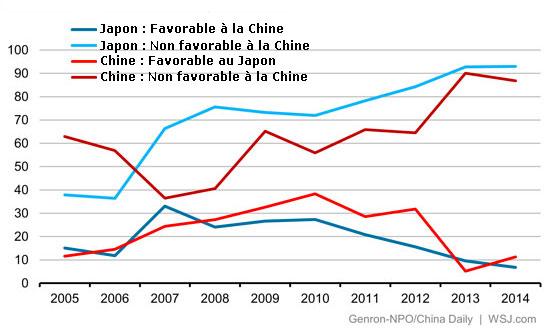
Alarming figures
Wounds Still Run Deep
Pollsters from Genron NPO and China Daily attempted to identify the reasons for this visceral hatred between the two peoples: The most frequently cited reason explaining Japanese unfavorable opinions toward China is, at a rate of 55.1%: "China's actions are incompatible with international rules", closely followed by "China's actions regarding resources, energy, and food are selfish" at 52.8% (48.1% the previous year). The most common response from last year, namely "The conflict over the Senkaku Islands" has declined, dropping from 53.2% last year to 50.4%; It thus becomes the fourth most cited reason by Japanese respondents. Consequently, it is no longer so much the concerns about the territorial conflict over the Diaoyu/Senkaku Islands that predominate, but rather the hegemonic behavior of China that is perceived as "harmful" and "concerning".
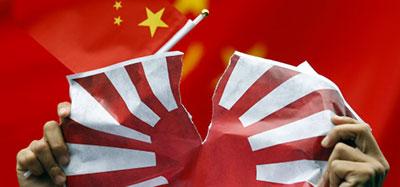
On August 16, 2012, a Chinese protester tears the Japanese Rising Sun flag in front of the Japanese Consulate in Hong Kong
Furthermore, among the reasons why surveyed Chinese held unfavorable opinions toward Japan, "The Diaoyu/Senkaku Islands" and "Historical facts" (understood as "Historical conflicts") were the top two responses, as was the case the previous year as well. However, it is interesting to note a decline in the number of people choosing these two arguments. Conversely, there is a marked increase in people who selected the option "Derogatory remarks by certain Japanese politicians", at a rate of 31.3% (compared to 25.2% the previous year). This result highlights the sometimes indelicate and inappropriate behavior of certain Japanese leaders, and their propensity to offend Chinese opinion.
A Glimmer of Hope Nevertheless
On a more positive note, when Japanese respondents were asked about reasons for their favorable opinions toward Chinese, the answer "Direct interactions with Chinese people (particularly with Chinese students in Japan)" was the most frequent, at 39.7% (32.3% the previous year). This tends to demonstrate the beneficial effect of direct relations with Chinese people, contrary to the prejudices held by a large majority of the population.
The reasons why Chinese held a "positive impression" of Japan were quite different. Naturally, "Japanese products are of high quality" (57.2%, compared to 49.4% the previous year), "Japanese are serious and diligent" (53.8% compared to 54.4% the previous year), and "Japanese are kind, have good manners, and a high cultural standard" (52.6% compared to 39.2% the previous year) were the most common responses, with more than half of votes.
As can be seen, Japanese technological expertise and civility are highly appreciated and contribute to a positive image of the country. Parallel to this survey, China called for cooperation between the two parties to try to improve relations: "Maintaining a stable and strong relationship between China and Japan is essential for our common interests and those of the international community.
But for this to happen, there must be a concerted effort by our two peoples", said Hua Chunying, spokesperson for the Chinese Ministry of Foreign Affairs, at a daily briefing. "Given the current situation, Japanese leaders must learn from what has happened, and ask themselves what measures they can implement to repair their mistakes in order to help our two peoples improve their exchanges." Are relations between the two countries likely to improve in the coming years? Nothing is less certain...
Frequently asked questions
Tensions between Japan and China are fueled by several factors: unresolved historical conflicts (particularly related to World War II), territorial disputes over the Senkaku/Diaoyu Islands, and divergences over the geopolitical behavior of each nation. According to a 2014 Genron NPO / China Daily survey, 90.1% of surveyed Japanese expressed an unfavorable opinion toward the Chinese.
The Senkaku Islands (for Japan) or Diaoyu Islands (for China) are an archipelago of small islands in the East China Sea over which both countries claim sovereignty. This territorial dispute is one of the main sources of diplomatic tension between Tokyo and Beijing, and remains a recurring subject in Sino-Japanese relations.
Overall, diplomatic tensions between Japan and China do not directly affect foreign tourists visiting either country. Travelers are generally well received. However, during periods of heightened tension, demonstrations may occur in certain cities, so it is advisable to stay informed before departure.
According to the 2014 Genron NPO / China Daily survey, 86.8% of surveyed Chinese expressed an unfavorable opinion toward Japanese people, primarily due to historical conflicts and the territorial dispute over the Diaoyu/Senkaku Islands. However, a significant share of surveyed Chinese appreciated the quality of Japanese products, the conscientiousness of Japanese people, and their civility.
Both countries have repeatedly expressed a desire to improve their relations. Direct exchanges between citizens, notably Chinese students in Japan, seem to contribute positively to the mutual image of the two peoples. Diplomacy and dialogue remain the main levers for normalizing Sino-Japanese relations.