Cost of Living in China
A hotel room in Fenghuang
Table of Contents
Once remarkably affordable, the cost of living in Chine has experienced steady growth over recent years. Nevertheless, it remains entirely possible to plan a trip to Chine in line with your budget, no matter how modest.
The most expensive destinations include Hong Kong, Macao, Beijing, Shanghai, Guangzhou, provinces along the eastern coast, and Special Economic Zones (SEZs). Beijing and Shanghai can be particularly pricey.
It's strongly recommended to compare products and prices to quickly get a sense of prevailing rates and avoid settling for the first shop you encounter. Choosing shops frequented by locals remains an excellent way to ensure you're not overpaying.
Accommodation
Accommodation represents the largest portion of your travel budget. In Chine, it's easy to find budget lodging, though you may need to compromise on comfort.
Staying in a dormitory is an increasingly common practice. Convivial and very affordable, dorms—though often basic—enjoy real success among backpackers. For roughly 7 euros, you can secure a comfortable bed (or a less comfortable one) and access to shared facilities.
In cities lacking dormitory accommodations, you can opt for a double room (single rooms are rare), priced around 160 Yuan (between 15 and 20 euros) in major cities (see our guides to Hong Kong, Yangshuo, or Fenghuang)
For a mid-range budget, you can aspire to greater comfort and choose a double room at 240 Y (around 30 euros).
A luxury hotel, of course, requires a considerably higher budget. By way of example, a 5-star hotel in a major city may offer a double room for up to 300 euros per night.
 A hotel room in Fenghuang
Transport
Getting around in Chine doesn't entail substantial expenses, regardless of your travel budget.
For short distances, the bus is highly economical at approximately 2 yuan per trip (30 cents). The metro is equally worthwhile—fast and rarely with long waits, journeys won't exceed 5 yuan (60 cents). Taxis, while slightly pricier, remain very affordable. It's difficult to quote an average fare, but a 20-minute journey typically costs no more than 30 yuan (4 euros).
For long-distance trips, the bus is by far the cheapest option. For a 4-hour journey, you'll spend less than 15 euros (read From Fenghuang to Zhangjiajie).
The train is also an easy way to travel without necessarily requiring a large budget. Prices vary depending on the train type and distance, but to give you an idea: we covered 1,600 km on a hard seat (27 hours) for a mere 226 Yuan, roughly 25 euros (check out this remarkable journey Zhangjiajie–Beijing). The same route on a sleeper train costs around 50 euros.
For flights, costs also vary, but crossing the country between Beijing and Guangzhou typically costs around 150 to 200 euros (see our Beijing–Guangzhou flight).
Train travel, being inexpensive, costs on average twice less than flying. This mode of transport is pricier, but discounts are common, and travelers short on time have little alternative for covering long distances.
 A Zhangjiajie–Beijing train
Food & Dining
Food remains inexpensive throughout the country, and budget-conscious travelers can get by on 40 Yuan (5 euros) per day. At moderately upscale restaurants, a meal runs between 40 and 80 yuan per person (5 to 10 euros). If you prefer only high-end luxury restaurants to satisfy your palate, expect to pay over 60 euros.
For travelers missing Western food, major cities typically offer a wide range of Western restaurants at varying prices, often reasonable for a mid-range budget (count on 8 to 20 euros per meal for two people).
 A typical meal in Guangdong
Bargaining in China
Bargaining is a game for Chinese merchants. Don't hesitate to negotiate from the asking price—you'll be surprised at the savings you can achieve.
If you're not yet comfortable with the local currency, don't let that stop you. Take your time converting and propose your prices—merchants aren't in a hurry and enjoy the exchange.
With a bit of cleverness and vigilance, even travelers on tight budgets will fare very well, even in Beijing and Shanghai.
While bargaining is common in Chine, it's not permitted everywhere. Choose your shops carefully: avoid major chain stores and favor street vendors and small merchants.
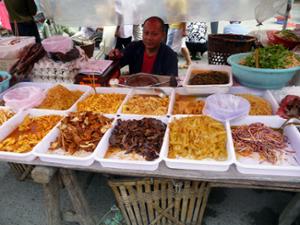 A market in Hunan
Traveling by bus or bicycle (rather than taxi), eating street food or at small restaurants, and avoiding all unnecessary expenditures allows you to live on roughly 200 yuan (25€) per day.
Western regions and interior areas remain relatively affordable. Yunnan, Sichuan, Guangxi, Gansu, Xinjiang, Qinghai, and Tibet remain the preferred destinations for budget-conscious travelers, who will have no trouble finding affordable lodging and dining.