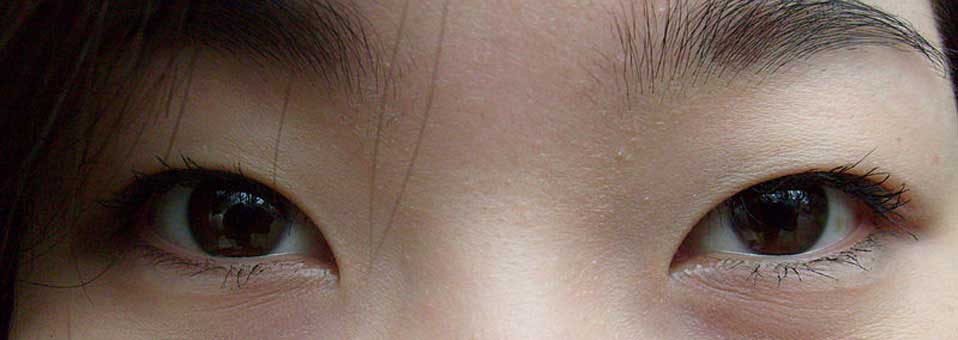
Why do Chinese people have almond-shaped eyes?
Our blog has been on pause for quite some time, and we sincerely apologize for that. Special thanks to everyone who reached out and motivated us to revive this project that we hold dear! Today's article marks the first in a new series titled "Why do Chinese people/China...".
Our blog has been on pause for quite some time, and we sincerely apologize for that. Special thanks to everyone who reached out and motivated us to revive this project that we hold dear! Today's article marks the first in a new series titled "Why do Chinese people/China...". As you've gathered, the concept is to address questions that many people ask about Chinese people and 中国 in general! Between preconceptions and stereotypes, our goal is to provide clear and concise answers whenever possible, hoping to entertain while informing! We're kicking off this week with a classic topic:
Why do Chinese people have almond-shaped eyes?
This question is asked very frequently without anyone really taking the time to answer it seriously. We'll attempt here to clarify this topic concerning this particular physical trait of Chinese people and Asians in general. First, it's worth explaining that almond-shaped eyes originate from a small mass of fat formed at the eyelid that conceals the epicanthic fold (between the eye socket and the eyelid). Chinese people indeed have the epicanthic fold at the eyelid level: the fold merges with the lash line. We then say that almond-shaped eyes have a single eyelid, unlike Westerners who have a double eyelid (the epicanthic fold is distinguishable above the lash line).

Chinese almond-shaped eyes due to weather conditions
Ancestors of the inhabitants of Siberia and countries with arid climates, Asians are believed to have acquired this physical trait solely to protect themselves from cold winds and the intense glare of the sun reflecting off snow. The epicanthic fold would be the consequence of the human body's adaptation to this climate. Despite this people's migration southward, this genetic modification is believed to have been passed down from generation to generation. It's worth noting that the eye fold is less pronounced in southern Asia than in the north, where the harsh climate requires superior protection.
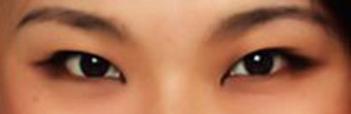
A face-pulling contest at the origin of almond-shaped eyes
If you enjoy unusual anecdotes, you should know that there's a tale claiming that almond-shaped eyes stem from a face-pulling contest. The lucky winner supposedly won the contest thanks to squinting. All fascinated by this grimace, his compatriots would squint repeatedly in turn until this trait became embedded in their genetic code. The scientific argument remains nevertheless the most likely one. Chinese people's almond-shaped eyes are a purely genetic physical trait resulting from environmental factors. This fold, which appeared naturally for human protection, subsequently developed genetically, becoming a typical physical feature of Asia and notably of 中国.
Before and after
Our personal experience in 中国 has often shown us that this physical aspect was not accepted by everyone. We frequently observe (particularly in clubs) striking physical transformations, thanks to highly sophisticated makeup. False lashes to elongate the gaze, white eyeliner under the eye to enlarge the eyes, and colored or regular contact lenses allow young Chinese women to westernize their appearance to the maximum extent. The transformation is often striking!

Which of these explanations seems most plausible to you?
Frequently asked questions
The epicanthic fold is a fold of skin on the upper eyelid that covers the inner corner of the eye. Very common among East Asian populations, it creates the appearance of what is commonly called 'almond-shaped eyes' or 'monolid'.
Scientists explain that almond-shaped eyes result from genetic adaptation to cold and windy environments. The ancestors of Asian populations living in Siberia are believed to have developed this epicanthic fold to protect their eyes from the cold and the glare reflecting off snow.
No, the trait varies by region. In North Asia (Northern 中国, Mongolia, Korea), the epicanthic fold is very pronounced. In Southeast Asia (Thailand, Vietnam, Philippines), it is often less pronounced due to the warmer climate.
No. Although very common in East Asia, the epicanthic fold can also appear in some populations of Africa, South America, and in infants of all origins. It is also associated with certain medical conditions such as Down syndrome.
Yes. Asian blepharoplasty, also called 'double eyelid fold surgery', is one of the most commonly performed aesthetic procedures in East Asia. It aims to create or accentuate the upper eyelid crease to achieve a more open eye appearance.