The 56 Ethnic Groups of China
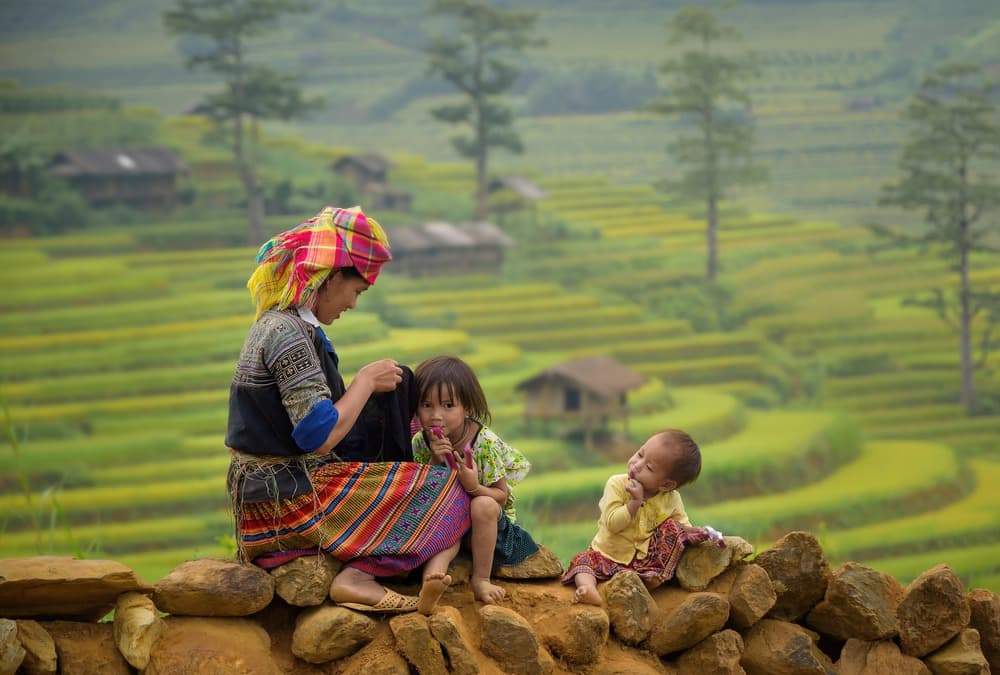
The Chinese people comprise an ethnic mosaic of 56 ethnic groups, the result of a long process of successive integration of populations from the borders of the Chinese civilizational era.
The Chinese people comprise an ethnic mosaic of 56 ethnic groups, the result of a long process of successive integration of populations from the borders of the Chinese civilizational era. The Han ethnic group represents nearly 90% of the total, while the habitat area of minorities covers more than 60% of Chinese territory and these regions are rich in natural resources.
Overview
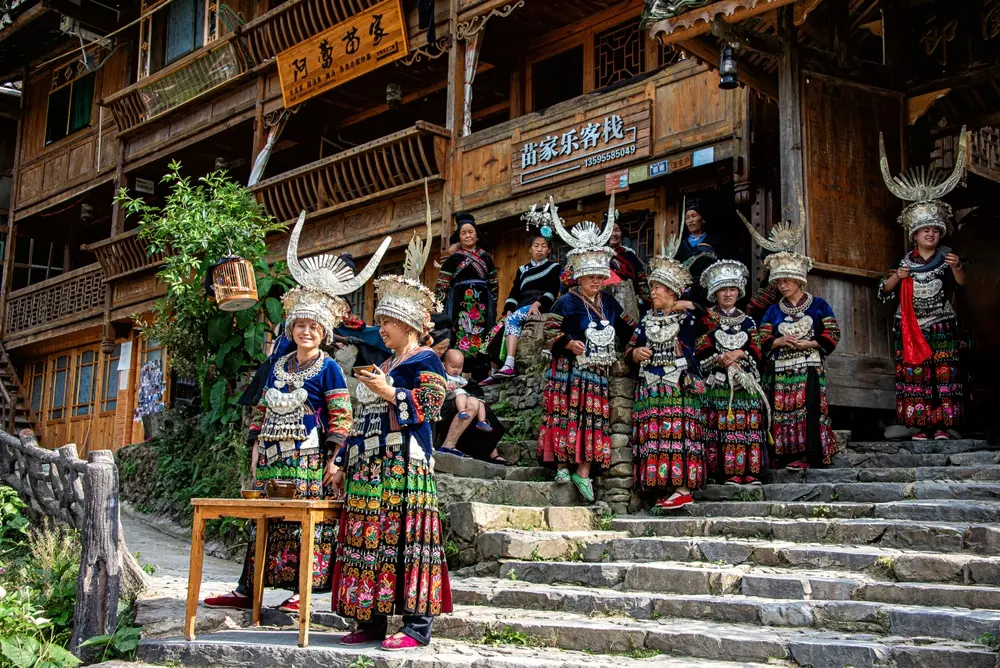
Thanks to historical texts, we can establish a list of the barbarian peoples from the empire's frontiers and observe the rise of ethnic mixing during the fragmentation of Northern China into small Sinicized barbarian kingdoms from the 3rd to the 6th centuries. However, the notion of ethnic minority (Uyghur, Miao, Mongol, Tibetan, Yao, Zhuang) only appears in texts from the 13th century.
After the birth of the People's Republic of China in 1949, the Chinese government officially recognized the existence of "national minorities" and created "autonomous regions" for the most numerous ones.
The definition of these groups is essentially ethnolinguistic: it is based on criteria of language, culture and sense of belonging.
The Han are considered a single ethnic group despite large internal differences. Thus, the Hakka (50 million) have not been separated from them, though their language and customs differ significantly from native Han in the regions of Jiangxi, Guangdong and Guangxi.
The 55 national minorities are characterized by their extreme diversity. A linguistic classification used in China distinguishes two main families subdivided into groups themselves formed of ethnicities. The Altaic family comprises the Turkic groups (Uyghurs, Kazakhs), Mongolic, Tungusic (Manchus) and Korean. Within the Sino-Tibetan family, we distinguish Sino-Tai groups (Zhuang, Dai, Bouyei, Dong, Li), Tibeto-Burman (Tibetans, Yi, Bai, Hani) and Miao-Yao. These nationalities then have very dispersed populations, ranging from 15 million individuals for the Zhuang to 2,000-3,000 for the Lhoba of the forests of southeastern Tibet and the Gaoshan of Fujian.
Today, minorities are distributed on the borders of China, in the marches of the North, West and South. In short, in regions where ethnicities are culturally established (language, writing, religion), or even scattered (Yunnan, Guizhou).
Table of the 56 Chinese Ethnic Groups
Ethnic Group | Population | Main Habitat Regions |
|
Han | 1,043,480,000 | Throughout Chinese territory |
|
Zhuang | 15,555,800 | Guangxi, Yunnan, Guangdong, Guizhou |
|
Hui | 8,612,000 | Ningxia, Gansu, Henan, Xinjiang, Qinghai, Yunnan, Hebei, Shandong, Anhui, Liaoning, Beijing, Inner Mongolia, Heilongjiang, Tianjin, Jilin, Shaanxi |
|
Uyghur | 7,207,000 | Hunan, Xinjiang |
|
Manchu | 9,846,800 | Beijing, Hebei, Heilongjiang, Jilin, Liaoning, Inner Mongolia, Tibet |
|
Miao | 7,383,600 | Guangdong, Guangxi, Guizhou, Hubei, Hunan, Sichuan, Yunnan |
|
Yi | 6,578,500 | Guangxi, Guizhou, Sichuan, Yunnan |
|
Mongol | 4,802,400 | Gansu, Hebei, Heilongjiang, Henan, Jilin, Liaoning, Inner Mongolia, Qinghai, Xinjiang, Yunnan |
|
Tibetan | 4,593,100 | Gansu, Qinghai, Sichuan, Tibet, Yunnan |
|
Bouyei | 2,548,300 | Guizhou |
|
Dong | 3,508,600 | Guangxi, Guizhou, Hunan |
|
Yao | 2,137,000 | Guangdong, Guangxi, Guizhou, Hunan, Yunnan |
|
Korean | 1,923,400 | Heilongjiang, Jilin, Liaoning, Inner Mongolia |
|
Bai | 1,598,100 | Hunan, Yunnan |
|
Hani | 1,254,800 | Yunnan |
|
Li | 1,112,500 | Hainan |
|
Kazak | 1,110,800 | Gansu, Xinjiang |
|
Dai | 1,025,400 | Yunnan |
|
She | 634,700 | Fujian, Guangdong, Jiangxi, Zhejiang |
|
Lisu | 574,600 | Sichuan, Yunnan |
|
Gelao | 438,200 | Guangxi, Guizhou |
|
Lahu | 411,500 | Yunnan |
|
Dongxiang | 373,700 | Gansu, Xinjiang |
|
Wa | 352,000 | Yunnan |
|
Sui | 347,100 | Guangxi, Guizhou |
|
Naxi | 277,800 | Sichuan, Yunnan |
|
Qiang | 198,300 | Sichuan |
|
Tujia | 192,600 | Gansu, Guizhou, Hubei, Hunan, Qinghai, Sichuan |
|
Tu | 192,000 | Gansu, Qinghai |
|
Xibe | 172,900 | Jilin, Liaoning, Xinjiang |
|
Mulam | 160,600 | Guangxi |
|
Kirghiz | 143,500 | Xinjiang |
|
Daur | 121,500 | Inner Mongolia, Heilongjiang, Xinjiang |
|
Jingpo | 119,300 | Yunnan |
|
Salar | 87,500 | Gansu, Qinghai |
|
Blang | 82,400 | Yunnan |
|
Maonan | 72,400 | Guangxi |
|
Tajik | 33,200 | Guangxi |
|
Primi | 29,700 | Yunnan |
|
Achang | 27,700 | Yunnan |
|
Nu | 27,200 | Yunnan |
|
Ewenki | 26,400 | Inner Mongolia, Heilongjiang |
|
Gin | 18,700 | Guangxi |
|
Jino | 18,000 | Yunnan |
|
De'Ang | 15,500 | Yunnan |
|
Uzbek | 14,800 | Xinjiang |
|
Russian | 13,500 | Xinjiang |
|
Yugur | 12,300 | Gansu |
|
Bonan | 11,700 | Gansu |
|
Monba | 7,500 | Tibet |
|
Oroqen | 7,000 | Inner Mongolia, Heilongjiang |
|
Derung | 5,800 | Yunnan |
|
Tatar | 5,100 | Xinjiang |
|
Hezhen | 4,300 | Heilongjiang |
|
Gaoshan | 2,900 | Fujian, Taiwan |
|
Lhoba | 2,300 | Tibet |
|
The Evolution of Different Ethnic Groups Throughout Chinese History
Before the Empire
The oldest Chinese dynasty, the Xia, lived in the Central Plains of the Yellow River basin and encountered the Qiang to the northwest, the Dongyi in the east between the Huaihe River and Mount Taishan, and the Sanmiao to the south in the Yangtzé valley.
The Huaxia kingdom was born from the assimilation of populations from the borders (Qiang, Rong, Kunyi, Miao and Man, among others).
Wars and integrations reduced the number of states from 2,000 to 100 during the Spring and Autumn period, then to 7 during the Warring States period.
Under Qin Shihuangdi
Following the unification of the country in 221 BC by Qin Shihuangdi, the first emperor of the Qin, the Dongyi peoples (Huaihe River), the Nanman (Yangtzé basin), the Baiyue (Guangdong, Guangxi, Fujian and Zhejiang), the Zhurong, the Ze, the Bu and the Yanlang lived under the emperor's authority.
To control them, he established prefectures and districts that reported directly to central authority, which did not prevent the persistence of rival powers that provoked long and serious conflicts.
Under the Han
206 BC - 220 AD. The Huaxia absorbed numerous tribes to form the Han nation. By the end of the second century BC, the Han dynasty controlled the Qiang of the Northwest. In 119 BC, the Wusun entered the empire, followed in 110 BC by the Man on the island of Hainan in the south, and in 91 BC by the Southern Xiongnu.
At the same time, the Northern Xiongnu began emigrating toward Europe, a movement that would end in numerous wars between the tribe led by Attila (the Huns) and local powers.
Finally, in 60 BC, the Han dynasty established a regional government in present-day Xinjiang, thus merging more than thirty city-states.
For a time, the Xianbei, occupying the territory abandoned by the Northern Xiongnu, posed a threat to the dynasty, until an alliance was concluded with the Eastern Han by their leader Budugeng.
Under the Wei, Jin, Northern and Southern Dynasties (220-581)
During this 300-year period, various major powers in China engaged in factional struggles. The period is marked by major population movements, annexations and assimilations.
Toward the end of the Eastern Han rule, numerous minority ethnicities (Rong and Kunyi) crossed the Great Wall to mix with the Han (who by then represented only 50% of the population) in the Central Plains.
The years following the fall of the Western Jin (265-316) are characterized by a new period of fragmentation (23 local powers and seven ethnic groups emerging in the northern part of the country and in Sichuan) known as that of the "Five Tribes and Sixteen States".
At that time, the Fuyu and Yilou lived in the Northeast, the Rouran, Tiele and Turks were active in the North and Northwest, and the Tuguhun and Di lived on the Qinghai-Tibet plateau.
Population movements in the Central Plains led to closer contacts and assimilations among the various tribes, and large numbers of Han war refugees moved south into the Yangtzé and Pearl River basins, and north, beyond the Great Wall.
Under the Sui and Tang Dynasties (581-907)
During this period, China was reunified and political, economic and cultural contacts among ethnic groups intensified (Sui dynasty, 581-618). In 630, the Tang dynasty conquered the Eastern Turks who lived north and south of the Gobi Desert, then in 657, the Western Turks of present-day Xinjiang and Central Asia, before their allies Gaochang, Yanqi, Guizi, Shule and Yutian.
Facing the rise of the Uyghurs on the former Turk territory, the Tang government conferred the titles of "Governor of Hanghai" and "Huairen Khan" on local leaders. Then in 713, the leader of the State of Zhen (Sumo and Mohe ethnicities) in the Northeast received the titles of "Dashing Grand General of the Guard of the Left" and "Prince of the Bohai State" from the Tang government.
Finally, all local ethnic powers succumbed to the appeal of the Tang court's system of prefectures, districts and circuits where it was established: the Shiwei in the Nenjiang and Heilong river basins, the Zhao of the South ("King of the Zhao of the South"), the Baiman ("King of Yunnan") and the Wuman ("Imperial Inspector") in present-day Yunnan, then the Li, Liao, Wuximan, Siyuanman and Moyao in the Southwest and south-central China.
Tribal chiefs were appointed governors and imperial inspectors, hereditary positions granting the power to rule as local authorities.
Under the direction of the governors' bureaus, census lists were drawn up and tax collection was instituted at the prefecture, sub-prefecture and district levels, far beyond the possible jurisdiction of the central Treasury. The Tang dynasty succeeded in establishing a system of 856 prefectures, sub-prefectures and districts throughout China, which forced the central Tang government to maintain close ties with the nation's numerous nationalities.
Under the Five Dynasties and Ten States (907-979)
During this period, China experienced another era of fragmentation that lasted 70 years. These rival powers were principally established by the Han, and the Later Tang were the only dynasty created by minority ethnicities (the Shatuo Turks).
Parallel to these rival powers existed the State of Qidan (Khitan, later renamed the Liao State) of the Qidan, the State of Dali (formed by the Baiman and several other small states) as well as the States of the Uyghurs, Tufan, Di and Qiang. During the periods of the Song, Liao and Jin (960-1234), the separatist regimes were absorbed by the Song (960-1279) who became the power of the south, and the states of Qidan (Liao, 916-1125) and Jin (Nuzhen, 1115-1234) in the north.
Under the Song (960-1279)
Under the Song dynasty, the Dangxiang of the Qing tribe established the Daxia regime (Western Xia, 1032-1227) which plunged China into another 300-year period of uncertainty.
In 1206, Genghis Khan consolidated all the Mongol tribes under the rule of the Golden Horde, then successively conquered the states of the Gaochang-Uyghurs, the Western Liao, the Western Xia, the Jin, the Dali and the Tufan to form a Mongol empire that became the Yuan dynasty in 1271 (1271-1368). In 1279, the fall of the Southern Song (1127-1279) subjected the country to the centralized rule of the Yuan.
The Yuan then established "provincial governments" (Northeast, Inner Mongolia, Xinjiang, Guangdong, Guangxi, Yunnan and Guizhou) with the power to administer the regions where minority ethnicities lived, and established special administrative departments to manage Tibet, Penghu and Taiwan.
Tribal chiefs were given hereditary posts as local leaders with administrative powers allowing them to mobilize soldiers, enroll workers, collect taxes and tributes on behalf of the court.
These measures placed minority nationality localities under stricter central government control than they had known during the prefecture and sub-prefecture period of the Song and Tang eras. Provincial governments were created with mixed administrations composed of local officials with hereditary posts and temporary officials sent by the Yuan court.
Superior to this level, positions filled by court officials exercised a first control supplemented by direct court control through officials sent by the central government or recruited from ethnic leaders.
Under the Ming (1368-1644)
By strengthening control of frontier regions and creating communication routes to promote trade growth among the various tribal groups, Ming rulers triggered the collapse of feudal economy in China.
Nevertheless, in certain regions inhabited by minorities, feudal economic structures persisted until the 1960s. Thus, in 1616, Nurhachi, a Manchu tribal chief, assimilated the various groups of the Nuzhen tribe, and in 1635, created the state of the "Later Jin", renamed "Qing" in 1636.
Under the Qing (1644-1911)
In the north, the Qing unified the three Mongol groups (Southern Mongols, Northern Mongols or Khalthas, and Western Mongols or Qirats) who lived around the Gobi Desert. The Qing government strengthened its control in the Xinjiang and Tibet regions by crushing rebellions of the Mongol Jungar tribe, the Uyghurs and the upper classes of Tibet who collaborated with the Mongols in Xinjiang and Tibet, and preserved national unity.
The Qing government consolidated its control in the Northeast among minority ethnicities of the Heilongjiang River basin by repelling the invasion of Tsarist Russia, then established a provincial government and district administrations on the island of Taiwan, thereby fully establishing its sovereignty over all of China and bringing all peoples forming the Chinese nation under a centralized regime.
In sum, it must be noted that on one hand, the struggle for unification was the primary concern of each dynasty despite the little hope of eliminating the internal divisions of China that a feudal autocratic regime represents, and on the other hand, at each new step toward unification, the various ethnic groups, their economy and culture, experienced positive development and forged closer relations with each other.
Under the People's Republic of China
The People's Republic of China comprises 56 ethnic communities. The Han represent 91% of the total population compared to 8.9% for the 55 other ethnic communities. Autonomous regions represent 64.3% of the national territory's area and have 160 million inhabitants, of which 72 million are members of ethnic minorities.
To ensure the equality, unity and prosperity of all ethnic communities, the Chinese government practices a system of autonomy for regions populated by minorities. It is the autonomous bodies of these regions that administer them.
Currently, China has 5 autonomous regions, 30 autonomous departments, 121 autonomous district-banners and nearly 1,200 ethnic townships in multi-ethnic regions. All Chinese ethnic communities enjoy equal rights and the principal leadership positions of the 156 local autonomous authorities are occupied by minority ethnic officials. Thus, in Tibet, more than 70% of officials are Tibetan or from other minority ethnicities.
The central government pays great attention to the gap in economic and social development between regions populated by ethnic minorities and the rest of the country. For this reason, ethnic minorities enjoy special advantages in developing their economy and culture. Each year, the state allocates them more than 30 billion yuan in "allocations to regions populated by ethnic minorities", "subsidies for frontier area development", "budgetary subsidies", "funds to aid the development of economically underdeveloped regions", "funds to help poor regions populated by ethnic minorities achieve food and clothing self-sufficiency", and "special allocations".
Currently, radio and television networks and a complete system of publishing, printing and distribution are developed in regions populated by ethnic minorities. Life expectancy in these regions is more than 60 years and has doubled since the founding of the People's Republic of China in 1949.
HistoryPeoples and Ethnicities
Frequently asked questions
China officially recognizes 56 ethnic groups according to the government. The Han ethnic group is the largest, representing approximately 91% of the total population. The 55 other groups are designated as 'national minorities'.
The Zhuang constitute the largest ethnic minority in China with approximately 15.5 million people. They live primarily in the Guangxi Autonomous Region, as well as in Yunnan, Guangdong and Guizhou.
The Lhoba of Tibet are one of the smallest recognized ethnic groups in China, with only approximately 2,300 individuals recorded. They live in the forests of southeastern Tibet.
Ethnic minorities are concentrated primarily in China's border regions: Yunnan (southwest), Guizhou, Xinjiang (west), Tibet, Inner Mongolia (north) and Guangxi. These areas cover more than 60% of Chinese territory.
China has officially recognized its 55 national minorities since 1949. It has implemented a system of regional autonomy with 5 autonomous regions, 30 autonomous departments and 121 autonomous districts. Special funds are allocated each year to the economic and cultural development of these regions.
Yunnan is the region with the richest ethnic diversity: you will find there notably the Naxi, Dai, Yi, Hani and Lisu. Guizhou is also renowned for its Miao and Dong villages, while Xinjiang is the territory of the Uyghurs and Kazakhs.