Sichuan, the province of spices and pandas
A province in central-southern Chine, Sichuan is a remarkably distinctive region. It is home to a culinary tradition renowned for its spices
A province in central-southern Chine, Sichuan is a remarkably distinctive region. It is home to a culinary tradition renowned for its spices, the most densely populated zone of the Middle Kingdom, and the primary refuge of pandas, an animal species of profound symbolic significance in Chine.
Sichuan 四川
Pinyin : Sìchuān
Abbreviation : 川 (Chuān) or 蜀 (Shǔ)
Status : province Capital : Chengdu
Surface area : 485,000 km²
Population (in 2004) : 87,250,000 inhabitants
Ethnic groups : Han (95%), Yi (2.6%), Tibetans (1.5%), Qiang (0.4%)
Did you know?
The term Sichuan means 'the four rivers', namely the Mekong, the Yangtze River, the Yellow River, and the Nu River.
General overview
Sichuan (or the four rivers) is one of Chine's most celebrated provinces, notably thanks to its spicy cuisine, its pandas, and its demographics, which make it the most populous region in the Middle Kingdom.
Located in the center-west of the country, Sichuan owes its name to an administrative division of the Northern Song dynasty, based on a network of four rivers crossing the province (see Did you know?).
On May 12, 2008, Sichuan was the epicenter—near Wenchuan—of an earthquake measuring 8.0 on the Richter scale. The official death toll exceeded 70,000, with 18,000 missing. On May 19, 2008, Chinese authorities declared three days of national mourning.
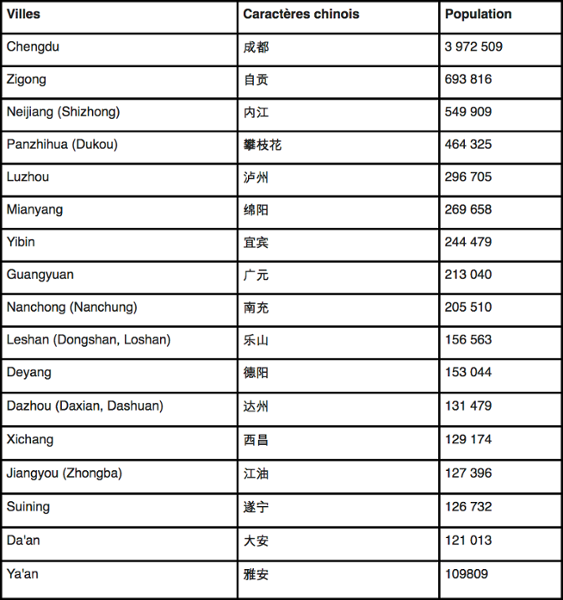
Main cities of the province
Geography of Sichuan
Sichuan alone accounts for 5.1% of Chine's total surface area and is the country's most populous province: 87 million inhabitants were recorded in 2004, though the municipality of Chongqing, densely populated but administratively independent, has not been counted in this figure since 1997.
Sichuan is bordered by Qinghai to the northwest, Tibet to the west, Gansu to the north, Shaanxi to the northeast, Chongqing municipality to the east, Guizhou to the southeast, and Yunnan to the south. In the north of the province lies the Longmen Shan fault, the epicenter of the May 2008 earthquake.
Surrounded by mountain ranges—the Himalayas to the west, the Qinling Mountains to the north, and the Yunnan mountains to the south—Sichuan alternates between 300 and 700 meters in its lowest-lying lands, and rises above 3,000 meters in the western plateaus.
The Sichuan Plain has a subtropical monsoon climate with long, humid summers, but short, dry, cloudy, and cold winters. The western region and its mountains experience very harsh winters.
History of Sichuan
The oldest traces of civilization in Sichuan date back to the Sanxingdui culture (三星堆), between 2,800 and 800 BC, in the city of Guanghan, 40 km from Chengdu.
Later, the rival kingdoms of Ba, in the Chongqing region, and Shu, in the Chengdu area, developed in the region. The Qin kingdom, which would become Chine's first empire, conquered and modernized the region in the 4th century BC: the Dujiangyan irrigation system was notably established in the 3rd century BC under the command of the famous administrator Li Bing.
Thanks to this achievement, the Sichuan region became an important center of the Qin kingdom, supplying it with substantial quantities of provisions and manpower. The province was also an important commercial and military zone, positioned on the route between the Yellow River valley and foreign lands to the southwest.
After 220 and the fall of the Han empire, Sichuan became the territory of the Shu kingdom during the period known as the 'Three Kingdoms', which inspired the novel of the same name...
Shortly before the Yuan dynasty came to power (1271-1368), the Southern Song dynasty (1127-1279) established a line of defense in Sichuan and Xiangyang (Hubei), but could not prevent the rise of the Mongol dynasty.
During the war with Japan (1938-1945), Chiang Kai-shek's Guomindang made Chongqing its headquarters, taking advantage of Sichuan's geography—a region difficult to access and therefore difficult for the Japanese army to conquer.
During the struggle for power between the Guomindang and the Communist Party after World War II, the Guomindang attempted once again to use Sichuan as a stronghold, but Chongqing fell to the Communists as early as November 1949, with Chengdu falling on December 10 of the same year.
The culture of Sichuan
While Sichuan is primarily inhabited by Han people, there are significant communities of Yi and Tibetan minorities. Several languages are spoken in the province: primarily varieties of southwestern Mandarin, as well as minority languages such as Tibetan.
Artistically, Sichuan distinguishes itself mainly by having its own variant of opera, and by being the birthplace of the celebrated Song dynasty poet Su Dongpo. Li Bai, a great poet of the Tang dynasty, grew up in the province after his first five years.
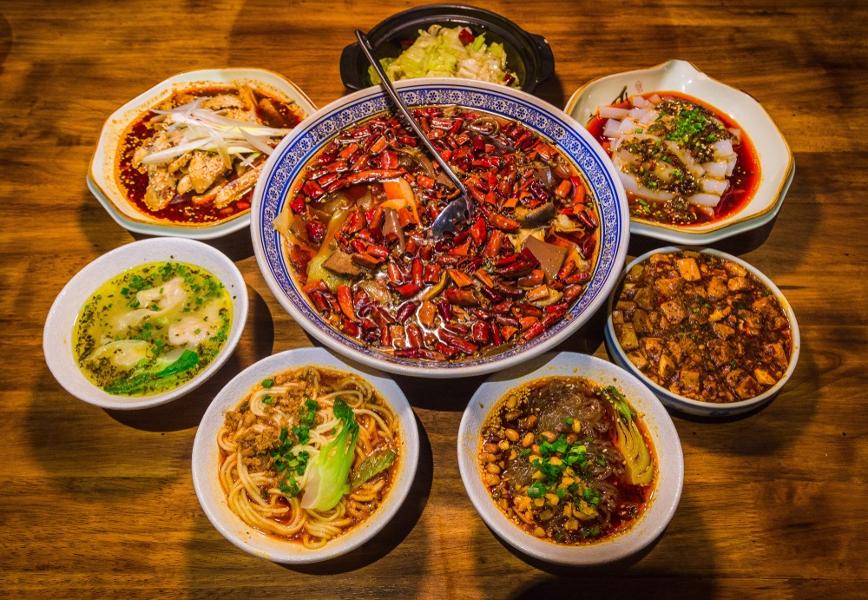
But when speaking of Sichuan culture, one cannot ignore its cuisine. Sichuan cuisine is one of the most popular in Chine, due to its powerful spices and variety. It ranks among the four great culinary traditions of Chine.
Economy of Sichuan
Sichuan is one of Chine's major agricultural provinces, particularly for rice and wheat production. Approximately 22% of Chine's wine production comes from here, while citrus fruits, sugarcane, sweet potato, peaches, and grapes are also part of the province's commercial crops. The region is also home to large pig farming operations and significant silk cocoon production.
Sichuan also has the advantage of possessing soil rich in minerals, with certain materials representing a significant proportion of the country's total wealth.
Industrially, the region boasts important centers such as Chengdu and Mianyang, renowned for electronics. The automotive industry is equally well developed, as are aerospace—a satellite launch center is based in Xichang—and military manufacturing.
Numerous Chineese and foreign investments have been made in the province to develop the electronics and information technology industries, making Sichuan a highly dynamic region. But one cannot discuss the local economy without mentioning tourism, an essential aspect of 21st-century Sichuan.
Tourism in Sichuan

Beyond its spicy cuisine, Sichuan is often associated with a second symbol: the panda. This animal, found exclusively in the wild in Chine, is particularly prevalent in the province. There is a "Giant Panda Sanctuary of Sichuan"—a UNESCO World Heritage site—as well as several other reserves in the region.
Sichuan is home to other UNESCO-listed sites:
Mount Emei, one of the four sacred Buddhist mountains of Chine
The Dazu Rock Carvings, Buddhist, Taoist, and Confucian religious sculptures
Huanlong, a scenic and historic area of interest in northern Sichuan
The natural reserve of the Jiuzhaigou Valley
Mount Qingcheng, a Taoist mountain associated with the legend of the Yellow Emperor
The magnificent bordering provinces are an advantage for Sichuan's tourism industry, as they offer the opportunity to organize high-value tourist circuits.
The seven provinces bordering Sichuan are Yunnan, Tibet, Qinghai, Gansu, Shaanxi, and Guizhou.
Frequently asked questions
The best time to visit Sichuan is spring (April-May) and autumn (September-October), when temperatures are mild and the landscapes are at their most beautiful. Summer is hot and rainy, while winter can be harsh, especially in the mountainous areas of the west.
The most famous place to observe giant pandas in Sichuan is the Giant Panda Research Center in Chengdu, located a few kilometers from the city center. The province is also home to the Sichuan Giant Panda Sanctuary, a UNESCO World Heritage site that comprises several nature reserves in the mountains.
Sichuan cuisine is renowned for its intense and spicy flavors, notably thanks to Sichuan peppercorn. Among the must-try dishes are mapo tofu (spicy tofu with ground meat), Sichuan hot-pot, gong bao chicken (with peanuts and chili peppers), and dan dan noodles. This gastronomy ranks among the four great culinary traditions of Chine.
Sichuan is home to several UNESCO World Heritage sites: the Sichuan Giant Panda Sanctuary, Mount Emei (a sacred Buddhist mountain), the Dazu Rock Carvings, the Huanlong region, the Jiuzhaigou nature reserve, and the Dujiangyan irrigation system associated with Mount Qingcheng.
The term Sichuan literally means 'the four rivers' in Chineese (四川, Sìchuān). This name refers to four major rivers crossing the province: the Mekong, the Yangtze River, the Yellow River, and the Nu River. It originates from an administrative division created under the Northern Song dynasty.
Sichuan is located in an active seismic zone. The province was notably struck by an earthquake measuring 8.0 on the Richter scale on May 12, 2008, near Wenchuan, causing over 70,000 casualties. While seismic risk exists, tourism has fully recovered since then. It is advisable to inquire about local conditions before traveling and to follow the recommendations of local authorities.