Top 10 Most Beautiful Landscapes in China
Today we invite you to escape through this top 10 of China's most stunning landscapes. The vastness of this territory abounds with natural treasures often unknown to the general public.
Today we invite you to escape through this top 10 of China's most stunning landscapes. The vastness of this territory abounds with natural treasures often unknown to the general public. Despite its growing urbanization, China has managed to preserve some of its greatest treasures for the delight of tourists and nature lovers alike. Here, in images, is a small non-exhaustive list of 10 Chinese landscapes you must see.
1 The Great Wall of China
Stretching over 6,000 km in length, the Great Wall of China is undoubtedly mankind's longest construction. Built between the 5th and 16th centuries to protect the northern borders of the Chinese empire against attacks from nomadic tribes from the north, the Great Wall is today an unmissable cultural and tourist site. The most famous and most visited section of the wall is Badaling. Recently renovated but far less touristy, you will also find Simatai and Jinshanling, which offers fabulous views of the mountains in every season.
2 Wulingyuan Natural Park
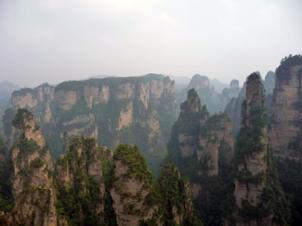
This large natural park of 360 km², located in the Wulingyuan district near Zhangjiajie, has been inscribed on the UNESCO World Heritage list since 1992. It houses highly diverse fauna and flora. Its fame lies in the 3,000 sandstone pillars known as sandstone pillars that cover it. The numerous trails and terraces that traverse the park offer breathtaking panoramic views of these peaks, some of which reach over 200 meters high.
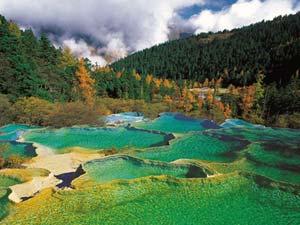
3 Huanglong National Park
Huanglong Park was inscribed on the UNESCO World Heritage list the same year as Wulingyuan. Located in the Chinese province of Sichuan, Huanglong belongs to the southern part of the Minshan mountain range. This site is especially renowned for its many natural pools formed by calcite deposits, revealing a stunning palette of colors that make it a magical and unforgettable place. Huanglong Park is also famous for its endangered wildlife, notably giant pandas and golden snub-nosed monkeys from Sichuan. In the same vein, we also mention Jiuzhaigou Valley, equally enchanting in every season.
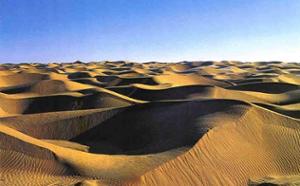
4 The Taklamakan Desert
The Taklamakan Desert is renowned as the most beautiful and vast desert in China, and above all as the world's second largest shifting sand desert. Its dunes, which can reach 300 meters in height, are carried by the wind and gradually gain ground at the expense of the oases. It also enjoys a notorious reputation, as it was once said that "once you enter it, you cannot leave it."
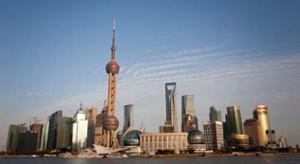
5 Pudong Skyline – The Pudong District of Shanghai
In the "urban landscapes" category, Pudong is a district of Shanghai situated along the Huangpu River, having emerged as a major financial and commercial center of China. A horizon of gleaming skyscrapers rises above what was once farmland. This impressive panorama includes the iconic Oriental Pearl Tower, the Shanghai World Financial Center, the Jin Mao Building, and the Shanghai Tower, which was set to be completed in 2014.
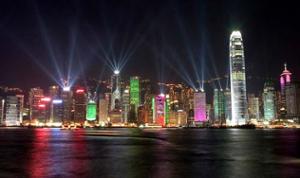
6 Victoria Harbour
The Victoria Harbour is known worldwide for its incredible panorama and its interplay of lights. Kowloon and especially the Avenue of Stars offer an unobstructed view of the skyscrapers which, as night falls, provide a stunning light spectacle.
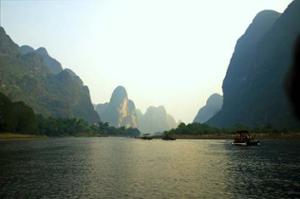
7 The Li River at Yangshuo
The Li River from Guilin to Yangshuo is a remarkable site to discover in the northeast of Guangxi province. The landscape is adorned with magnificent hills, steep cliffs, incredible caves, and typical agricultural villages. Stays in this fairy-tale setting are truly a source of delight for many tourists. Bordered by bamboo forests, mountains, and rice paddies, the Li River offers a breathtaking landscape.
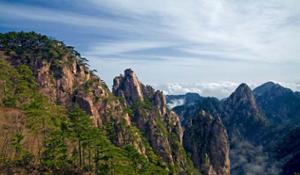
8 Huangshan: Mount Huang
Mount Huang (Huangshan) is recognized as China's most beautiful mountain. It presents an almost unique spectacle thanks to its natural aesthetics and its granite heights emerging from the clouds. This enchanting site marries high mountains, forests, lakes, tiered waterfalls, and limestone ridges in a lyrical symphony. A rich diversity blanketed with remarkable colors, the fruits of numerous turquoise-tinted lakes and trees which, come autumn, seem straight from a Monet painting.
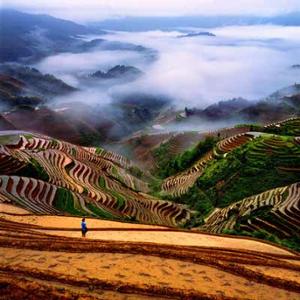
9 The Longji Rice Terraces
These terraced rice paddies called Longji are the fruit of the hard work of the Zhuang people. The beauty of the interconnected rice terraces varies by season, each offering a fascinating landscape and striking colors. In winter, all the terraces are covered in snow yet display the same undulations resembling the shape of a dragon (hence the name Dragon's Backbone rice terraces). Beyond its attractive panorama, Longji is a region to discover also for the ethnic minorities that inhabit it and its charming atypical villages.
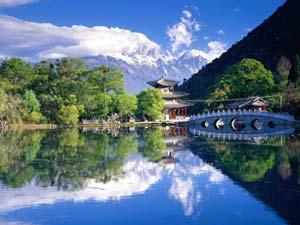
10 Jade Spring Park
Jade Spring Park is located in Lijiang in Hunan. It is famous for its expanses of jade-colored water upon which pagodas, trees, and mountain peaks are reflected. But it is undoubtedly the reflection of Mount Yulong Xueshan that stands as its most striking symbol. Mount Yulong, also nicknamed the snow-capped jade dragon mountain for its eternal snows, delivers a unique landscape. Home to numerous animal species, the Jade Dragon Mountain is among China's most important nature reserves.
We hope this small list will have given you some ideas for your next vacation destinations. It obviously does not claim to be exhaustive, and you are indeed invited to share your thoughts in the comments if a place in China has particularly struck you.
Frequently asked questions
China abounds with exceptional landscapes, but Mount Huangshan (Mount Huang) is often cited as the most beautiful by travelers, thanks to its granite peaks emerging from clouds, its pine forests, and its lakes. Wulingyuan Park and the Li River at Guilin are also among the most admired.
Several of China's most beautiful landscapes are on the UNESCO World Heritage list, notably Wulingyuan Natural Park (Zhangjiajie) and Huanglong Park in Sichuan, both listed since 1992. The Great Wall of China is also inscribed on the UNESCO list since 1987.
The best time depends on the regions. Spring (April-May) and autumn (September-October) are generally ideal for visiting most natural sites such as Huangshan, the Longji rice terraces, or the Li River. Summer can be rainy and crowded with tourists in popular areas.
Most foreign nationals must obtain a visa to enter China. Temporary visa exemptions exist for certain countries. It is advisable to check entry conditions with the Chinese consulate or a travel agent before planning your trip.
Yes, the Taklamakan Desert is accessible to tourists, particularly from the city of Kashgar or Ürümqi in the Xinjiang region. However, it is advisable to be accompanied by a local guide, as this desert, the world's second largest shifting sand desert, can be dangerous to traverse alone.
Wulingyuan Natural Park is located in the Wulingyuan district, near the city of Zhangjiajie, in Hunan province. It is famous for its approximately 3,000 sandstone pillars that are said to have inspired the scenery in the movie Avatar. It spans around 360 km².