The State of Buddhism in China
A widespread current of thought, Buddhism is official in several Asian countries. In China, it is part of the "Three Teachings" and thus coexists with Taoism and Confucianism,
A widespread current of thought, Buddhism is official in several Asian countries. In China, it is part of the "Three Teachings" and thus coexists with Taoism and Confucianism, to which one could add the official doctrine of the Party...
Understanding the situation of Buddhism in China is not straightforward, and it must be acknowledged that no other country resembles the Middle Kingdom on this point.
The Introduction of Buddhism to China
Officially imported in the 1st century of our era, Buddhism would have penetrated China through merchants and missionaries from regions already touched by the Buddha's teaching (Buddha-Dharma). An atypical phenomenon in the history of religions, its expansion owed nothing to military conquests and force, and was merely the fruit of voluntary adoption by indigenous populations.
Tolerated and even well received by the various powers in place, Buddhism developed and from the 2nd century onward the first Buddhist temples and monasteries appeared. From the 4th century, the expansion of this current of thought accelerated, and one can speak of Buddhism's apogee in China during the 5th and 6th centuries.
845: The End of the Golden Age
The institution prospered because it had the support of regimes in power, and thus received donations (notably in lands) and paid fewer taxes. Without attempting to disturb or dominate indigenous cults, which surely explains its success, Buddhism became the best-organized religion throughout the Middle Kingdom, and therefore the most powerful.
Nevertheless, in 845, the golden age came to an end: still perceived as a foreign religion, Buddhism was proscribed by imperial power. Monasteries and lands were confiscated, statues destroyed...
The proscription, though quickly annulled, marked the end of Buddhism's hegemony, which would henceforth have to officially coexist with Taoism and Confucianism through the doctrine of the "Three Teachings".
A Distinctly Chinese Buddhism
It is clear that today, the situation of Buddhism in China bears no comparison with what exists in the rest of Asia. The Buddha's teaching is not an official state religion, but it is accepted to guide the population (and not to dominate it, according to Beijing's official terms).
Moreover, it is also to its historical evolution that Chinese Buddhism owes its distinctive features. Just as happened before its introduction to China, the Buddha's teaching was divided into several schools, each representing a particular interpretation of the primitive sources.
From the Mahayana, the one of the three great currents of Buddhism that took root in China, were thus born Tiantai, Huayan, Chan, and Pure Land (Ching-Tu). Until the end of the Tang dynasty (618–907), the translations of the Buddha's original texts were in full bloom.
A New Interpretation of Buddha-Dharma
While some attempt to remain as faithful as possible to the original meaning, apocryphal texts met with great success among the population because they addressed local concerns.
The original texts were reinterpreted in light of local thought, and thus were born the great distinctly Chinese schools, as well as Chan (the equivalent of Zen in Japan, emphasizing meditative practice, while Tiantai and Huayan had more philosophical concerns).
A Union of Buddhism, Taoism, and Confucianism?
Unlike many other religions throughout the world, Buddhism did not conquer China by force but was instead accepted by the indigenous people. Over time, it even adapted and integrated into Chinese society by incorporating ancestral Chinese traditions and ideas from the two other great currents of thought—Taoism and Confucianism—into its practice.
Thus, today, it seems more appropriate to consider the Chinese "Three Teachings" as a whole rather than as three fundamentally different modes of thought. Many Chinese, indeed, although knowing and even accepting the ideas of Buddhism, do not consider themselves Buddhist practitioners. The same is true for the teaching of Lao Zi and that of Confucius (Kong Zi).
Through their education and culture, the ideal of many Chinese who lived before the Cultural Revolution was moreover a blend of the principles of the "Three Teachings". On this point, one can thus consider Chinese Buddhism as part of a syncretism among doctrines, which would be "controlled" or "monitored" by the Chinese Communist Party.
Official figures for Buddhism in China:
- 13,000 Buddhist temples
- nearly 200,000 Buddhist monks and nuns
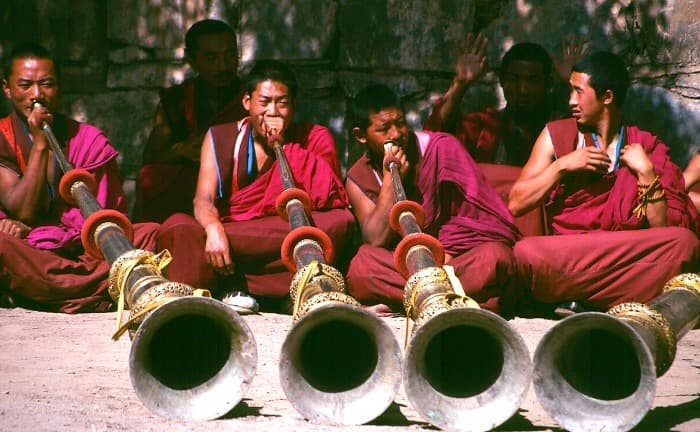
Lamaism, Tibetan Buddhism
If Mahayana is the source of the various forms of Buddhism present in China, Lamaism is in many respects a distinct variant.
First, because of the cultural particularity of Tibet, officially Chinese but whose political situation is subject to debate. Second, because of the history of Buddhism's penetration onto the Tibetan highlands.
Lamaism, widespread in Tibet and also in Inner Mongolia, takes its source from the third great current of Buddhism: Vajrayana. While some perceive it only as yet another variant of Mahayana, the Diamond Vehicle is clearly different.
Advocating the possibility of attaining Enlightenment in a single lifetime, Vajrayana also adopted magical rituals as well as deities from Hindu religion.
7 million practitioners distributed among the Tibetan, Mongolian, Tu, Uyghur, Naxi, Pumi, and Moinba ethnic groups.