Bodhidharma, the Man Behind the Shaolin Legend and Pioneer of Chinese Buddhism
A legendary figure, Bodhidharma is regarded by the most widely accepted traditions as the propagator of Chan (Zen) Buddhism in Chine.
A legendary figure, Bodhidharma is regarded by the most widely accepted traditions as the propagator of Chan (Zen) Buddhism in Chine. The martial arts of the Shaolin Temple itself are said to be his legacy.
Vocabulary
chán zōng 禅宗 : Chan Buddhism (Zen in Japanese), the doctrine of meditation (or contemplation)
chán 禅 : meditation, contemplation
zōng 宗 : order, objective, purpose, clan, doctrine
Note:
Bodhidharma is a figure shrouded in mystery, making it difficult to present a truly reliable biography of his life. He likely came from southern India and was said to be of princely descent.
Bodhidharma's Chinese name is Damo (Dámó 達摩). His full name is translated as Pútídámó 菩提達摩. His Tibetan name is Dharmottara. In Sanskrit, Bodhidharma means "teaching of wisdom".
Bodhidharma is credited with spreading Chan Buddhism, a current of Mahāyāna in Chine. This movement developed strongly in the Far East and became known as Zen Buddhism in Japan.
Legend has it that Bodhidharma was the man who brought kung fu to the Shaolin monastery. Nevertheless, no historical evidence confirms this hypothesis.
Bodhidharma According to Legend
While Bodhidharma, or Damo in Chinese, is known worldwide, the man behind this name remains mysterious in many respects. The most commonly accepted version of the stories and legends about him presents him as a Buddhist monk from India who founded the Chan Buddhism school (called Zen in Japan) in Chine.
This contemplative teaching (dhyāna) is part of Mahāyāna, the Great Vehicle, which holds that every living being contains the potential of a Buddha. Bodhidharma is said to be the 28th patriarch of the Chan lineage and, of course, the first on Chinese soil, as he was the one who brought this philosophy there.
Bodhidharma's fame does not end with the spread of Chan Buddhism in Chine: his name is also associated with the mythical Shaolin Temple. It was he who is said to have transmitted to the temple's monks meditation techniques, physical exercises (mainly respiratory) and combat systems (72 in total).
From this emerged the legendary Shaolin kung fu (Shaolin Quan), with new styles developing around the foundation offered by Damo. While the monastery enjoys a worldwide reputation today, the resemblance between what the original Shaolin Boxing was and what bears its name now is surely quite distant. Indeed, the temple was destroyed and rebuilt multiple times, and it was mainly foreign interest that allowed its reopening in 1981.
What Biography for Bodhidharma?
Attempting to describe in detail and with accuracy the life of Bodhidharma is a utopian endeavor, given the scarcity of historical traces he left behind. The most comprehensive sources of information about him are later than his time, which significantly undermines their reliability.
The oldest testimony about Damo is attributed to Tanlin (曇林; 506–574), considered a student of Huike, Bodhidharma's principal disciple. His text is a preface to the book Er'ru sixing (二入四行論), called in English "Two Entrances and Four Practices".
It indicates that the 28th patriarch of Chan Buddhism came from a princely family in southwest India and came to bring the dharma, Buddha's teaching, to Chine. Daoyu and Huike are presented as two of his disciples.
According to the Xù gāosēng zhuàn (續高僧傳), "Further Biographies of Eminent Monks" by Daoxuan (道宣), Bodhidharma would have belonged to the Brahmin caste. He is said to have arrived in southern Chine during the reign of Liu-Song (or Southern Song, 420-479) before moving to the Northern Wei kingdom. This source places the death of the pioneer of Chinese Buddhism at 529 AD.
The Zǔtángjí (祖堂集), "Anthology of the Patriarch's Hall", presents Bodhidharma as a disciple of the 27th patriarch of Chan Buddhism, Prajñātara, an Indian monk who lived in southern India. According to this source, Damo's arrival in Chine was late, mentioning the year 527 and the Liang dynasty (502-557), the third dynasty of southern Chine.
This hypothesis makes historically plausible the meeting between Bodhidharma and Emperor Wudi, the first sovereign of the Southern Liang dynasty. The meeting is mentioned in numerous sources, notably including a text by Shenhui, the 7th legitimate patriarch of Chan Buddhism.
The Meeting Between Bodhidharma and Emperor Wudi:
The emperor asked Bodhidharma how many merits he had earned by having monasteries built, offering gifts to the Buddhist community, and copying and reciting sutras. "No merit at all" the sage replied. "What are the true merits?" asked the sovereign.
"Pure wisdom is marvelous and perfect, its essence is empty and peaceful. Such merits cannot be acquired through worldly methods" Bodhidharma answered. "What is the supreme meaning of the noble truth?" Wudi asked again. "The vast emptiness without nobility" he received in reply. Wudi: "Who are you?", Bodhidharma: "I do not know".
The sovereign could not understand the meaning of his interlocutor's words, which were far from his initial conception of Buddhism.
It was only after this meeting that Bodhidharma is said to have gone to the Shaolin temple on Mount Song, in Henan. Legend has it that he then spent 9 years sitting in meditation facing a wall: the meditation posture called zazen (or zuochan) is said to have been born at this time, as was the nickname given to the sage, "Brahmin contemplating a wall".
While it would seem logical that his death occurred in Chine around the middle of the 6th century, some texts describe a person traveling to India with only one sandal... The mystery of Bodhidharma thus remains as great as the legacy attributed to him.
Bodhidharma's Spiritual Teaching
Bodhidharma's principal disciple was Huike (慧可 487-593), the 2nd patriarch of Chan Buddhism. The master entrusted his student with the four volumes of the Sutra of the Descent on the Island (Lankāvatārasūtra in Sanskrit, Léngjiā ābāduōluó bǎojīng 楞伽阿跋多羅寶經 in Chinese), saying: "When I see the land of Chine, there is only this sutra that can save people. Through it, you will save the world". He had just chosen the most appropriate method, in his view, to transmit Buddha's word to the rest of the world.
The teaching received from Bodhidharma emphasizes the notion of transcending duality and illusory thoughts to reach a state of global consciousness. A philosophy that approaches Yogācāra (yújiāxíng 瑜伽行), a branch of Mahāyāna Buddhism.
Seeking to develop one's perception to achieve emptiness of mind, a state of pure consciousness, is the essential condition for understanding the dharma, Buddha's teaching. The goal is none other than perceiving one's true nature by setting aside the illusions of thought.
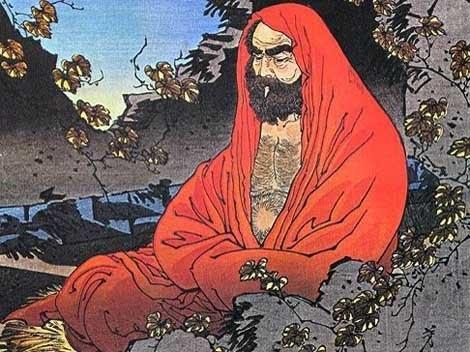
The Buddhism taught by Bodhidharma is clearly contemplative and relies on meditation techniques. Its iconography often depicts him sitting cross-legged facing a wall and remaining motionless in order to calm his mind (安心 ān xīn). This could simply be the Zazen posture (坐禪 zuòchán in Chinese), also practiced kneeling.
The teaching and work attributed to Bodhidharma have had a worldwide influence, as Chan (or Zen) became a religion of primary importance in Korea and Japan. In the rest of the world, particularly in the West, the interest aroused by Zen Buddhism and meditation is beyond question.
Nevertheless, after Bodhidharma's death, a distinctly Chinese Buddhism was born from the interpenetration of Indian Chan (transmitted by the master) and Chinese Taoism. Depending on the era, the latter was more or less associated with Buddhist teaching in order to preserve what is one of the two great modes of thought born in Chine.
Damo and the Shaolin Monastery
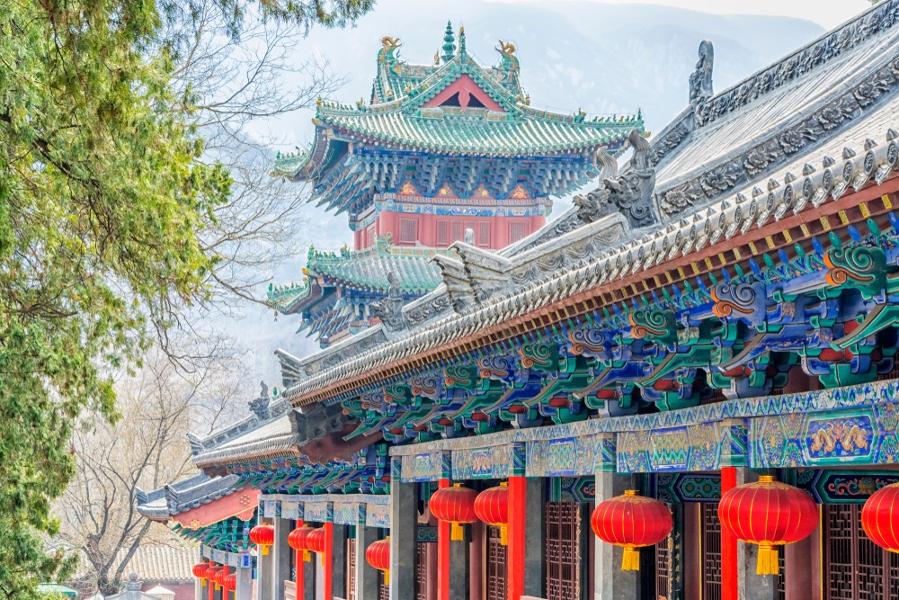
Many sources place Bodhidharma's arrival at Shaolin in 520, after his meeting with Emperor Wuxi. Although no historical evidence attests to his presence in the famous monastery, the commonly accepted legend holds that Damo taught Chan Buddhism and martial arts to the monks.
He is thus considered the father of Shaolin Quan (Shaolin kung fu) and suggests that a large part of traditional Chinese martial arts finds its true source in India, the homeland of the 1st Chinese patriarch of Chan Buddhism.
Why teach combat arts to monks when his task was to transmit the dharma? Damo had noticed that the monks were in very poor physical condition. He then taught them physical and respiratory training techniques, as well as 72 combat techniques so they could defend themselves against bandits and wild animals. The martial arts born at Shaolin (or stemming from his legacy) are today considered to have Buddhist influence, whereas the majority of other traditional Chinese martial arts are said to have Taoist influence (Taiji Quan, Bagua Zhang...).
The distinction made between these two types of martial arts leads some observers to sometimes refer to external arts (based on heavy physical training) for disciplines linked to Shaolin, and internal arts (based mainly on internal and energetic strengthening of the body) for disciplines of Taoist influence.
Many historians doubt that Bodhidharma ever went to Shaolin, but they cannot deny that his doctrine became one of the pillars of Shaolin Temple.
Iconography and Bodhidharma
The figure of Bodhidharma is celebrated in many Asian countries: Chine, Korea and Japan of course, but also Vietnam and Malaysia. In the latter territory, it is said that Bodhidharma passed through before spreading Chan in Chine.
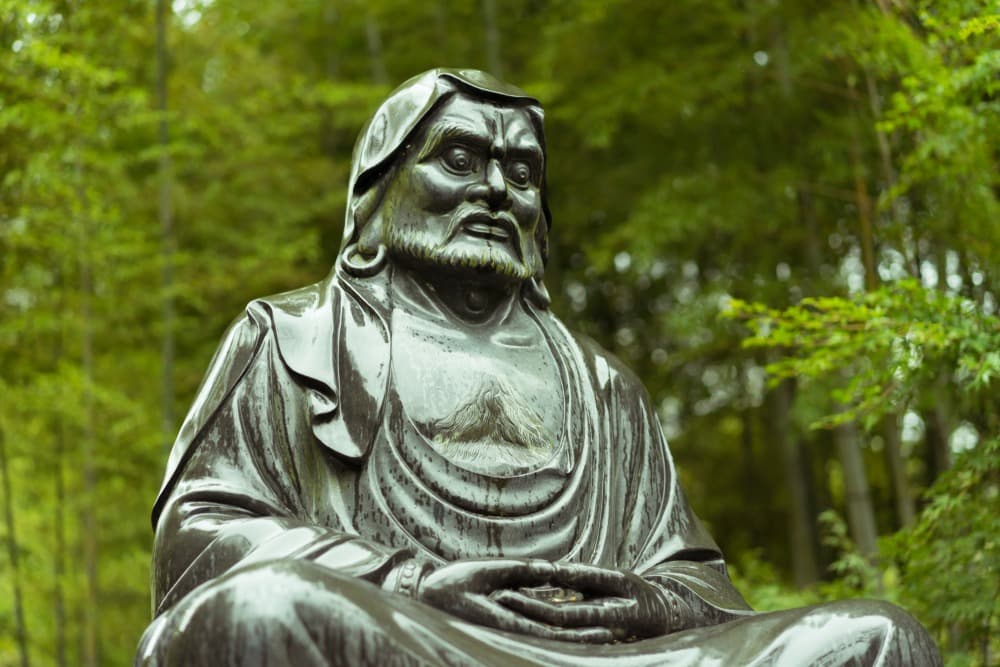
In most cases, depictions of Bodhidharma show a bearded monk with large eyes and a dark appearance. As for the spherical Japanese statuettes representing the sage, they are said to be linked to the legend of his 9 years of meditation, which allegedly atrophied his legs...
A story also attributes to him the development of tea cultivation in Chine: after 7 years of meditation, he fell asleep. To guard against sleep, he then cut off his eyelids, which as they fell to the ground supposedly gave rise to two tea plants.
Bodhidharma's Words Full of Wisdom
Prajñātara gave his father Suganchas, king of Kanchipuram (today one of the seven holy cities of India), a precious stone of great value. To assess the understanding of several children, he asked them their opinion on the stone.
Logically, they all responded that the stone was wonderful, except for one, who said: "this stone is not of great value because ultimately the only thing that has value is the mind, it is the mind that is capable of understanding the value of existence, the value of things, the value of beings, the stone in itself is worth nothing without the mind, it is the mind that matters". The child was none other than Bodhidharma. Sensing enormous potential for wisdom, Prajñātara took him as a disciple.
Frequently asked questions
Bodhidharma, known in Chinese as Damo, is a Buddhist monk from India regarded as the founder of Chan (Zen) Buddhism in Chine. He is also associated with the legend of the martial arts of Shaolin Temple, whose techniques he is said to have taught to the monks.
According to legend, Bodhidharma taught 72 combat techniques to the monks of Shaolin Temple to help them defend themselves and maintain their physical condition. However, no historical evidence confirms his presence at Shaolin, and historians remain skeptical about this point.
Chan Buddhism, transmitted by Bodhidharma in Chine, and Zen are actually the same doctrine: 'Chan' is the Chinese term, while 'Zen' is its Japanese equivalent. Both emphasize contemplative meditation as the path to enlightenment.
Yes, Shaolin Temple is located on Mount Song in Henan Province in Chine. It reopened in 1981 and now welcomes thousands of visitors each year. It is possible to attend martial arts demonstrations and learn about the history of the site.
Historical sources differ on this date. According to some texts, he arrived during the reign of Liu-Song (420-479 AD), while other sources place his arrival in 527, during the Liang dynasty (502-557).
Zazen (zuochan in Chinese) is a seated meditation posture practiced in Chan and Zen Buddhism. Legend attributes its origin to Bodhidharma, who is said to have spent 9 years meditating seated facing a wall in Shaolin Temple, earning him the nickname "Brahmin contemplating a wall".