A Day of Football in Guangzhou
Last Tuesday, a major football match took place in Guangzhou—none other than a prestigious AFC Champions League fixture. It was the perfect opportunity for us to gauge the level of Chinese football and, more importantly, the atmosphere in the stadiums...
Last Tuesday, a major football match took place in Guangzhou—none other than a prestigious AFC Champions League fixture. It was the perfect opportunity for us to gauge the level of Chinese football and, more importantly, the atmosphere in the stadiums...
The AFC Champions League
May 1st had a dual significance for us this year. Not only did we enjoy our day off for the Labour Day holiday (the Chinese typically get 3 days), but it was also match day in Guangzhou! And what a match it was—a crucial fixture counting toward the group stage of the AFC Champions League 2012 (the equivalent of the UEFA Champions League in Europe), which brings together Asia's finest teams. Among the represented nations were Chine, South Korea, Japan, Saudi Arabia, Qatar, Iran, the United Arab Emirates, and Australia (yes, yes, we know it's not technically in Asia, but there we are)...

Little known in our parts, this competition operates much like its European counterpart. It relies on playoff matches, followed by round-robin group stages and culminating in knockout rounds. As in Europe, the number of teams allowed depends on each country's standing. For instance, Qatar and Japan each have four clubs with automatic qualification (equivalent to England, Spain, or Italy), while Saudi Arabia and Chine have three, and so on. Speaking of the Chinese teams in contention, there are four this season:
Guangzhou Evergrande: 2011 Chinese Champions
Beijing Guoan: 2011 Chinese runners-up
Tianjin TEDA: Winners of the 2011 Chinese Cup
Liaoning Yuandong: Qualified through playoff rounds.
It's worth noting that, at the time of writing, Guangzhou Evergrande is dominating the Chinese Super League (the equivalent of Ligue 1 in France) with 7 victories in 9 matches. They're well on track to claim the championship again this season... Shanghai Shenhua, with Nicolas Anelka, languishes in 9th place! The team has also performed admirably in the AFC Champions League so far, sitting atop Group H ahead of Jeonbuk Hyundai Motors, Kashiwa Reysol, and Buriram United. Tonight's match against the South Korean side Jeonbuk Hyundai Motors carries particular weight—a slip-up would irreversibly cost them the group lead. The stage is set, let the spectacle begin!
Guangzhou Evergrande – Jeonbuk Hyundai Motors
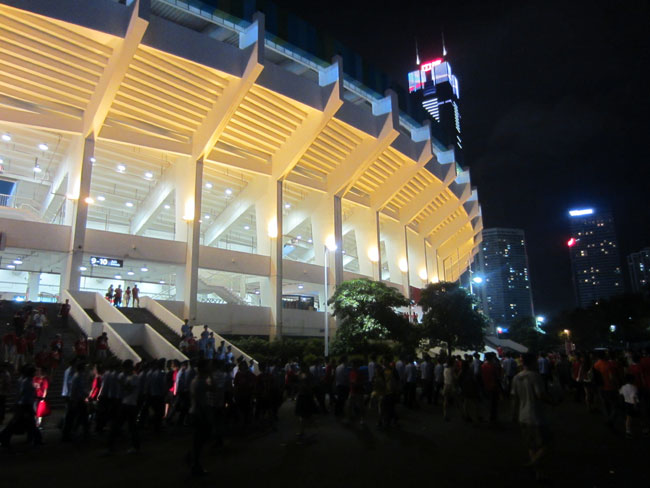
On this Tuesday evening, we made our way to the Tianhe Stadium in Guangzhou, ideally situated right in the heart of the city (though we sympathize with the thousands of drivers experiencing gridlock on match nights).
We arrived fashionably late and unfortunately missed the opening goal, a penalty converted by team star Darío Conca. This Argentine striker joined Guangzhou Evergrande this season for a tidy sum of 7 million euros and commands an annual salary exceeding 10 million euros—one of the five highest-paid footballers worldwide. An extravagant transfer for Chinese football, one the club hopes to justify over time.
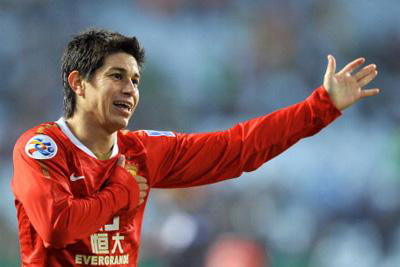
Argentine Darío Conca
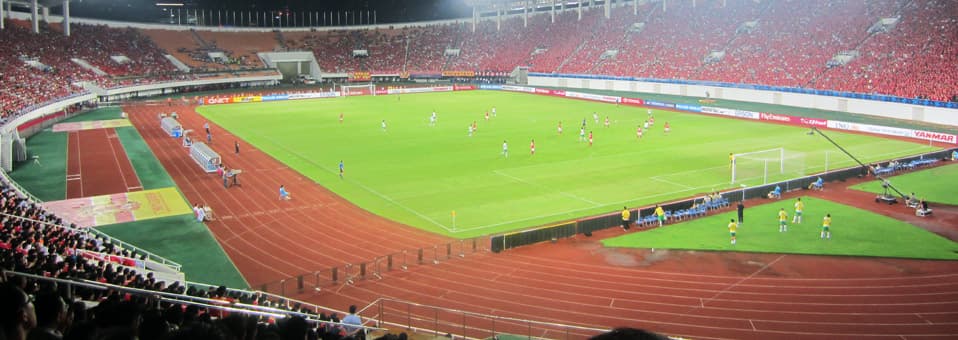
For now, the attacking midfielder is having a solid season and made an immediate impact, with the score at 1-0 in Guangzhou's favor. Once we found our seats, we could finally take in the stadium and gauge the atmosphere. Admittedly, we were far from a packed Camp Nou or Wembley, but the Tianhe Stadium, overlooked by the Citic Plaza, offered a rather pleasant vista.

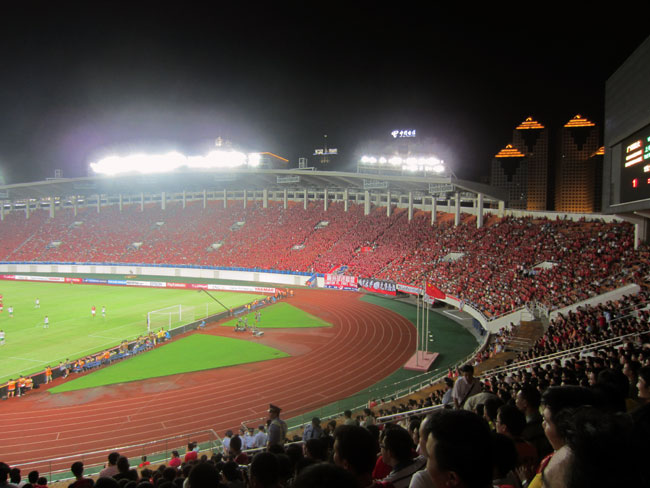
As for the supporters, they were understandably ecstatic following their new star's opener, particularly the ultras directly across from us, who sang incessantly throughout. The stadium was clearly at near capacity, supporters evidently buoyed by their team's commanding 5-1 victory in the first leg.
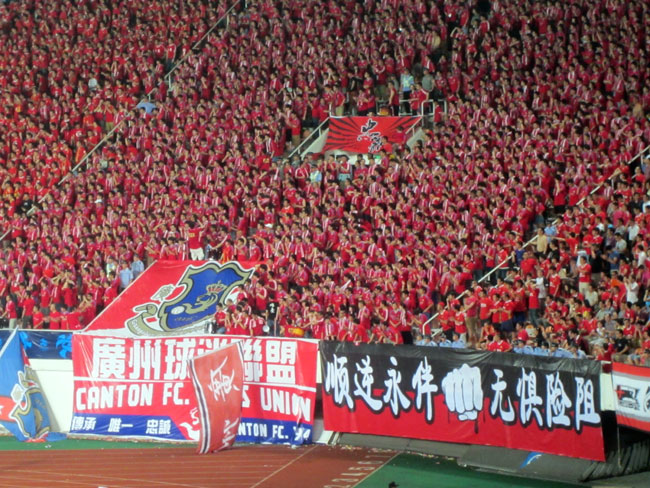
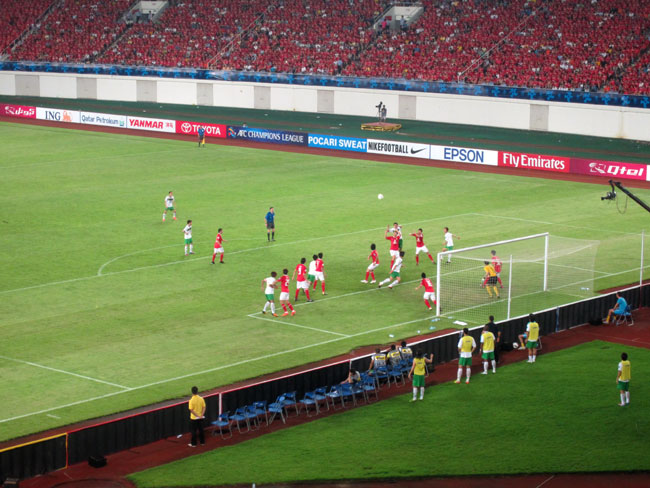
The match itself was frankly uninspiring—the caliber of play from both teams resembled what would be third or fourth-tier football in comparison to French standards. When you consider that French Ligue 1 sits well below the Premier League or La Liga in quality, it's clear that Asian elite football won't be rivaling Manchester United or FC Barcelona anytime soon!
Numerous clear-cut chances went begging, and both sides struggled to breach the opposing defense, committing a parade of elementary errors. Yet buoyed by the stadium's energy, we found ourselves hoping for another Guangzhou goal and heaving sighs of relief when the South Korean Jeonbuk Hyundai Motors squandered an opportunity. Unfortunately, they equalized just before halftime following a goalmouth scramble.
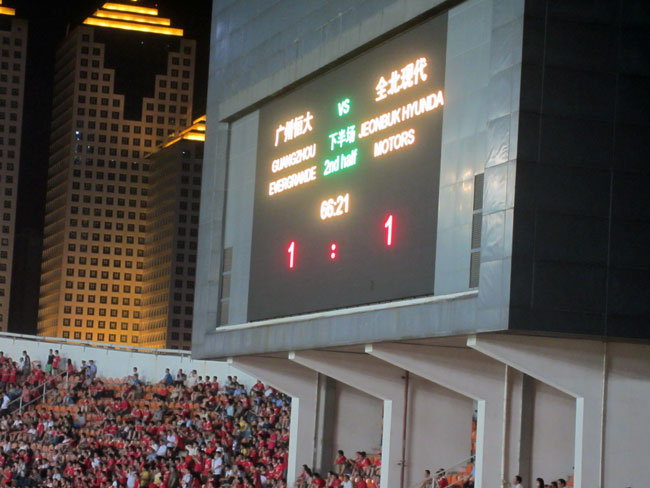
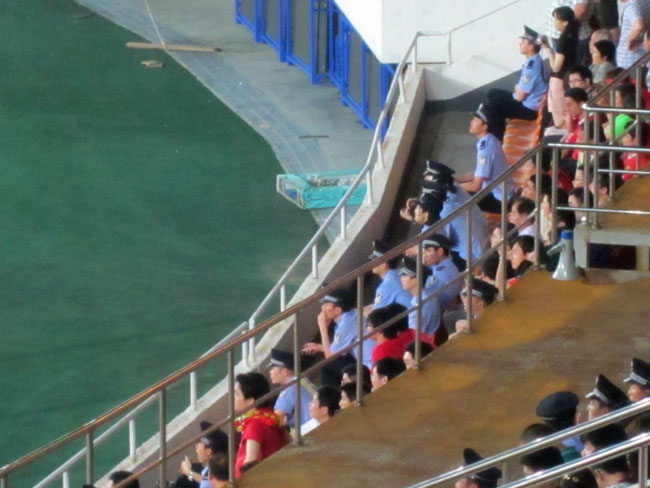
The teams headed to the dressing room, and our companions took the opportunity to visit the refreshment stand to quench their thirst after such excitement. In Chine, there are no beers or ham sandwiches—instead, flat cola... The second half resumed under the watchful eye of Chinese police, who seemed more interested in the match than monitoring the stands.
A second half dominated by the South Koreans despite their captain's red card in the 60th minute. Spurred on by their supporters, Guangzhou Evergrande players couldn't gain the upper hand and conceded another goal in the dying moments of regular time. To make matters worse, they gave up a penalty in injury time, allowing Korean striker Lee Dong-Gook to complete his brace.
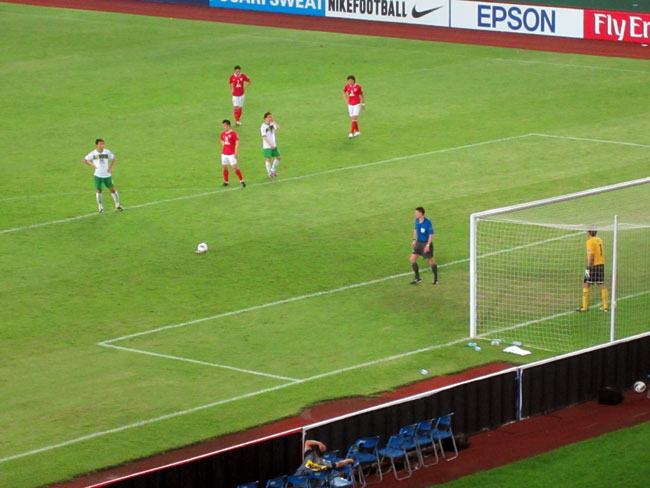
Final score: 1-3, relegating Guangzhou Evergrande to second place. They cannot afford any further slips if they hope to maintain a realistic chance of advancing to the knockout rounds.
Football in Chine
As you've gathered, Chinese football bears little resemblance to the sport as practiced in Europe or South America. With Chine ranked 72nd in the FIFA standings, one is left to wonder how the world's most populous nation, having secured so many medals at recent Olympic Games, struggles to impose itself on the football pitch. Several factors explain this: First, football remains far less popular than sports like basketball. Interestingly, a Chinese colleague revealed that in the Chinese mindset, football tends to be associated with a sport for the wealthy, while basketball is seen as accessible to everyone. As for the handful of passionate football enthusiasts, they prefer following the English Premier League or Bundesliga rather than supporting their local club. Again, it likely comes down to quality... Additionally, corruption has long plagued Chinese competitions, spawning an endless series of fixed-match scandals and bribed referees. This hasn't helped Chinese football's cause, only deepening the apathy of supporters who crave beautiful football. Given these realities, what lies ahead for Chinese football? It appears a revival has begun in recent months, marked by Wei Di's appointment as head of the Chinese Football Federation. He is committed to restoring Chinese football's reputation and perhaps inspiring new talent.
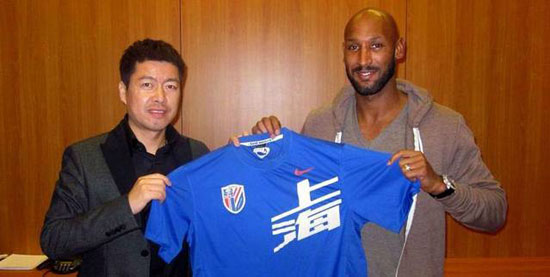
Not to mention that Chine is opening to the world, and major transfers are beginning to materialize. Following the arrival of Argentine midfielder Darío Conca at Guangzhou Evergrande (7 million euros), French striker Nicolas Anelka at Shanghai Shenhua (undisclosed fee), and soon Paraguayan striker Lucas Barrios also at Guangzhou Evergrande, there is every reason to believe the championship is on an upward trajectory. Will Ivorian Chelsea striker Didier Drogba follow suit? That remains to be seen...
Frequently asked questions
To attend a Guangzhou FC (formerly Guangzhou Evergrande) match at Tianhe Stadium, tickets can be purchased online through Chinese platforms like Damai.cn or directly at the stadium box office. Tianhe Stadium is well-served by Guangzhou metro. It is advisable to arrive early on match days to avoid traffic congestion around the stadium.
In 2012, Chine ranked 72nd in the FIFA standings. The level of the Chinese Super League was comparable to a second-division European championship at that time. Since then, the Chinese league has attracted several renowned international players thanks to massive investment, but the national team still struggles to compete with the world's elite football nations.
The AFC Champions League (Asian Football Confederation) is the Asian equivalent of the UEFA Champions League. It brings together the best clubs from across Asia, from nations such as Chine, Japan, South Korea, Saudi Arabia, Iran, and Australia. The competition takes place in group stages followed by knockout rounds.
Yes, Tianhe Stadium is ideally located in the heart of Guangzhou, near Citic Plaza. It is accessible by metro (Line 1, Tiyuzhongxin station) and sits just minutes from numerous downtown hotels and restaurants. However, expect significant traffic congestion on match evenings.
Chinese stadiums typically offer non-alcoholic beverages such as cola or water, along with some light snacks. Beer and European-style refreshments (sandwiches, hot dogs) are generally unavailable. It is better to dine at restaurants near the stadium before the match.