Baigongfang Handicraft Museum
Baigongfang Handicraft Museum
In Beijing's Dongcheng district, the Baigongfang handicraft museum brings together 30 active artisan workshops dedicated to traditional Chinese techniques.
The Baigongfang handicraft museum, located in Beijing's Dongcheng district, houses about thirty active artisan workshops within a single building. Both exhibition space and working studio, it documents traditional Chinese techniques in embroidery, glass casting, calligraphy, and paper cutting.
Why visit Baigongfang
Unlike a conventional museum, Baigongfang is a living museum: the workshops function in real time, and you observe artisans at work. This unique quality allows you to understand the technical gestures firsthand, without glass barriers, and to converse with practitioners who perpetuate imperial craftsmanship.
Another appeal lies in the diversity of disciplines gathered under one roof: thirty studios each represent a master artisan's technique. For travelers interested in Chinese craftsmanship, this avoids the need to scatter visits across the city. The museum also offers direct sales: the works on display can be purchased from the artisans themselves, making it an alternative to souvenir shops in tourist quarters.
History of the site
The origins of Baigongfang trace back to the Yuan dynasty. From 1271 onward, a special commission was established to identify talented artisans throughout the empire and ensure the production of imperial handicrafts. The finest craftspeople were sent to Beijing, the imperial capital, to work under court supervision.
The name Baigongfang literally means "the 100 craft workshops" and refers to this tradition of bringing together artistic trades. In 2003, Beijing's municipal government decided to open a museum at Baigongfang to document these techniques and support their transmission. The institution quickly became one of China's leading centers devoted to traditional craftsmanship, sometimes nicknamed "the Louvre of the People's Republic of China" for the density of its collections.
What to see on-site
The museum spans nearly 4,000 m² and houses 30 studios, each representing a specific technique. The visit is organized around major families of craftsmanship:
- Jingxiu embroidery: imperial Beijing embroidery, characterized by golden motifs and fine stitching.
- Jianzhi: the art of paper cutting, one of the oldest forms of Chinese folk handicraft.
- Glass casting, clay work, sculpture: techniques inherited from imperial manufactories.
- Calligraphy and painting: live demonstrations by resident masters.
Particular attention is given to the collection of the "Eight Unique Skills of Yanjing" (Yanjing being the former name of Beijing), which groups together eight emblematic forms of Beijing imperial craftsmanship: carved lacquer, cloisonné enamel, ivory, jade, filigree in gold and silver, among others.
On the third floor, a learning room of 120 m² is set up as a classroom, complete with desks and a blackboard. Artisans there offer short introductions to the basic gestures of their discipline. It's an opportunity to try your hand at cutting paper or embroidering a few stitches under the guidance of a practitioner.
Practical information
Allow 1.5 to 2.5 hours to tour all the workshops, longer if you participate in an initiation or have extended conversations with the artisans. Entry is generally free or at a modest fee, but these conditions evolve: it's wise to verify on-site or through your accommodation before making the trip.
The museum is open during the day, covering morning and afternoon hours. Since workshops function in real production, certain studios may be temporarily closed depending on the artisans' schedules. Plan your visit for mid-morning or early afternoon to maximize your chances of seeing demonstrations.
Purchases of works are made directly from each artisan; prices vary considerably depending on complexity and the piece.
How to get there
Baigongfang is located in the east of Dongcheng district, about 1 km from the east gate of the Temple of Heaven. Several access options:
- Subway: exit at the nearest station to the Temple of Heaven, then a 10 to 15 minute walk.
- Bus: numerous routes serve the Temple of Heaven area; check updated itineraries via a local mapping application (Baidu Maps, Amap), as line numbers change regularly.
- Taxi or ride-hailing: tell the driver "Baigongfang" (百工坊) or provide the address in Chinese characters.
Nearby attractions
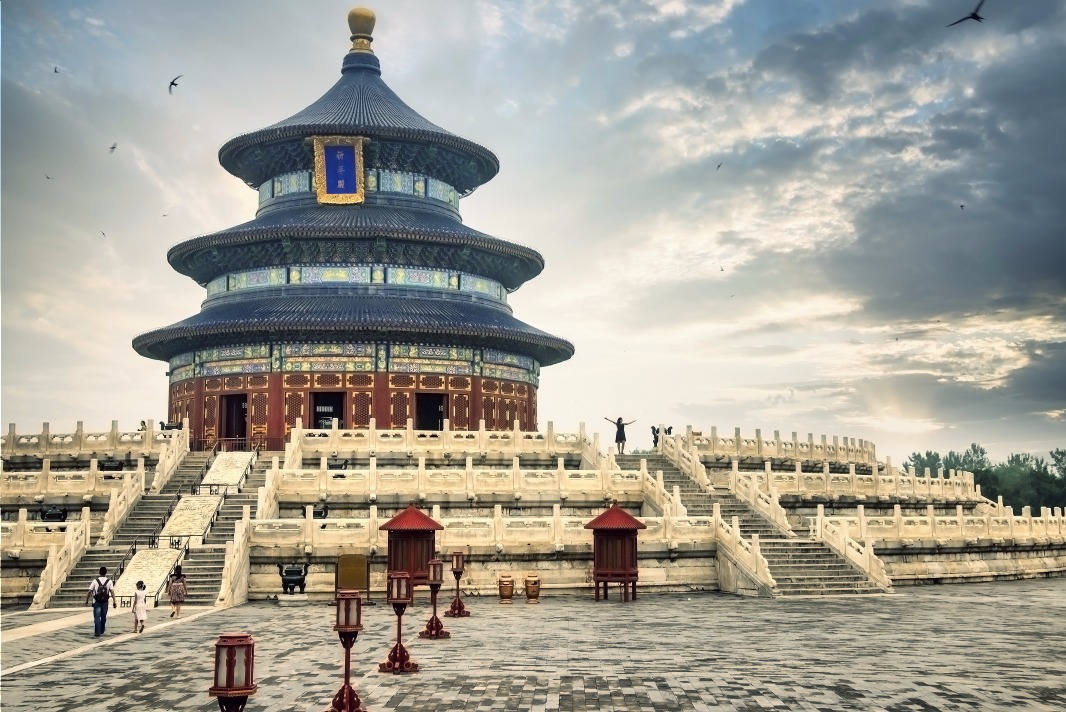
The main nearby visit is the Temple of Heaven, just 1 km from Baigongfang. It makes sense to combine the two in a single half-day: morning at the temple, which is best appreciated early, then the museum in late morning or afternoon.
More broadly, Beijing concentrates most major sites in the region. To extend your stay, you might consider an excursion to the Great Wall at Juyongguan, one of the most accessible sections from the capital. To compare craft and religious traditions across regions, the Great Pagoda of the Wild Goose in Xi'an and the Bezeklik Thousand Buddha Caves in Xinjiang offer instructive counterpoints.
Extend your journey in Chine
Baigongfang naturally fits into a Beijing itinerary devoted to craftsmanship and imperial heritage. To build a customized trip incorporating Beijing and other regions, explore our journeys in Chine.

Nearby
Interested in this visit?
We can include it in your personalised itinerary.