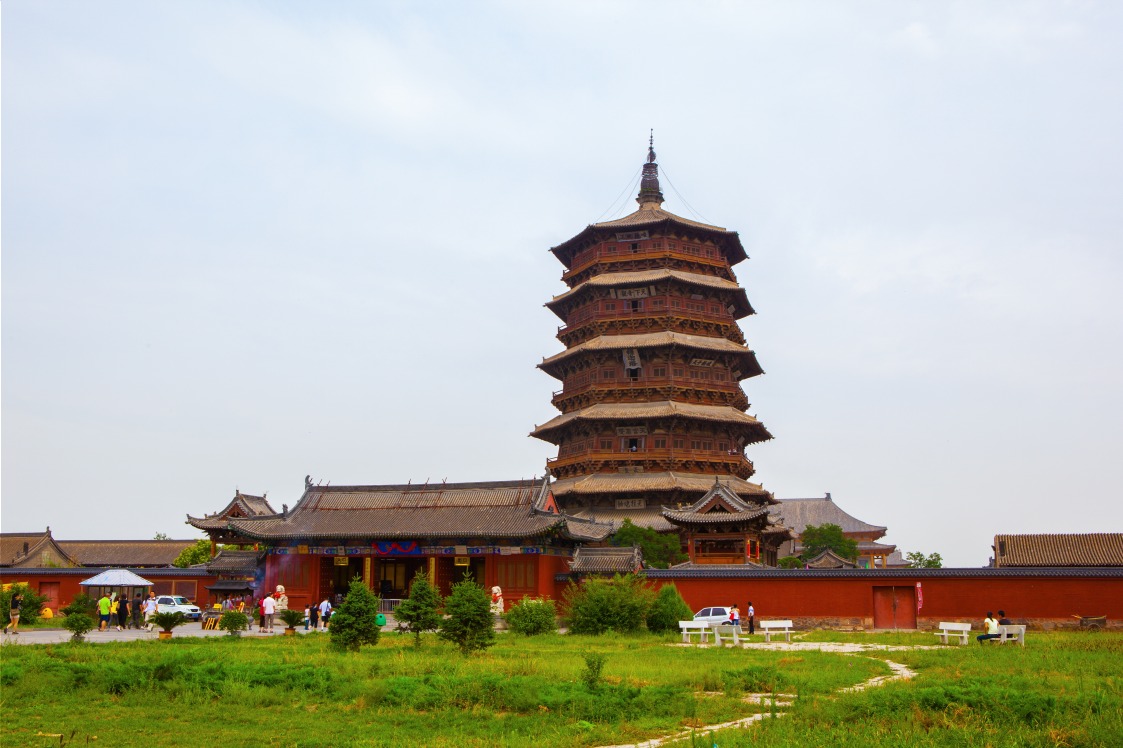
Sakyamuni Pagoda at Fogong Temple
Built in 1056, the Sakyamuni Pagoda of Fogong Temple in Yingxian (Shanxi) is the tallest and oldest entirely wooden pagoda still standing in the world. Its nail-free timber frame, Liao-era frescoes, and colossal Buddha statue make it a unique monument of Buddhist architecture.
Erected in 1056 under the Liao Dynasty, the Sakyamuni Pagoda of Fogong Temple, known locally as Yingxian Muta ("Yingxian Wooden Pagoda"), is the tallest and oldest entirely wooden pagoda still standing in the world. Its nine interior levels—five visible from the outside—rest on an assembled timber frame without a single nail. It stands in Yingxian, Shanxi Province, approximately 70 km south of Datong.
Quick Facts at a Glance
- Admission: Paid entrance (Fogong Temple site ticket)
- Interior Access: Climbing within the pagoda has been restricted or prohibited to visitors for several years for conservation purposes—verify before your visit
- Recommended Duration: 1 to 1.5 hours for the complete site
- Dress Code: Modest attire recommended (active Buddhist place of worship)
- Accessibility: The ground floor of the pagoda and temple courtyard are accessible; upper levels are not
What You'll See
The pagoda rises to approximately 67 meters. Its octagonal silhouette with five tiered roofs, covered in gray tiles, dominates the Shanxi plain. Inside the ground floor stands a colossal statue of Sakyamuni over 11 meters tall, surrounded by remarkably well-preserved Liao-era murals. The wooden framework employs more than 50 different types of dougong bracket assemblies, with no reliance on metal fasteners.
History and Context
Built in 1056 under Liao Emperor Daozong, the pagoda has survived major earthquakes, including several exceeding magnitude 6. Its resilience stems from the flexibility of the wooden structure and the sophistication of the dougong assemblies. Protected as a first-category national monument since 1961, it represents an outstanding achievement in timber engineering and Buddhist architecture.
Highlights of Your Visit
The Dougong Timber Framework
Observe from the courtyard the stacked wooden consoles beneath each roof tier. Each dougong assembly functions as a natural shock absorber. Architects and engineers from around the world come to study this system, nearly a thousand years old.
The Sakyamuni Statue at Ground Level
The gilded figure, seated in lotus position, occupies almost the entire height of the first level. The surrounding frescoes, with pigments still vibrant, depict bodhisattvas and guardians of faith in Liao style.
The Exterior View at Sunrise
Early morning, before tour groups arrive, the pagoda stands against often-clear skies. Low-angle light reveals the grain of the wood and the sculpted details of the roof tiles.
Etiquette and Visit Guidelines
- Fogong Temple is an active Buddhist place of worship: adopt calm and respectful behavior.
- Do not touch sculptures or wooden elements of the structure.
- Check access restrictions to upper levels before your visit: conservation policies evolve regularly.
- Photography is generally permitted outdoors; verify interior rules with staff on-site.
Photography Tips
Position yourself at the southwest corner of the courtyard to frame the entire pagoda with the temple roofs in the foreground. Morning light (before 9 a.m.) is most favorable: it avoids backlighting and harsh shadows. A wide-angle lens is essential to capture the full 67 meters of height from within the courtyard.
Location and Access
Yingxian is located in central Shanxi, approximately 70 km south of Datong. Regular buses connect Datong to Yingxian; the journey takes about an hour. From Datong, taxis and private tour vehicles allow you to combine a visit with other sites in the region. The nearest railway station is Datong, served by high-speed trains from Beijing and Xi'an.
Nearby Attractions
- Yungang Grottoes — In Datong, one of China's largest ensembles of Buddhist rock-cut sculptures, dating from the 5th century.
- Hanging Temple of Xuankong — Clinging to the cliffs of Mount Hengshan, about fifty kilometers from Yingxian, this Taoist-Buddhist-Confucian temple has defied gravity since the 6th century.
- Old Town of Datong — Restored fortifications, historic streets, and city museum to explore in half a day.
Frequently asked questions
Access to upper levels has been restricted for several years to protect the wooden structure. Only the ground floor is generally open. Verify current policy with your agency or the official site before you go.
Spring (April–May) and autumn (September–October) offer pleasant temperatures and favorable light. Summer is hot and can be crowded with school groups; winter is cold but sees fewer visitors.
From Datong, depart early for Yingxian (about 1 hour's drive), visit the pagoda, then return to Datong in the afternoon for the Yungang Grottoes. A private vehicle makes this circuit feasible in one day.
Photography is generally permitted in the courtyard and outdoors. Inside the ground floor, rules may vary: ask staff on-site before taking photos.
Plan for 1 to 1.5 hours to explore the courtyard, examine the timber frame from all angles, and admire the interior statue. Architecture or Buddhism enthusiasts can easily spend 2 hours here.
Local guides are sometimes available at the entrance, primarily in Mandarin. For an English-speaking guided tour, it is preferable to arrange one through your agency before departure.
Interested in this visit?
We can include it in your personalised itinerary.