Temple of the Five Pagodas
Temple of the Five Pagodas
A Tibeto-Mongolian Buddhist monastery in Hohhot, the Wutasi stands out for its 16-meter sculpted pagoda and a rare Mongolian astrological chart.
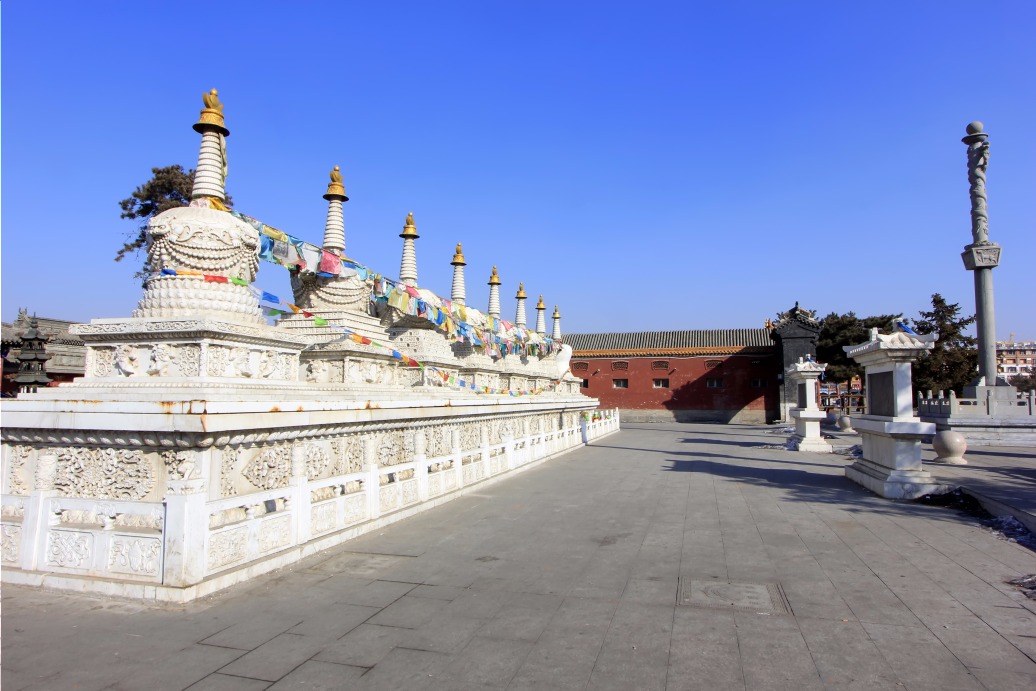
The Temple of the Five Pagodas, also known as Wutasi, is a Tibeto-Mongolian Buddhist monastery situated on the banks of the Changhe River in Hohhot, the capital of Inner Mongolia. The structure is distinguished by its architecture inspired by Indian pagodas, which is rare in northern China, and by the richness of its sculptural decoration.
Why Visit the Temple of the Five Pagodas
This temple presents several distinctive features that justify a detour during a stay in Hohhot:
- A central pagoda standing 16 meters high, entirely covered with sculpted Buddha figurines
- A Mongolian astrological chart engraved on the northern wall, one of the very few preserved in Inner Mongolia
- Decorative heritage blending Sanskrit inscriptions, Mongolian art, and Tibetan art
- A cultural stop that complements a journey toward the surrounding steppes
History of the Temple
The present-day temple was constructed between 1727 and 1732 under the Qing dynasty. It was inspired by the model of the pagoda at Zhenjuesi in Beijing, itself erected in 1473 following the design of Indian pagodas in the shape of a diamond throne.
A local tradition connects the sanctuary's origins to an earlier account: an Indian Buddhist monk named Bandida is said to have presented Emperor Zhu Di (Ming dynasty) with gold Buddha figurines and the sketch of the Jing-Hong Throne. Impressed by his teachings, the emperor reportedly appointed him as a religious leader and had a temple built to preserve these gifts, following the plan brought by the monk. This legend is associated with the spiritual lineage of the place rather than with the physical construction visible today.
Of the five original pagodas, only one still belongs to the initial structure; the others have been renovated over the centuries following deterioration.
What to See On-Site
The complex consists of a massive base, a central body, and four small pagodas crowning the summit. An interior staircase, rather steep, allows access to the upper terrace from which you can overlook the old quarter.
The Sculptural Decoration
The exterior walls are entirely covered with small Buddha figurines in relief. You will also observe:
- Diamond sutras carved into the stone
- Imprints of Buddha's feet
- Stylized lotus petals
- Inscriptions in Sanskrit and Mongolian
The Mongolian Astrological Chart
On the northern wall of the temple, a Mongolian-language astrological chart lists constellations and celestial bodies. It constitutes one of the most studied elements of the site and rare testimony to the astronomical sciences practiced in the region.
Conserved Artworks
The interior houses Buddhist sculptures, paintings with Tibetan and Mongolian influences, as well as relics attributed to the Indian monk Bandida, displayed in niches within the four tall pagodas.
Practical Information
Allow approximately one to one and a half hours to explore the site at a leisurely pace. The temple is open year-round; precise hours and entrance fees (modest) may vary, so it is recommended to check with the local tourism office before your visit. Morning offers the calmest moment to appreciate the sculpted decoration in raking light.
How to Get There
The temple is located in central Hohhot and is easily accessible by public transport:
- Buses 50, 56, or 79, stop Zonggonghui Neimenggu
- Taxi from the train station or city center, short journey
To See in the Region
To extend your discovery of Inner Mongolia and northern China, several sites complement the Wutasi visit well:
- Wudangzhao Lamasery, the largest Gelugpa monastery in Inner Mongolia
- Yungang Caves, a UNESCO-listed Buddhist sculptural complex
- Hengshan, a sacred mountain in Shanxi
FAQ
Frequently asked questions
It is situated on the banks of the Changhe River in Hohhot, the capital of the Inner Mongolia Autonomous Region, in northern China.
None: Wutasi is the Chinese name (wu = five, ta = pagoda, si = temple) of the same Tibeto-Mongolian Buddhist monastery.
Allow one to one and a half hours to observe in detail the exterior figurines, inscriptions, and the Mongolian astrological chart.
Of the five pagodas, only one belongs to the structure built between 1727 and 1732. The others have been restored following several phases of deterioration.
Plan Your Journey
The Temple of the Five Pagodas naturally fits into an itinerary combining Buddhist heritage and vast Inner Mongolian landscapes. To build a customized trip, explore our China travel ideas.
Nearby
Interested in this visit?
We can include it in your personalised itinerary.