Inner Mongolia Museum
Inner Mongolia Museum
In Hohhot, the Inner Mongolia Museum brings together fossils, Xiongnu treasures and collections on the peoples of the steppes, spread across four floors.
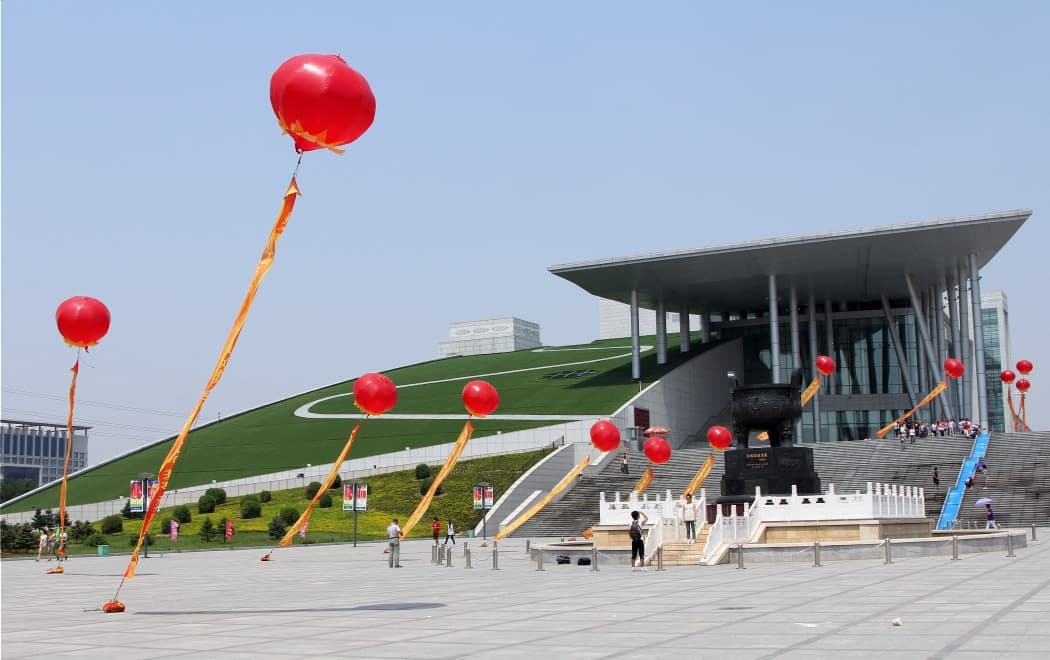
The Inner Mongolia Museum houses the reference collections on the history, archaeology and cultures of the autonomous region in Hohhot. Located in a contemporary building at the intersection of Xinhua Street and Zhongshan Street, it unfolds across four floors with pieces covering prehistory, steppe empires and ethnic minorities in northern Chine.
Why visit this museum
The museum is the most comprehensive entry point for understanding Inner Mongolia before heading to the grasslands, deserts or more remote Mongolian sites. Three key strengths distinguish it:
- A remarkable paleontological collection, dominated by the skeleton of Nuoerosaurus changanensis, considered one of the largest sauropods ever unearthed in Asia.
- Collections on steppe peoples, from the Xiongnu to Mongolian dynasties, through to present-day Evenki, Oroqen and Daur ethnic groups.
- Two national treasures on display: a gold crown linked to the era of a Xiongnu Chanyu, and an ancient ceramic piece 42.7 cm in height.
History and architecture
The museum was founded in 1957, the year of its official opening which coincided with the anniversary of the creation of the Inner Mongolia autonomous region. The original building was crowned with a galloping horse facing north, toward Mongolia. After the upheavals of the 1966 Cultural Revolution, the horse's orientation was reversed toward the south—a political signal meant to symbolically tie Mongolian minorities to the centre of Chinese territory.
Several decades later, a new building was constructed approximately 5 km east of the original museum, with more spacious and decidedly contemporary architecture. The collections were transferred there. The old building was not abandoned, however: since 2014, it has hosted temporary exhibitions, such as one devoted to calligraphy that same year.
The current site spans over 50,000 m². The grassy terraces bordering the building echo the Mongolian grasslands and offer a visual transition between the city and the imagined world of the steppes.
What to see in the collections
The four floors are organised by major themes. Here are the exhibits that most often capture visitors' attention.
Paleontology and fossils
Excavations conducted in Inner Mongolia have yielded numerous dinosaur and Pleistocene mammal fossils. The centrepiece remains the skeleton of Nuoerosaurus changanensis, a Lower Cretaceous sauropod whose size makes it one of the largest ever reconstructed on the Asian continent. Mammoth skeletons complete the prehistoric journey.
Steppe empires
The historical section spans the era of the Xiongnu, Turks, Khitans and Mongols. The gold crown attributed to the era of a Xiongnu Chanyu, classified as a national treasure, illustrates the wealth of nomadic aristocracies. Weapons, harnesses and ritual objects document the lifestyles of these societies.
Arts and ceramics
Among the classified pieces, an ancient ceramic 42.7 cm in height, also a national treasure, testifies to the refinement of ceramic production under the dynasties that controlled the region.
Northern peoples
The final section is devoted to the Evenki, Oroqen and Daur ethnic groups, still present in north-eastern Chine. Costumes, hunting tools and domestic objects restore lifestyles once rooted in reindeer herding, boreal forest hunting or mixed agriculture.
Practical information
- Visit duration: allow 2 to 3 hours to explore the four floors at a leisurely pace.
- Closure day: the museum typically closes one day per week for maintenance (Monday, to be confirmed on-site).
- Admission fees: entrance is free for Chinese public museums, upon presentation of an identity document. Online reservation may be required during peak season.
- Languages: labels are primarily in Chinese and Mongolian, sometimes in English.
Access
The new museum is located east of central Hohhot. Several options are available to visitors:
- Urban bus: multiple lines serve the Xinhua Dajie stop, notably lines 3, 5, 13, 21, 22, 24, 34 and 303.
- Taxi or ride-sharing: the most direct option from the station or central hotels, with short and affordable rides.
- On foot from central districts: possible, but expect a substantial walk depending on your starting point.
What to see nearby
Hohhot makes a useful stopover for exploring Inner Mongolia. Several sites complement this visit well:
- The Hexigten Geopark, further north-east, for the volcanic and lacustrine landscapes of the steppe.
- The Great Wall at Juyongguan, accessible from Beijing, to extend the narrative of Chine's northern frontiers.
- The Bezeklik Thousand Buddha Caves, further west, which document the Buddhist routes of Central Asia.
Frequently asked questions
Frequently asked questions
Like most Chinese public museums, admission is generally free upon presentation of an identity document (passport for foreign visitors). Prior reservation may be required depending on the season.
Allow 2 to 3 hours to explore the four floors. Paleontology or steppe history enthusiasts can spend half a day here.
Labels are primarily in Chinese and Mongolian, with variable English presence. A local guide or translation app greatly facilitates the visit.
The skeleton of Nuoerosaurus changanensis, a sauropod considered one of the largest in Asia, as well as the gold crown from the Xiongnu era, classified as a national treasure.
May through September offers the best conditions, particularly for combining a museum visit with a grassland excursion. Winters are harsh in this northern region.
Extend the experience
The museum finds its full meaning as the opening to a broader itinerary through the steppes, deserts and Buddhist sites in the north of the country. To build a tailor-made trip, consult our suggestions for travel in Chine.
Nearby
Interested in this visit?
We can include it in your personalised itinerary.