Zhaozhou Bridge
Built around 605 AD by engineer Li Chun, Zhaozhou Bridge in Hebei is the world's oldest open-spandrel stone arch bridge still standing, enduring for over fourteen centuries.
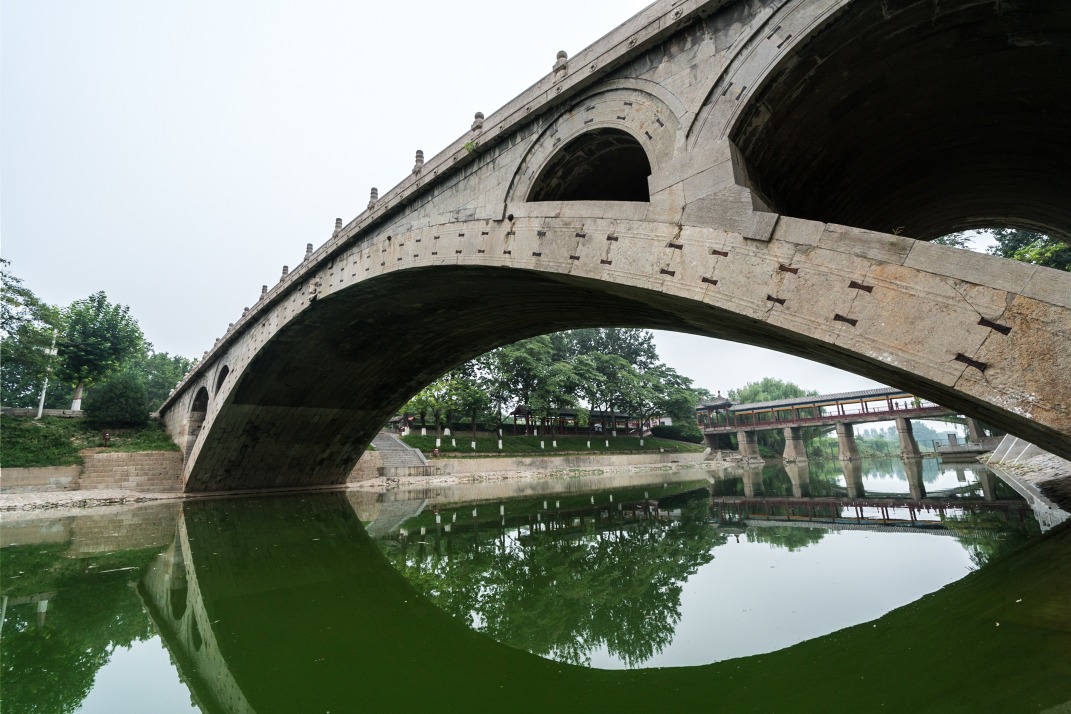
Zhaozhou Bridge, also known as Anji Bridge, spans the Jiao River in Zhao County, Hebei Province. Constructed between 595 and 605 AD during the Sui dynasty, it is the oldest open-spandrel stone arch bridge still standing in the world. Its design, attributed to engineer Li Chun, influenced bridge architecture for fourteen centuries.
Quick facts
- Access: Zhao County (Zhaoxian) is accessible by bus or taxi from Shijiazhuang, the capital of Hebei.
- Recommended duration: 1 to 2 hours for the bridge and surrounding park.
- Dress code: No special requirements.
What to see
The bridge measures approximately 50 meters in length and 9 meters wide. Its main arch, spanning nearly 37 meters, is flanked by two smaller arches on each side—a structural innovation that reduces weight and facilitates flood flow. The stone railings are adorned with dragons and floral motifs, some dating back to the Tang period.
History and context
Li Chun designed the bridge under Emperor Yangdi of the Sui dynasty. The solution of open secondary arches—called open spandrel—would not appear in Europe until the 14th century. The bridge has survived ten major floods, eight earthquakes, and numerous wars. It has been designated a national historical monument of China since 1961 and is listed among UNESCO's heritage sites for civil engineering.
Highlights of your visit
The main arch and secondary arches
Observing the structure from the riverbank reveals the ingenuity of the system: the four secondary arches (two on each side) reduce total mass and distribute lateral loads. No mortar was used; the limestone voussoirs are held in place by geometry alone and iron clamps.
Sculptures on the railings
The sculptured panels depict intertwined dragons, phoenixes, and wave motifs. Some date back to the Tang period (618–907), added during successive restorations. They represent rare testimony to the decorative architectural art of that era.
Adjacent park and museum
An landscaped park surrounds the bridge. A small museum displays scale models, technical drawings, and objects related to the site's history. Explanatory panels are available in Chinese and English.
Photography tips
Morning light, before 9 AM, illuminates the main arch without backlighting. From the riverbank below, you can frame the entire structure with its reflection in the Jiao River. Sculptured railing details photograph best in raking light during late afternoon. No photography restrictions are known on site.
Location and access
The bridge is located in Zhao County (Zhaoxian), approximately 45 km southeast of Shijiazhuang. Regular buses connect Shijiazhuang's main bus station to Zhaoxian. From Zhaoxian town center, the bridge is accessible on foot or by taxi. The site is on flat terrain with no significant elevation change, making it accessible for most people with limited mobility for the exterior areas.
Nearby attractions
- Longxing Si Monastery at Zhengding — one of Hebei's best-preserved Buddhist complexes, north of Shijiazhuang.
- Shijiazhuang — Hebei's provincial capital and logistical gateway for the region.
Frequently asked questions
Spring (April-May) and autumn (September-October) offer pleasant temperatures and favorable light. Summer is hot and humid in Hebei; winter can be cold but the site is less crowded.
The bridge is largely accessible on foot. Some sections may be cordoned off depending on ongoing conservation work; check on site for details.
One to two hours suffice for the bridge, park, and museum. Allow half a day if traveling from Shijiazhuang by public transport.
Yes. The terrain is flat, the park is spacious, and the railing sculptures generally capture children's interest.
Yes. Longxing Si Monastery in Zhengding and Shijiazhuang's center can easily be visited the same day or over a weekend from Beijing, which is accessible by high-speed train.
Interested in this visit?
We can include it in your personalised itinerary.