Everest Base Camp
Everest Base Camp
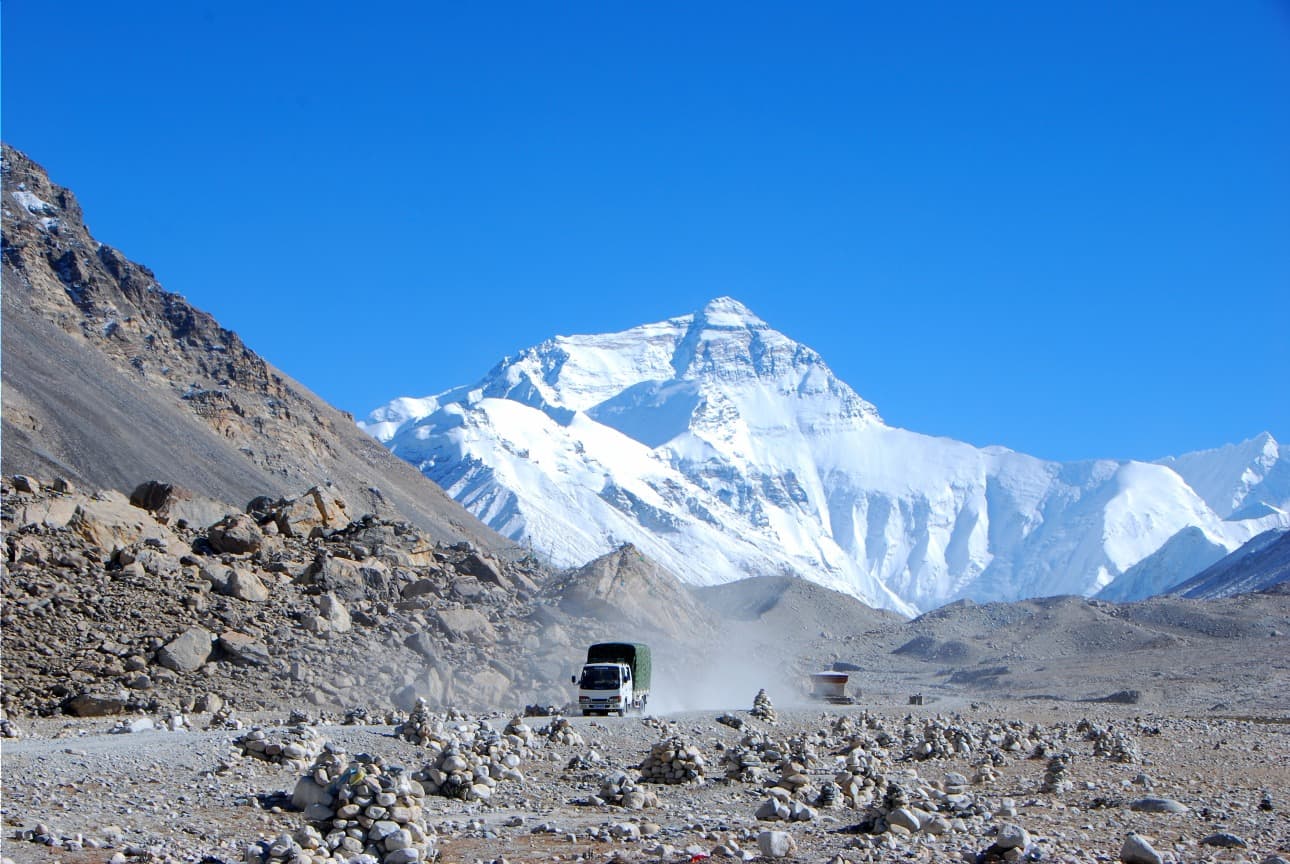
At 5,150 meters altitude in Tibet, the North Base Camp of Everest offers a frontal view of Chomolungma's north face. Accessible by vehicle with required permits, it combines perfectly with Rongbuk Monastery, the world's highest inhabited monastery.
The North Base Camp of Everest, accessible from Tibet, extends at 5,150 meters altitude at the foot of Chomolungma's north slope — the Tibetan name for the roof of the world. From the Rongbuk plain, the mountain's north face unfolds without obstruction, framed by the glacier of the same name. This is where Chinese and international expeditions organize before the ascent. For travelers, it is one of the rare places on Earth where one approaches an 8,849-meter mountain on foot without mountaineering equipment.
Quick Facts
Altitude: 5,150 m (base camp) — acclimatization essential before visiting.
Access: Tibet Travel Permit mandatory, plus a specific permit for the Everest zone (Alien's Travel Permit + Military Area Permit). These documents are obtained through an authorized agency.
Clothing: Warm garments in all seasons; negative temperatures frequent even in summer.
Recommended duration: Half-day on site, but allow 2-3 days travel from Lhassa.
Accessibility: Paved road to the base camp; terrain remains uneven and altitude makes hiking difficult.
Recommended season: April-May (before monsoon) and September-October (after monsoon) for best visibility.
What to See
The central panorama is Everest's north face, visible in its entirety from the base camp. The Rongbuk Glacier, one of the world's highest, descends toward the plain forming seracs and ice towers. Rongbuk Monastery, a few kilometers downstream, is the world's highest inhabited monastery. Tibetan prayer flags dot the path and the camp itself.
History and Context
The north slope was the route of the first British attempts in the 1920s, including Mallory and Irvine's expedition in 1924 — their disappearance remains one of mountaineering's great mysteries. China opened this slope to foreign expeditions from the 1980s onward. Rongbuk Monastery, founded in the early twentieth century, already hosted British mountaineers who sought its blessing before their ascent.
Highlights of Your Visit
The North Face Viewed from the Plain
From the base camp, Everest's summit pyramid stands out clearly, with no spur obscuring the view. The angle differs from the Nepali base camp: more frontal, more mineral. In clear weather, the plume of snow blown by wind at the summit is visible to the naked eye.
Rongbuk Glacier
The glacier descends directly toward the camp. Its seracs and ice pinnacles — called penitents — create a lunar landscape. A short walk from the camp allows you to approach the glacier's terminal tongue.
Rongbuk Monastery
Founded by Lama Ngawang Tenzin Norbu, this Tibetan Buddhist monastery of the Nyingma tradition remains active. Monks reside here. It also offers a remarkable foreground for photographing Everest.
Etiquette and Visiting Rules
Respect ceremonies at Rongbuk Monastery; ask permission before photographing monks.
Do not move or remove stones, prayer flags, or ritual objects.
All trash must be carried out: the zone is subject to strict environmental preservation rules imposed by Chinese authorities.
Circulate clockwise around stupas and prayer wheels.
Photography Tips
Golden sunrise light illuminates the north face directly from the base camp. Position yourself with Rongbuk Monastery in the foreground for a classic composition. In late afternoon, shadows lengthen the glacier's relief. Avoid midday hours when light is flat and clouds often present. A telephoto lens (200 mm and above) allows you to detail the northeast ridge and upper camps.
Location and Access
The North Base Camp lies in Tingri County, Shigatse Prefecture, Tibet Autonomous Region. The route from Lhassa passes through Shigatse and Tingri, approximately 700 km by road. Travel in a 4×4 vehicle with an authorized driver is mandatory for foreigners. No public transport serves the site. The road is paved to the base camp, making it accessible by vehicle, but altitude remains the principal physical obstacle.
Nearby Attractions
Rongbuk Monastery — The world's highest inhabited monastery, a few kilometers downstream from the camp.
Shigatse — Tibet's second city, seat of the Panchen Lama and Tashilhunpo Monastery, an essential stop on the route.
Lhassa — Capital of Tibet Autonomous Region, logistics starting point for any Everest expedition.
Gyatso La Pass — Pass over 5,000 m on the Tingri route, with panoramic views of Himalayan peaks.
Frequently Asked Questions
Frequently asked questions
April-May and September-October offer the best conditions: clear skies, milder temperatures. The monsoon (June-August) brings clouds and rain that often obscure the summit. Winter is possible but temperatures drop very low and some roads may close.
Three documents are required: the Tibet Travel Permit (mandatory for all Tibet), the Alien's Travel Permit for zones outside Lhassa, and the Military Area Permit for the Everest border zone. All are obtained through an English-speaking travel agency in Tibet — it is impossible to obtain them independently.
Yes. At 5,150 m, acute mountain sickness is a real risk. It is strongly recommended to spend at least two nights in Lhassa (3,650 m) and one night in Shigatse or Tingri before ascending. In case of severe headaches, nausea, or confusion, you must descend immediately.
Basic tent guesthouses are available at the base camp, run by local Tibetan operators. Rongbuk Monastery also offers very simple accommodation. Conditions are basic: bring a warm sleeping bag and appropriate clothing.
Yes. The North Base Camp is accessible to any traveler in good health and properly acclimatized, without mountaineering equipment. The vehicle road reaches the camp directly. A short walk on flat terrain allows you to approach the glacier.
The two camps are on opposite slopes and in different countries. There is no direct passage between them for tourists. Combining both requires two separate trips — Tibet via China, and Nepal via Kathmandu — with separate visas and permits.
Want to discover this destination?
Our local advisors design your tailor-made trip.