Detian Waterfalls
Detian Waterfalls
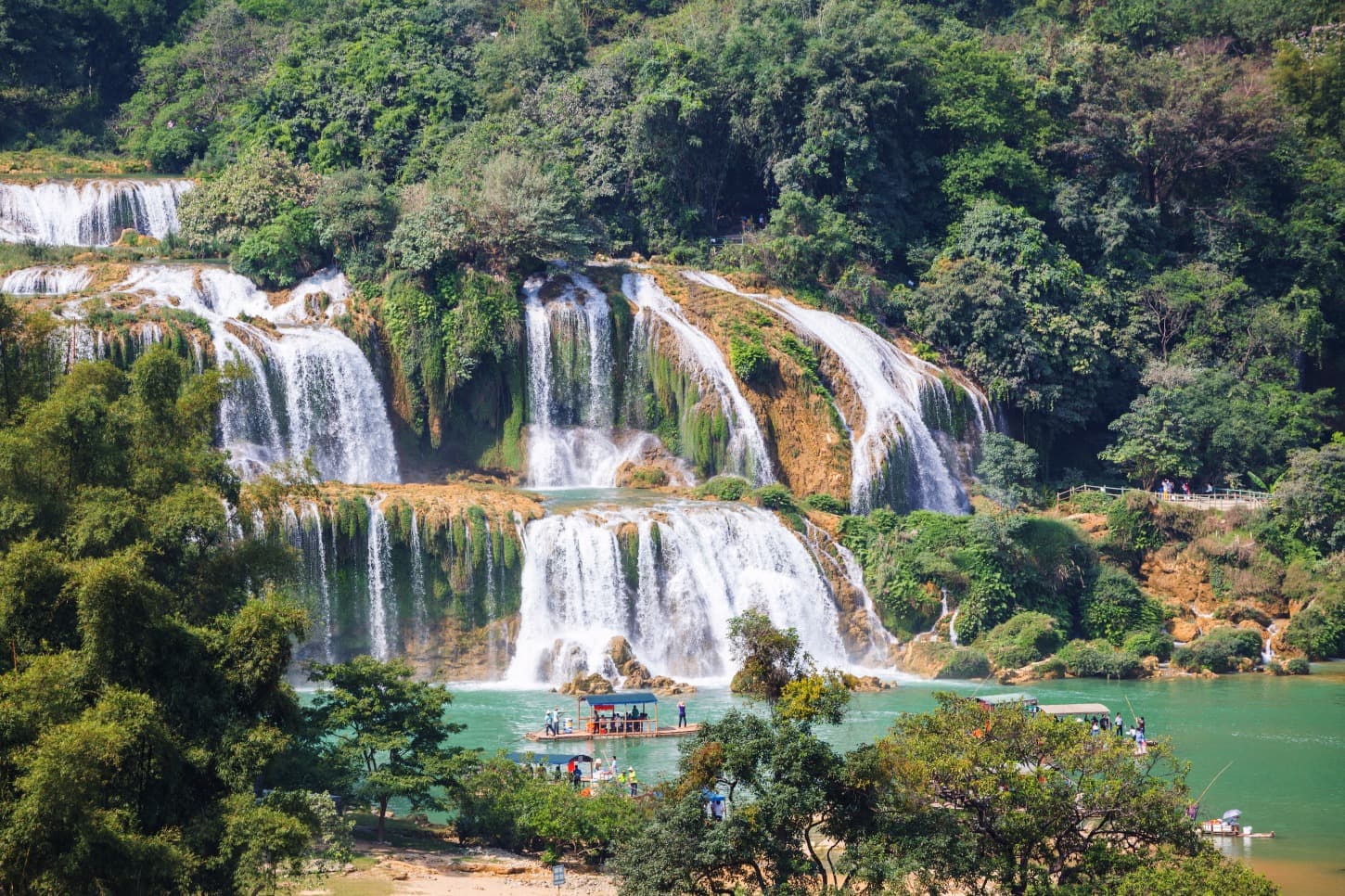
Straddling Chine and Vietnam, the Detian Waterfalls reveal 6 cascades tiered over 70 meters high, set amid the karst landscapes of Guangxi.
The Detian Waterfalls, nicknamed the "Sino-Vietnamese Friendship Falls," extend across the border between Chine and Vietnam, south of Guangxi province, approximately 210 km from Nanning. Known as Ban Gioc on the Vietnamese side, they form one of the world's largest transnational waterfalls, mentioned alongside Iguazu, Victoria, and Niagara.
Why visit the Detian Waterfalls
The site's appeal rests on three rarely combined elements. First, singular geography: the falls mark the international border between two countries, and from the Chine shore one observes Vietnamese villages opposite. Second, a karst landscape typical of southern Chine, with limestone peaks, rice paddies, and enclosed valleys. Finally, a cultural dimension: the Sino-Vietnamese riverside population shares the language and customs of both sides of the Guichun, evident in an annual community fair blending both traditions.
History and geology
The waterfalls formed along an ancient geological fault. The deepest part of the system dates to the Cambrian period (approximately 540 million years ago), placing the formation among the region's oldest hydrological structures.
Diplomatically, the falls long constituted a poorly defined border zone. The treaty signed in 1999 between the Socialist Republic of Vietnam and the People's Republic of Chine established Detian as an official landmark, accompanied by thousands of additional markers placed along the entire land border. This convention stabilized the site's status and enabled its gradual opening to tourism on the Chine side.
What to see on-site
The waterfalls form on the Guichun River (Quây Sơn in Vietnamese), which originates in Guangxi, crosses Vietnamese plateaus, then returns to Chine. The structure comprises:
- 3 tiered basin levels and 6 interconnected cascades;
- a main fall of approximately 70 meters in height;
- a natural pool 200 meters long at the base, where water accumulates.
Bamboo boats allow you to approach the base of the falls from the shore. Many are piloted by local boatmen who know the best viewing angles and the boundary not to cross on the Vietnamese side. Around them, the landscape combines karst peaks, terraced rice paddies, and forested hillsides characteristic of rural Guangxi.
The riverside population, Sino-Vietnamese, has historically lived from the river and, more recently, from tourism. The annual community fair is an opportunity to witness cultural blending: products, language, gastronomy, and music from both countries intersect there.
When to visit
The waterfall's flow varies dramatically by season, radically changing the experience.
- Rainy season (summer): peak flow, spectacular falls but often obscured by thick mist that reduces visibility.
- Autumn: moderate flow, clear skies, golden hues of harvested rice paddies — generally the most photogenic period.
- Spring: increasing flow, blooming vegetation on the banks, mist rarer than in summer.
- Winter: weak flow, less impressive falls but clear light.
For a balance between waterfall power and landscape visibility, autumn and late spring are the recommended periods.
Practical information
The site is equipped with trails, viewpoints, and landing docks. Plan on average half a day to a full day of visiting if you include a boat ride and upper viewpoints. An entrance ticket is required (moderate fee, reduced for children, free for very young ones); conditions change regularly, so check with your Nanning accommodation or agency before departure.
Bring closed-toe shoes (wet trails), a light windbreaker for spray, and your passport: as the zone is a border area, occasional identity checks are possible.
How to get there
Detian is reached mainly from Nanning, capital of Guangxi. Long-distance buses depart daily from the Langdong bus station toward Daxin, the usual transit point for reaching the site by shuttle or local taxi. Total travel time is approximately 3 to 4 hours depending on connections.
A more comfortable option is to book a private transfer from Nanning, allowing you to leave early morning and avoid bus station waits. Local agencies and Nanning hotels also organize day trips including transport and entrance.
Nearby
If you extend your exploration of Guangxi and southern Chine, several sites complement the visit well:
- Nanning, a logical base for exploring Detian and discovering southwestern Chine cuisine;
- the Baigongfang Crafts Museum, for an overview of traditional craftsmanship;
- the Beishan Temple, a cultural stop to integrate into a broader itinerary;
- the Bell and Drum Towers, to understand historical Chine urbanism.
Frequently asked questions
Include Detian in your journey
The Detian Waterfalls fit naturally into a southern Chine itinerary, complementing Nanning, rural Guangxi, or a loop toward Vietnam. To build a bespoke trip incorporating this border site, consult our Chine travel suggestions.
Interested in this visit?
We can include it in your personalised itinerary.