Leshan Grand Buddha
Leshan Grand Buddha
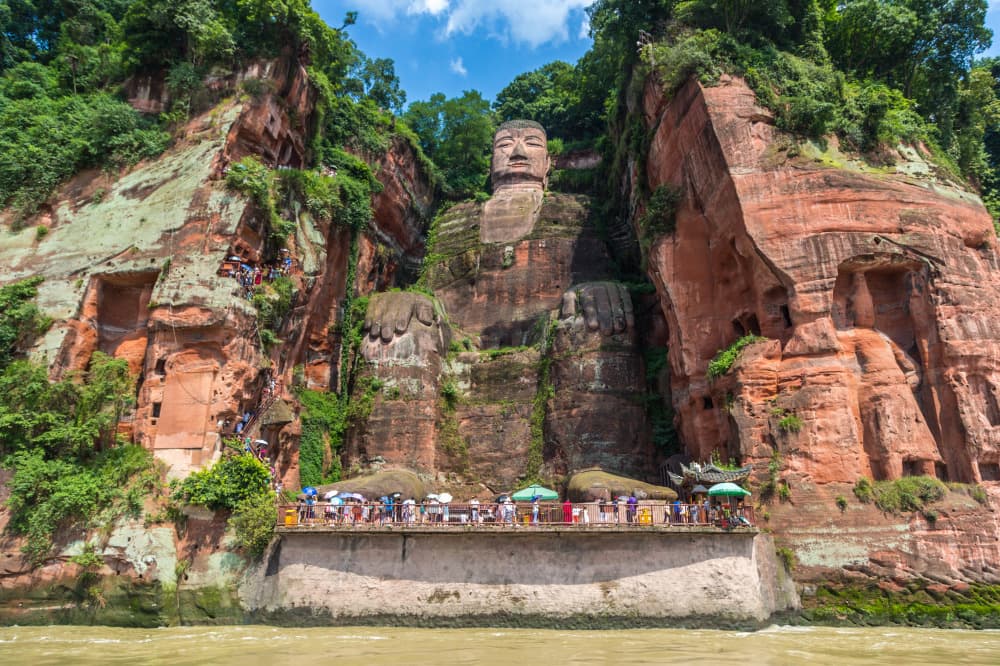
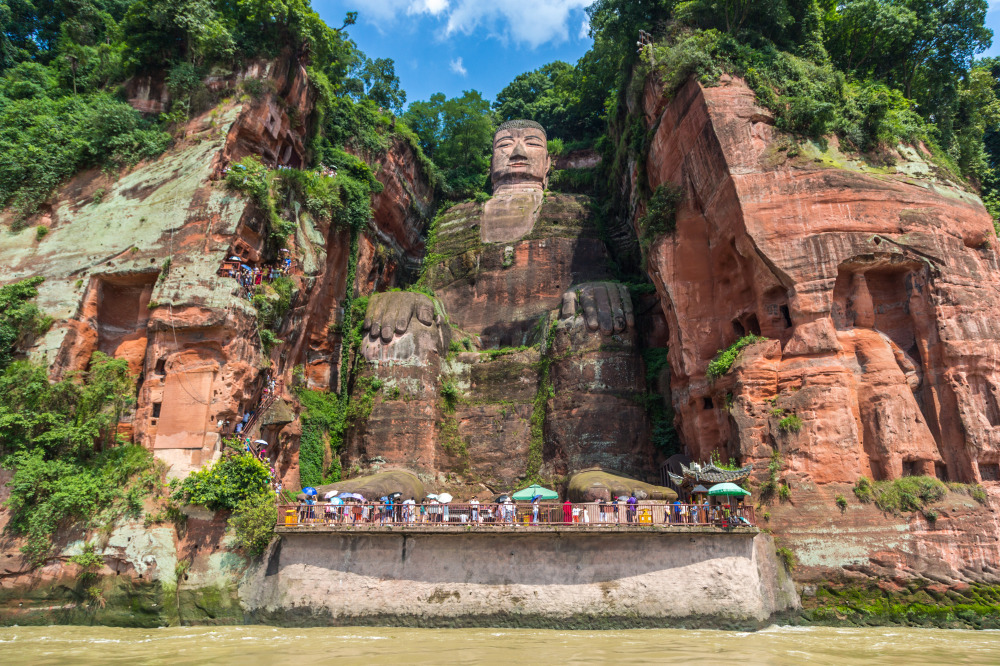
The world's largest rock-carved Buddhist statue, the Leshan Grand Buddha has dominated the confluence of the Dadu and Min rivers since 803. A UNESCO site in Sichuan.
Carved into the cliff face of Mount Lingyun, above the confluence of the Dadu and Min rivers, the Leshan Grand Buddha is the world's largest rock-carved Buddhist statue. Inscribed as a UNESCO World Heritage Site in 1996, it dominates the city of Leshan, in southern Chine, and embodies more than a century of human effort in service of an ambition both religious and hydraulic.
Why Visit the Leshan Grand Buddha
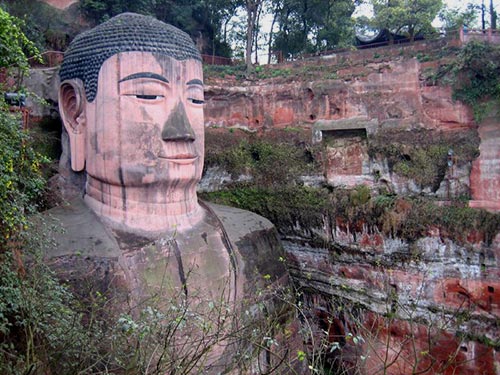

Standing 71 meters tall, the Grand Buddha commands an extraordinary scale for a statue carved directly from the cliff face. The visit offers multiple points of interest:
- An engineering marvel of the 8th century, incorporating a drainage system still functional today.
- A UNESCO-listed site since 1996, recognised for both its natural qualities (Mount Lingyun) and cultural significance.
- A privileged vantage point over the confluence of the Dadu and Min rivers.
- A boat approach that allows you to view the statue in its entirety, from the tips of the feet to the crown of the head.
History: 90 Years of Construction and One Determined Monk
Construction began in 713 at the initiative of Haitong, a Buddhist monk convinced that the presence of the Buddha would calm the tumultuous waters at the confluence, where many vessels were wrecked. The idea was not purely spiritual: the rock blocks carved and thrown into the river over the course of the project gradually filled the dangerous depths and reduced the violence of the currents.
Haitong died before witnessing his work's completion—the project had then reached the Buddha's shoulders. Work halted, then resumed with support from local government. It was completed in 803, ninety years after it began. The people of Leshan are quick to note that the river has since become safer—an effect attributed equally to the works themselves and to the Buddha's own protection.
What to See on Site
The Statue and Its Dimensions
The Grand Buddha represents Maitreya, the Bodhisattva of the future, seated facing the river with hands resting on the knees. A few figures give a sense of the work's scale:
- 71 meters in height, 24 meters across the shoulders.
- Head: 14.7 meters long, 10 meters wide, topped with 1,021 curls representing the hair.
- Eyebrows over 5 meters long.
- Foot arch 8.5 meters deep: it is said that a hundred people could sit on it.
Local guides enjoy conveying these dimensions with vivid comparisons: according to local saying, a basketball court could fit on the shoulders, and a dining table on a single toenail. Take these as evocative ways of grasping the monument's scale.
The Drainage System
A network of channels, gutters, and cavities is integrated into the statue from its inception. Concealed within the curls, behind the ears, and along the folds of the robes, it channels rainwater away and limits erosion. It is largely thanks to this system that the statue has survived to the present day in a condition approaching its original state.
The Surroundings and Lingbao Pagoda
The Buddha is surrounded by guardian figures carved to approximately 8 meters in height. Staircases cut into the cliff on both sides allow descent to the feet and ascent to the summit. At the top are several pavilions and the Lingbao Pagoda, which overlooks the site.
Practical Information
- Duration: allow 2 to 3 hours for a complete visit (descent, ascent, surroundings).
- Entrance Fee: paid entry, at a moderate level for a UNESCO site. Verify the current rate before your visit.
- Hours: open daily during daylight hours. Aim to arrive early morning to avoid crowds.
- Tip: the staircases are narrow and can be slippery. Wear sturdy shoes and avoid visiting on days of heavy rain.
When to Visit
Sichuan enjoys a humid subtropical climate. The best periods to visit Leshan are spring (March to May) and autumn (September to November), with mild temperatures and more bearable humidity. Summer is hot and stormy, while winter is mild but often misty.
Crowds peak during China's national holidays (May 1st, the Golden Week in early October, and Chinese New Year). To enjoy the site under better conditions, avoid these periods or plan to arrive at opening time.
How to Get There
Two approaches are possible from central Leshan:
- By boat: the recommended option for an initial comprehensive view. Vessels cruise along the cliff face and pause directly opposite the Buddha, allowing time to observe and photograph it.
- By tour bus: shuttle services run from Leshan to the site entrance. This option allows you to then walk through the grounds and use the staircases to view the statue up close.
The ideal approach is to combine both: boat for the frontal view, then ground access for the details.
Nearby Attractions
The Grand Buddha sits within a Sichuan region rich in natural and cultural sites. A few stops worth considering:
- Leshan: the city itself, its markets and temples.
- Bifengxia Panda Base: a wildlife protection centre accessible from Sichuan.
- Cangshan: a mountain range with contrasting landscapes, ideal for hiking.
- Gyantsé Dzong: a Tibetan fortress, to extend your journey westward.
Frequently Asked Questions
Frequently asked questions
Allow 2 to 3 hours for a complete visit including descent by staircase, ascent, and the pavilions at the summit. If you add a boat approach, plan for a half-day.
Both approaches are complementary. The boat offers the only frontal and complete view of the statue. The on-foot visit allows you to appreciate the details, descend to the feet, and climb to the Lingbao Pagoda.
Access to the Buddha's feet involves narrow staircases carved into the cliff, unsuitable for people with reduced mobility. The boat visit remains the best option to enjoy the site without physical exertion.
Spring (March–May) and autumn (September–November) offer the most pleasant conditions. Avoid China's national holidays, when crowds are very heavy.
The site has been inscribed since 1996 as a mixed (natural and cultural) World Heritage Site for the exceptional value of the statue, its landscape integration on Mount Lingyun, and the quality of its preservation, particularly thanks to its original drainage system.
Planning Your Trip
The Leshan Grand Buddha combines well with a stop at the nearby Mount Emei, one of the four sacred Buddhist mountains of Chine. To incorporate this site into a broader itinerary, consult our suggestions for travel in Chine.
Photos
Interested in this visit?
We can include it in your personalised itinerary.