Dazu Grottoes and Rock Carvings
Dazu Grottoes and Rock Carvings
Listed as UNESCO World Heritage since 1999, the Dazu grottoes house more than 50,000 Buddhist sculptures carved into rock between the 7th and 13th centuries, 100 km from Chongqing.
Inscribed on the UNESCO World Heritage list in 1999, the Dazu grottoes and rock carvings comprise more than 50,000 Buddhist statues carved into stone between the 7th and 13th centuries. Spread across five mountains in Dazu District, roughly 100 kilometres north-west of Chongqing, they form one of China's best-preserved ensembles of religious art, blending Buddhist, Taoist, and Confucian influences.
Why visit Dazu?
The site stands out for three characteristics that make the journey from Chongqing worthwhile:
- Exceptional scale: 75 protected sites, more than 50,000 sculptures and inscriptions, spanning nearly six centuries of artistic activity.
- Unique religious syncretism: Dazu is one of the rare places in the world where Buddhist, Taoist, and Confucian sculptures coexist on the same rock faces, testament to the spiritual fusion characteristic of medieval China.
- Remarkable state of preservation: original pigments still visible on certain works, fine details preserved, carefully maintained by Chinese authorities.
Unlike the better-known Mogao or Longmen grottoes, Dazu attracts fewer international visitors, allowing for a more leisurely experience.
History of the site
The earliest rock carvings at Dazu date back to the beginning of the Tang dynasty, around 650. Activity truly gained momentum in the late 9th century: in 892, Wei Junjing, prefect of Changzhou, pioneered large-scale carvings at Beishan, commissioning the first major Buddhist compositions.
After a pause at the start of the Song dynasty, activity resumed in 1078, under Emperor Yuan Feng, continuing at Beishan and neighbouring mountains. The site reached its peak between 1174 and 1252, when the monk Zhao Zhifeng oversaw the monumental Baodingshan project, bringing master craftsmen from across the country to create a major ritual site dedicated to Buddhism.
Wars at the end of the 13th century interrupted the work. Activity resumed tentatively under the Ming dynasty, then gradually ceased. Today, the ensemble constitutes a major artistic and historical heritage, studied as a pinnacle of Chinese rock sculpture.
What to see at Dazu: the five mountains
The 75 protected sites are distributed across five mountains. Two of them concentrate most of the tourist appeal: Baodingshan and Beishan.
Baodingshan, the essential mountain
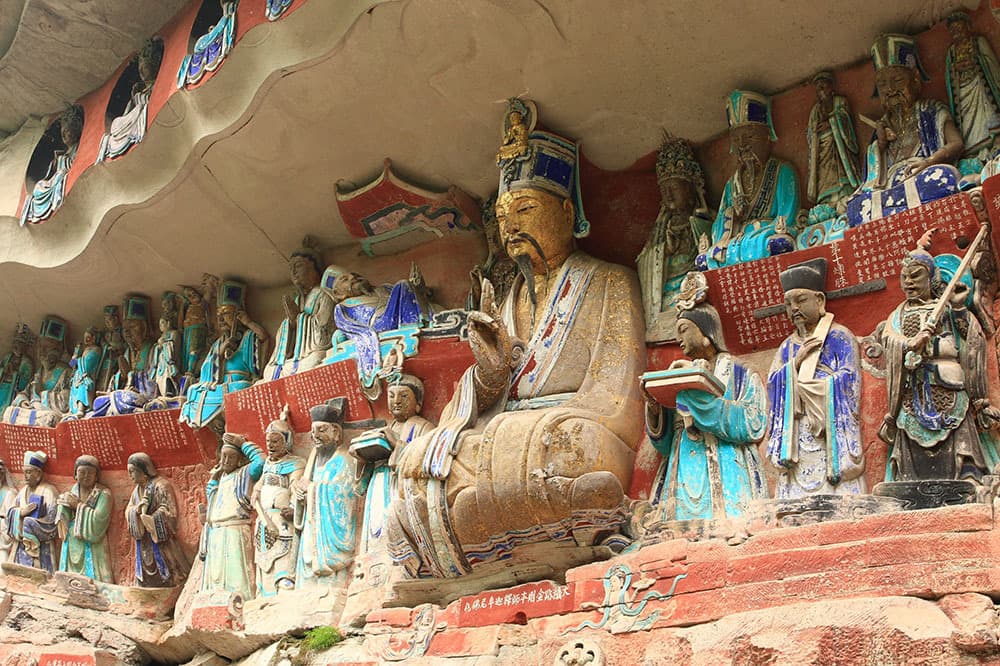
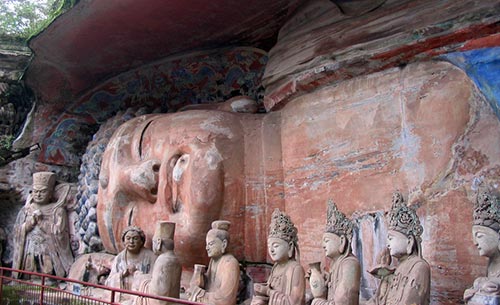
This is the most visited and spectacular site. Designed as a coherent ritual path by monk Zhao Zhifeng, it unfolds in an arc along a cliff face. Notable features include:
- The great reclining Buddha, surrounded by his disciples, carved directly into the rock face.
- The Three Worthies of Huayan, 7-metre-high statues representing Vairocana and two bodhisattvas.
- Vast narrative scenes illustrating the wheel of life, filial piety, and Buddhist hells.
Beishan, the site's birthplace
The first carved cliff, Beishan houses more than 10,000 carvings, predominantly dedicated to Tantric Buddhism. The niches, more modest in size than at Baodingshan, strike visitors with their fine execution and iconographic diversity.
Nanshan, Shizhuanshan and Shimenshan
- Nanshan: 12th-century sculptures, primarily devoted to Taoist themes.
- Shizhuanshan: late 11th-century carvings illustrating Buddhist, Taoist, and Confucian rituals – a rare example of syncretism in sculpture.
- Shimenshan: works from the first half of the 12th century, blending Buddhist and Taoist scenes.
These three sites receive fewer visitors and offer an interesting supplement for those with more time.
Practical information
- Duration: allow half a day for Baodingshan alone, a full day to combine Baodingshan and Beishan.
- Tickets: several options available, individual by mountain or combined. Prices vary between high season (March to November) and low season (December to February), with a gap of around 25%. Check conditions at the entrance.
- Opening hours: open during daylight hours year-round; last admission mid-afternoon.
- What to bring: comfortable shoes (pathways involve stairs and forest trails), water, sun protection or rain gear depending on season.
When to visit Dazu?
Chongqing's climate is subtropical and humid, with very hot, stifling summers (July-August often above 35°C) and mild but misty winters.
- Spring (March-May) and autumn (September-November): most pleasant periods, with mild temperatures and favourable light for photography.
- Winter (December-February): reduced prices, fewer visitors, but often overcast skies.
- Summer: possible but challenging due to heat and humidity.
Avoid Chinese public holidays (Lunar New Year, National Day in early October), when visitor numbers surge.
How to get there?
Dazu is approximately 100 km north-west of Chongqing, near the Sichuan border. Several options:
- By bus: from Chongqing's bus station, buses reach Dazu in roughly two hours. Upon arrival, a tuk-tuk or local bus takes you to the entrance of Baodingshan or Beishan.
- By train: Dazu South railway station is served by express trains from Chongqing (approximately 1 hour).
- By organized tour: the easiest solution for a day excursion, with transport and English-speaking guide included.
To combine with your stay
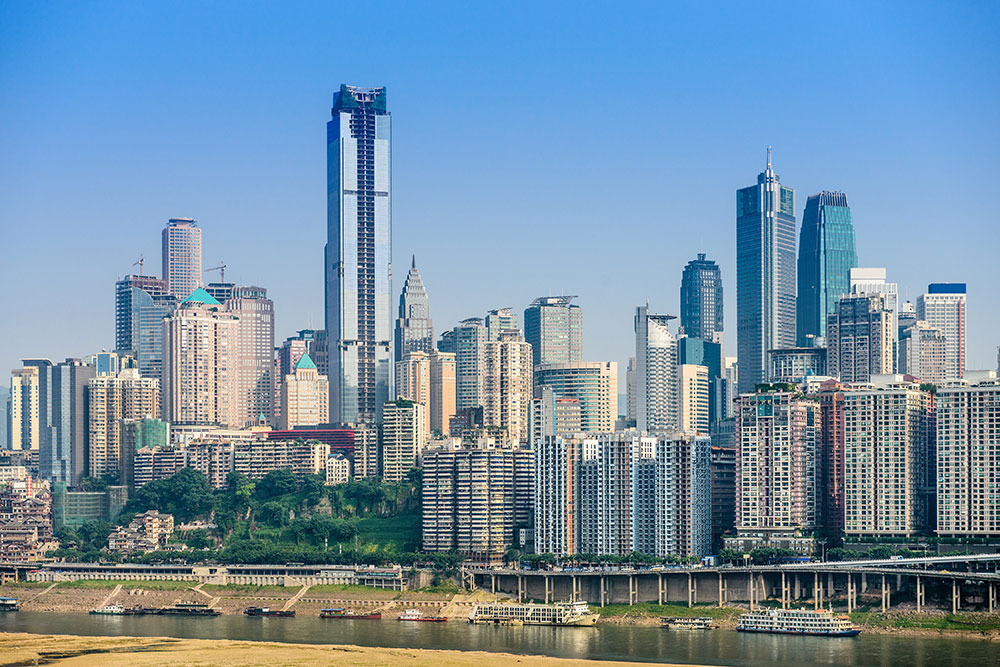
A visit to Dazu integrates naturally into a stay in Chongqing, a south-west metropolis whose fiery gastronomy and urban landscapes merit at least two days. From Chongqing, you can also reach the Yangtze River Three Gorges cruises, or venture further into neighbouring Sichuan.
For other major Buddhist art sites in China, consider the Great Wild Goose Pagoda in Xi'an or Longgong Grotto.
Frequently asked questions
Frequently asked questions
Half a day suffices for Baodingshan alone, the most emblematic site. Allow a full day if you wish to add Beishan, and two days to also explore Nanshan, Shizhuanshan, and Shimenshan.
Baodingshan, without hesitation. The great reclining Buddha, the Three Worthies of Huayan, and the narrative scenes make it the most impressive and comprehensive site in the complex.
Yes. With roughly two hours by bus or one hour by express train, a day excursion from Chongqing is entirely feasible.
Signage is primarily in Chinese and English. To fully appreciate the iconographic and historical richness of the sculptures, an English-speaking guide or audio guide is highly recommended.
Spring and autumn offer the most pleasant conditions. Winter allows you to benefit from reduced rates and fewer crowds, at the cost of often overcast skies.
Include Dazu in your China trip
The Dazu rock carvings fit naturally into an itinerary combining Chongqing, Sichuan, and major Buddhist sites in central China. Our specialist advisors can arrange this stop with an English-speaking guide and private transport. Discover our bespoke China travel ideas.
Images restored from source website — reposition manually if necessary.
Photos
Interested in this visit?
We can include it in your personalised itinerary.