Maiji Shan Grottoes
Maiji Shan Grottoes
Maiji Shan shelters over 7,700 Buddhist sculptures carved into a Gansu cliff face over 1,600 years of history. A UNESCO World Heritage site less famous than Dunhuang, yet exceptionally rich in sculptural and pictorial heritage, located 45 km from Tianshui.
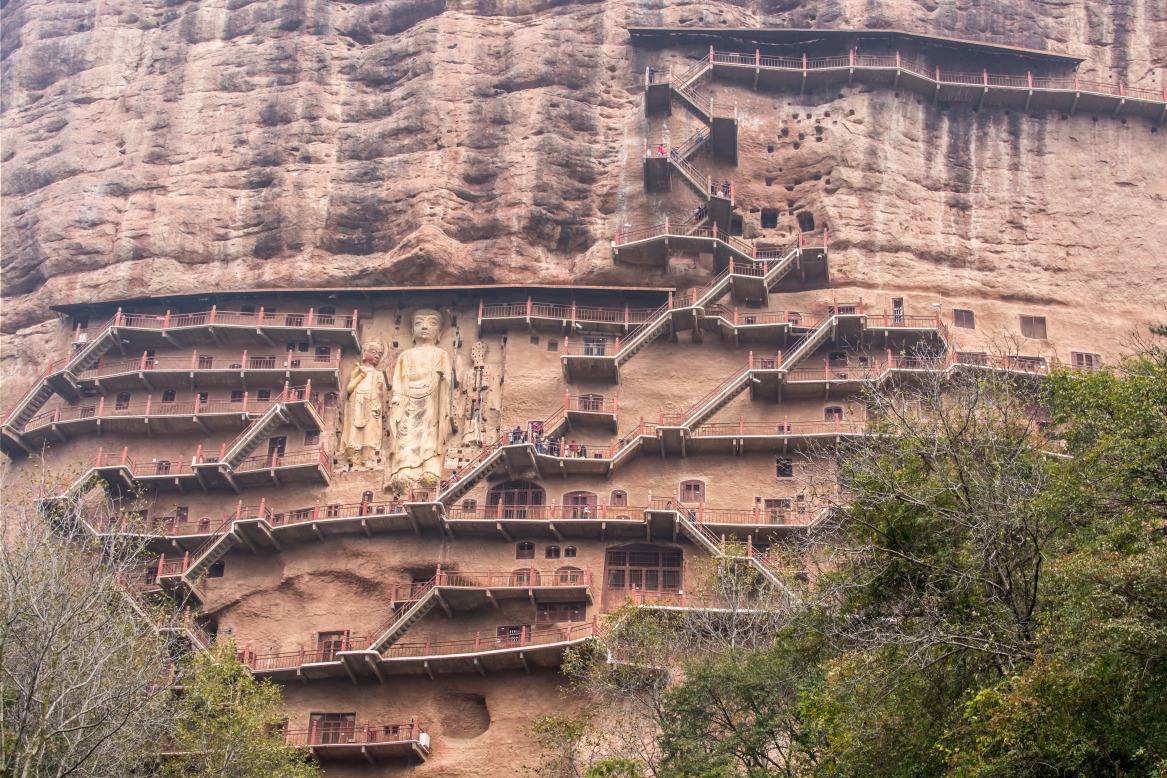
Maiji Shan — literally "haystack mountain" — is an isolated rocky massif in the mountains of Gansu, some forty kilometres southeast of Tianshui. Its cliffs harbour over 7,700 Buddhist sculptures and roughly 1,300 m² of frescoes scattered across 194 grottoes carved over more than 1,600 years. It is one of the four major Buddhist grotto complexes in Chine, less visited than Dunhuang, yet remarkable for its sculptural density.
Essential Practical Information
- Admission : paid entry (site ticket plus supplementary fee for certain grottoes closed to general public)
- Recommended duration : 3 to 4 hours to explore the walkways and accessible grottoes
- Dress code : closed-toe shoes with non-slip soles strongly recommended — the elevated metal walkways can be slippery
- Access : bus from Tianshui coach station or taxi; the road winds through a pine forest before reaching the site
- Accessibility for reduced mobility : severely limited — the suspended walkways clinging to the cliff face are unsuitable for wheelchairs
What to See
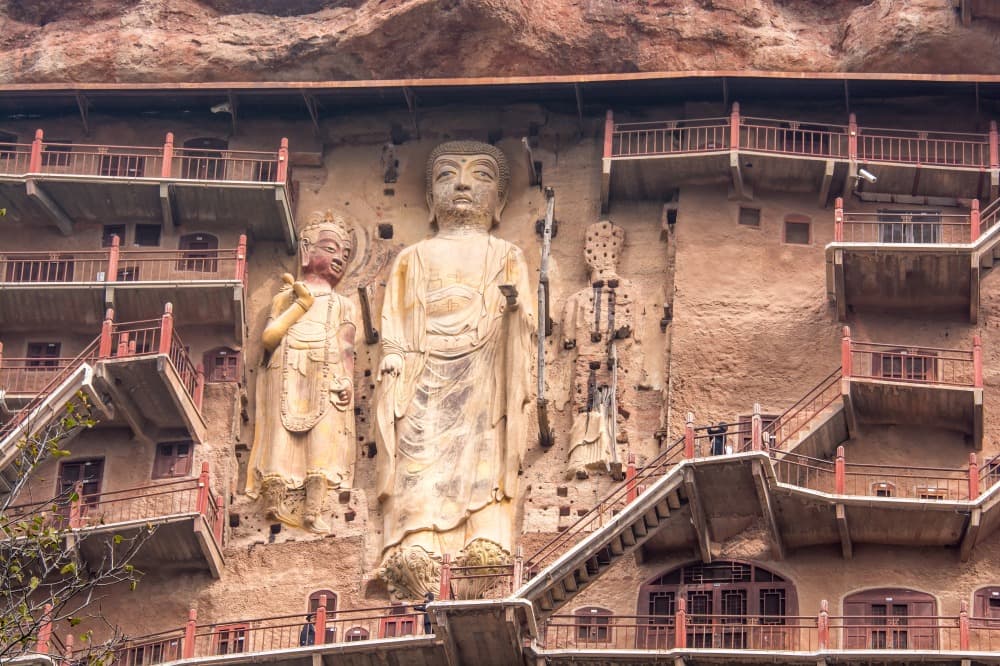
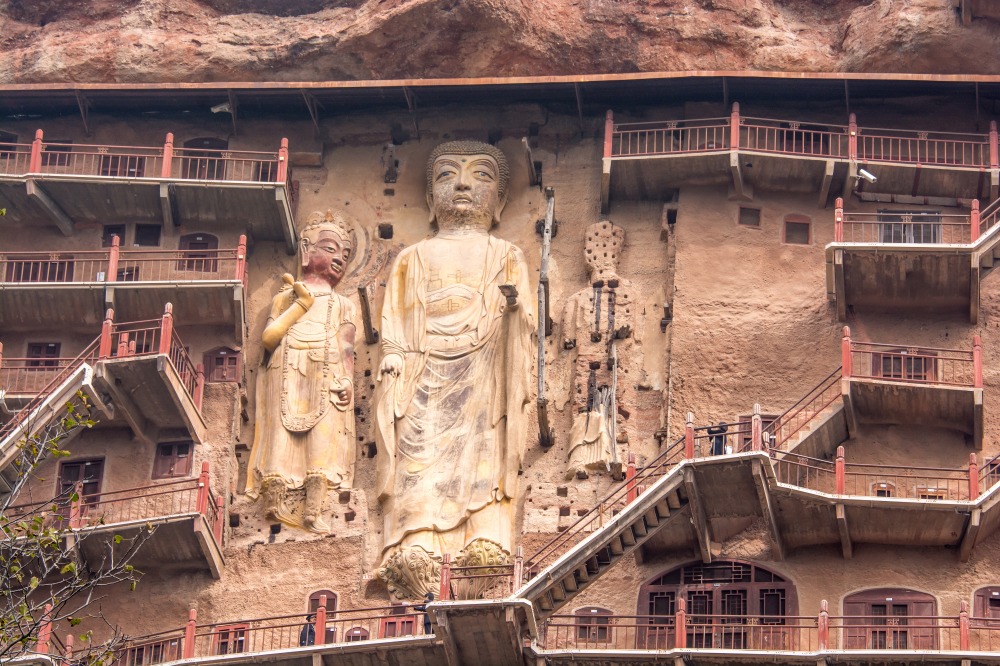
The grottoes are stacked across the vertical cliff face, connected by a network of wooden and metal walkways anchored to the rock. The sculptures range from small painted clay reliefs to colossal Buddhas spanning dozens of metres. The styles evolve noticeably from one grotto to the next, reflecting the successive dynasties that financed the work.
Two massive seated Buddhas dominate the eastern façade. The frescoes, better preserved than at other sites exposed to desert winds, display ochre, red, and blue hues still visible today. Certain grottoes remain closed to the public for conservation reasons; special access can be arranged for researchers.
History and Context
The earliest grottoes date to the period of the Sixteen Kingdoms (4th century), influenced by the trade routes crossing the Gansu corridor. The Northern Wei, Sui, Tang, Song, and Ming dynasties each left their stylistic mark. A major earthquake in the 8th century destroyed the great central walkway, dividing the site into two distinct sections — east and west — still visible today.
Maiji Shan has been inscribed as a UNESCO World Heritage site since 2014, as part of the "Silk Roads: the Chang'an-Tian Shan trade route network".
Highlights of the Visit
The two colossal Buddhas of the eastern façade
Carved directly into the cliff face, these two seated figures measure approximately 15 and 16 metres respectively. Their Northern Wei style — elongated faces, delicate drapery — contrasts with the more robust Tang sculptures visible elsewhere in the complex.
The Song and Ming grottoes
The grottoes from the Song and Ming dynasties contain some of the best-preserved frescoes. Narrative scenes illustrate jatakas (tales of the Buddha's previous lives) in colours still vibrant today.
The suspended walkways
The route itself is an experience: metal walkways zigzag along the cliff face, offering vertiginous views over the forest and close-up angles of high sculptures. The ascent can be dizzying.
The surrounding forest
The site is surrounded by dense forest of pines and cypresses. The vegetation creates a humid microclimate that has aided the preservation of painted clay, unlike the desert sites of Xinjiang.
Etiquette and Visit Rules
- Do not touch the sculptures or painted walls.
- Photography is permitted in most open grottoes, but flash is prohibited.
- Respect barriers and do not venture beyond marked walkways.
- The site remains an active place of worship for some Buddhist visitors: maintain discrete behaviour.
Photography Tips
Morning light illuminates the eastern façade, where the colossal Buddhas are located. In late afternoon, the western façade receives raking light that brings out relief. A wide-angle lens is useful in narrow grottoes. Since flash is forbidden, high ISO sensitivity or optical image stabilization is essential for interior frescoes.
Location and Access
Maiji Shan lies in Maiji District, approximately 45 km southeast of central Tianshui. The city of Tianshui is accessible by train from Xi'an (around 2 hours 30 minutes by high-speed rail) and Lanzhou (around 1 hour 30 minutes). From Tianshui-Nan station, tourist buses and taxis serve the site. The journey from the city winds through the Wei valley before climbing into forested hills.
Immediately near the car park, an active Buddhist temple marks the site entrance. Local guides offer their services at the entrance; some speak English.
Nearby Attractions
- Fuxi Temple (Tianshui) — Taoist temple dedicated to Fuxi, a legendary figure in Chinese civilization, located in central Tianshui.
- Bingling Si Grottoes — another major Buddhist grotto complex in Gansu, accessible from Lanzhou, featuring a colossal Tang-period Buddha.
- Old Town of Tianshui — traditional streets and architecture of the historic centre, ideal to combine with a Fuxi Temple visit.
Frequently asked questions
Spring (April–May) and autumn (September–October) offer pleasant temperatures and colourful vegetation. Summer is humid and can make walkways slippery. Winter sees fewer visitors, though some areas may be closed.
Non-slip sole shoes are essential. The elevated metal walkways can be wet and slippery, especially after rain. Avoid sandals and smooth-soled footwear.
Photography without flash is generally permitted in grottoes open to the public. Special grottoes, accessible on request, may have additional restrictions. Check signage at the entrance of each grotto.
Budget 3 to 4 hours to explore the walkways and accessible grottoes at a leisurely pace. If you wish to include the surrounding forest and entrance temple, plan for a full half-day.
Tianshui sits on the Xi'an–Lanzhou railway line. You can visit Maiji Shan in a day trip from Tianshui, then travel to Lanzhou for the Bingling Si grottoes or continue towards Dunhuang along the Silk Road.
No. The suspended walkways clinging to the cliff face feature numerous steps and narrow sections. Wheelchair access is virtually impossible beyond the site entrance.
Interested in this visit?
We can include it in your personalised itinerary.