The Terracotta Army of Emperor Qin
The Terracotta Army of Emperor Qin
Located 35 km from Xi'an, the mausoleum of Qin Shi Huang houses thousands of terracotta soldiers buried since 246 BC and inscribed as a UNESCO World Heritage site since 1987.
The Terracotta Army has guarded the mausoleum of Emperor Qin Shi Huang, founder of Chine's first unified empire, for over two millennia. Located 35 km northeast of Xi'an in Shaanxi province, the site brings together several thousand statues of soldiers, horses and chariots buried as early as 246 BC. Inscribed as a UNESCO World Heritage site in 1987, it ranks among the major archaeological discoveries of the twentieth century.
Why visit the Terracotta Army
Three pits, a museum and an imperial mound together form an ensemble exceptional in its historical coherence and scale. Each terracotta warrior displays individualized features—face, hairstyle, attire—making it a rare testament to sculpture and military organization in ancient Chine. The site documents the birth of the empire in the third century BC and early Qin funeral beliefs, intertwining convictions about the afterlife with the demonstration of political power.
History of the site
Built beginning in 246 BC, the mausoleum of Qin Shi Huang mobilized, according to ancient sources, hundreds of thousands of workers. The buried army was meant to protect the emperor in the afterlife: two historical hypotheses coexist—fear of avenging spirits and a desire to continue ruling after death. The soldiers remained buried in silence for nearly 2,200 years.
The site's rediscovery was accidental: in 1974, two peasants digging a well near the tomb unearthed the first fragments. Excavations, still ongoing, have since yielded thousands of statues, and new pits continue to be identified. The site was inscribed as a UNESCO World Heritage site in 1987.
What to see on site
The exhibition hall
The tour typically begins with the exhibition hall, which houses weapons, statues, chariots and funerary objects recovered during excavations. A documentary is screened to present the historical context and sculpting techniques employed. Visiting it first allows you to approach the pits afterward with the necessary interpretive framework.
Pit No. 1
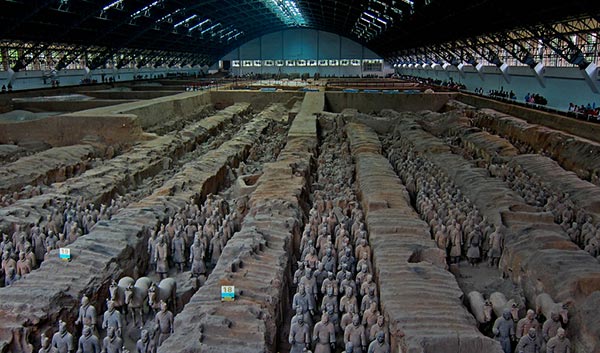
It is the largest: approximately 210 meters long containing an estimated 6,000 statues, many of which remain buried. The soldiers are arranged in battle formation across 11 parallel corridors, with archers in the front ranks, followed by infantry and cavalry. The sense of mass is most striking here.
Pit No. 2
More modest in size (96 m × 84 m), it houses approximately 1,500 warriors, accompanied by horses and foot soldiers. It illustrates the specialized corps of the Qin army: kneeling archers, cavalry and war chariots.
Pit No. 3
The smallest (21 m × 17.6 m) corresponds to the command headquarters: 68 soldiers, 4 horses and one chariot. Its configuration suggests a command post responsible for coordinating the other two formations.
The tomb of Qin Shi Huang
Located 1.5 km from the pits, the imperial tomb appears today as a simple wooded mound. It has never been opened and is said, according to ancient texts, to contain funerary furnishings of great wealth. The visit remains subtle visually but is essential to understand the overall logic of the complex.
Practical information
- Duration of visit: allow 3 to 4 hours to see all three pits, the museum and the mound.
- Admission fees: entry ticket at high price by Chinese standards, with slightly reduced rates in low winter season. Verify current rates before departure.
- Hours: open daily in the morning, closing in late afternoon, with more limited hours in winter.
- Photography: permitted without flash in most pits.
- Accessibility: the site is extensive; wear comfortable shoes.
How to get there
The site is located approximately 35 km northeast of Xi'an, in Lintong District.
- Bus 306 (Tourism Bus 5) departing from Xi'an railway station: journey of about 1 hour, the most direct option.
- Bus 307 from Tang Paradise Park in the south of the city.
- Taxi or ride-hailing service for a faster journey, to be negotiated or booked via an app.
- On site, free shuttles run between the museum and the emperor's tomb upon presentation of your ticket.
When to visit
The site is open year-round. Spring (April-May) and autumn (September-October) offer the best weather conditions. Avoid if possible Chinese national holidays (Chinese New Year, National Day week in early October, May 1st) when crowds are very heavy. Weekdays and early morning hours see lighter traffic, which significantly improves the quality of your visit, especially in Pit No. 1.
What to see nearby
Xi'an concentrates several major sites that complement the mausoleum visit well:
- The Great Pagoda of the Wild Goose, an emblematic Buddhist monument in Xi'an, built during the Tang dynasty.
- The Ming walls and Muslim quarter in the heart of the old city.
- To extend your itinerary in Chine, the Great Wall at Juyongguan near Beijing, or the Bezeklik Caves of the Thousand Buddhas in Xinjiang.
Frequently asked questions
Frequently asked questions
Plan an average of 3 to 4 hours to view the exhibition hall, the three pits and reach the emperor's mound. A full half-day is ideal.
Estimates place around 8,000 statues distributed across the three pits, with a significant portion still buried. Pit No. 1 alone is thought to contain nearly 6,000 figures.
The tomb itself has never been opened. You can access the site, which appears as a wooded mound, 1.5 km from the pits, with a free shuttle included in your ticket.
Yes, photography without flash is generally permitted in the pits and exhibition hall. Check signage on site.
Spring and autumn offer pleasant weather. Avoid major Chinese holidays to limit crowds, and prioritize visiting early in the morning.
Plan your trip
The Terracotta Army naturally fits into an itinerary centered on Xi'an and the Silk Road. To build a custom itinerary including this site and other major monuments of the country, explore our trips in Chine.

Photos
Interested in this visit?
We can include it in your personalised itinerary.