Afaq Khoja Mausoleum (Xiangfei Mu)
Afaq Khoja Mausoleum (Xiangfei Mu)
A major Islamic monument in Xinjiang, the Afaq Khoja Mausoleum houses five generations of the Khoja family beneath a glazed turquoise dome. Both a historical site and a living pilgrimage destination, located 5 km northeast of Kashgar's city center.
Five kilometers northeast of Kashgar's city center, the Afaq Khoja Mausoleum is the most revered Islamic monument in Xinjiang. Built in the 17th century, it houses the burial grounds of five generations of the Khoja family, an influential Uyghur religious and political lineage. Its glazed turquoise dome, visible from a distance, crowns a funerary complex surrounded by poplars and serene gardens.
Quick reference
- Entrance : paid admission required
- Recommended duration : 1 to 1.5 hours
- Dress code : modest attire required; women must cover shoulders and knees
- Access : taxi or bus from Kashgar city center; the site lies away from the main bazaar
- Accessibility : partially accessible terrain, earthen pathways
What you'll see
The main building is a mausoleum featuring a central dome flanked by four corner minarets. Its interior houses dozens of cenotaphs covered in embroidered textiles. Surrounding structures—a prayer hall, madrasa—form a cohesive complex. The whole is enclosed within a wall pierced by a gateway of enameled brick decorated with geometric blue and green patterns.
History and context
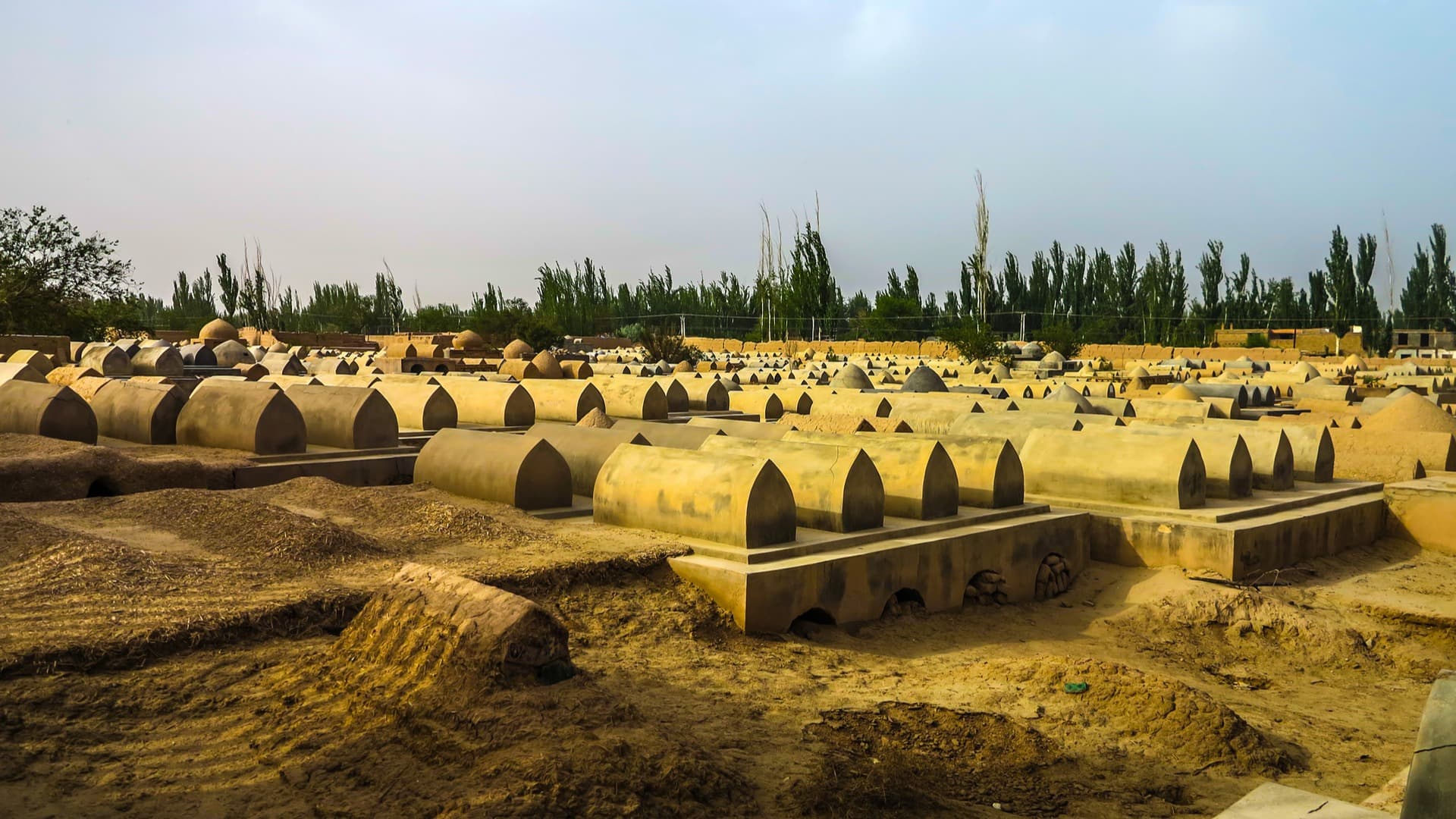
Construction began around 1640 under Muhammad Yusuf Khoja. His son, Afaq Khoja, lent the mausoleum his name and regional prominence: a Sufi spiritual leader of the Naqshbandiyya order, he wielded considerable influence across Central Asia. The site became a family necropolis; it now contains over seventy burials spanning five generations. The Qing dynasty also linked it to the legend of the "Fragrant Concubine" (Iparhan), which gave it the Chinese name Xiangfei Mu.
Highlights of your visit
The glazed dome
Covered in turquoise and green ceramic tiles, the main dome represents the most refined example of Uyghur Islamic architecture in Xinjiang. Its hue shifts with the light throughout the day, ranging from deep blue to celadon green.
The cenotaph hall
The mausoleum's interior is austere and contemplative. The tombs, arranged beneath colorful drapes, create a palpable atmosphere of devotion. Pilgrims still visit, lending the space a living dimension that transcends its role as a mere monument.
The entrance gateway and gardens
The enameled brick gateway, adorned with blue and white arabesques, is a subject worthy of photography in itself. Tree-lined pathways and pools reflecting the dome offer a tranquil setting, rare in the bustling city of Kashgar.
Etiquette and visit guidelines
- Remove your shoes before entering the tomb chamber.
- Speak softly; worshippers may be praying on site.
- Do not touch the cenotaphs or draperies.
- Dress covering shoulders and knees is mandatory for all visitors.
- Some interior areas may be restricted to non-Muslims during certain periods.
Photography tips
Morning light (before 10 a.m.) is ideal: it strikes the facade directly, highlighting the turquoise glazes without harsh shadows. The dome's reflection in the garden pools works well in late afternoon. Photography is generally permitted indoors, but check posted restrictions at the entrance; avoid using flash out of respect for worshippers.
Location and access
The mausoleum stands approximately 5 km northeast of Kashgar's historic center, in a residential Uyghur neighborhood. A taxi from the old town or Id Kah Bazaar takes about fifteen minutes. Local buses serve the area. The site is distinct from the city center and warrants a dedicated trip, possibly combined with a visit to nearby Shah Mosque.
Nearby attractions
- Id Kah Mosque — Xinjiang's largest mosque and the spiritual heart of Kashgar, best visited early in the morning.
- Old City of Kashgar — a labyrinth of earthen alleyways, artisan workshops, and traditional Uyghur houses.
- Kashgar Sunday Bazaar — one of Central Asia's largest markets, bustling every weekend.
Frequently asked questions
Yes, non-Muslim visitors are admitted with a ticket. Some interior areas may be temporarily closed during religious ceremonies.
Shoulders and knees must be covered for all visitors. It is advisable to bring a scarf. Shoes are removed before entering the tomb chamber.
Yes, though the mausoleum is 5 km from the center: plan for a taxi round trip or arrange a full-day taxi circuit including Id Kah Mosque and the bazaar.
Spring (April–May) and autumn (September–October) offer pleasant temperatures. Summer is hot but the gardens are lush. Avoid major Islamic holidays if you prefer a quieter visit.
One to one and a half hours is sufficient to explore the mausoleum, gardens, and ancillary buildings at a leisurely pace.
Generally yes, without flash. Check signage at each room's entrance and respect worshippers at prayer.
Interested in this visit?
We can include it in your personalised itinerary.