Xuankong Hanging Monastery
Xuankong Hanging Monastery
Clinging 50 meters above Jinlong canyon, near Datong, Xuankong hanging monastery has united Buddhism, Taoism and Confucianism since 491.
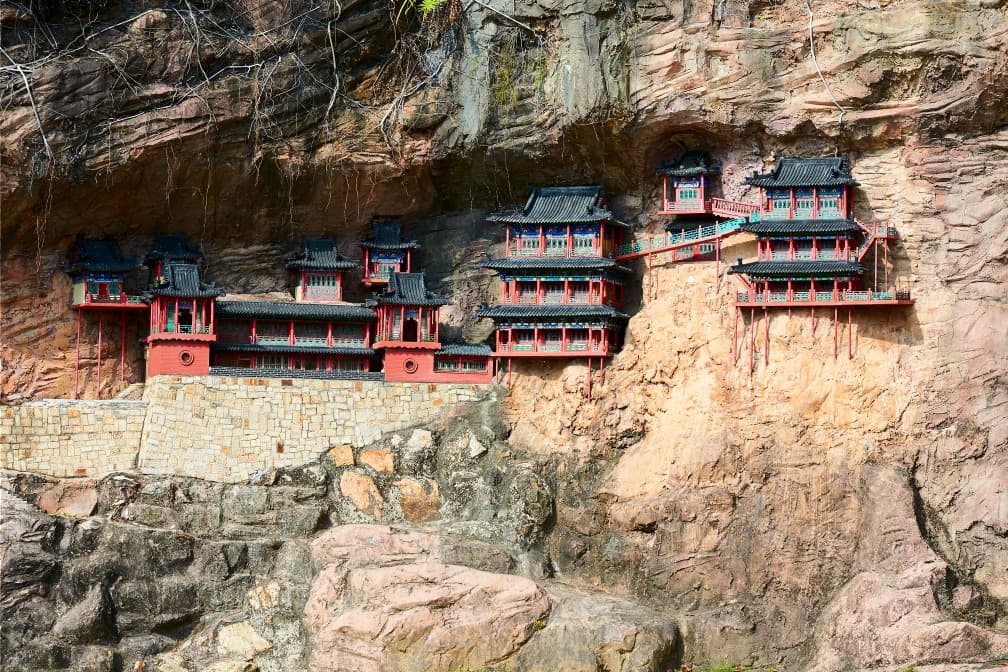
The Xuankong hanging monastery (Xuankong Si) clings to the vertical cliff face of Jinlong canyon, on the flank of Mount Hengshan, approximately 65 km northwest of Datong, in Shanxi Province. Built 50 meters above the Heng River, it has remained in place for over 1,400 years thanks to red wooden pillars driven into the rock. Its singularity extends beyond its architecture alone: it is also the first building in Chine to have united under one roof the country's three major spiritual traditions.
Why visit Xuankong hanging monastery
The site combines three interests rarely brought together at a single attraction: a feat of medieval engineering, an active spiritual site since the 5th century, and a spectacular location at the foot of Hengshan, one of the five sacred mountains of Taoism. The visit remains brief (count approximately 1 hour on site) but it fits logically into a circuit around Datong, complementing the Buddhist grottoes of Yungang.
The appeal is as much architectural as cultural: witnessing Sakyamuni Buddha, Laozi and Confucius coexisting in a single hall remains, even today, an exception in the Chinese religious landscape.
History of Xuankong Si
The monastery was built in 491, during the Northern Wei dynasty (386-534). The choice of the rock face was no accident: it placed the building beyond the reach of floods from the Heng River below, and protected it from the elements thanks to the natural overhang of the cliff.
In 735, Tang poet Li Bai, struck by the beauty of the place, had an inscription carved onto the canyon's façade praising the monastery. The building subsequently survived the centuries through successive restorations, the most significant carried out during the Qing dynasty. The red wooden pillars visible today have supported the structure for over fourteen centuries, though many have been replaced during restoration work.
Its doctrinal particularity is unique: Xuankong Si is the first known structure to unite Buddhism, Taoism and Confucianism in a single space of worship, testifying to the religious syncretism that characterizes part of ancient Chine.
What to see on site
The suspended architecture
The complex comprises 40 buildings connected by narrow walkways, corridors and wooden stairways. The ensemble follows the curve of the cliff face, at mid-height of the canyon, creating the impression that the pavilions float in the void. The pillars visible beneath the structure serve mainly a stabilizing role: the main load rests on beams anchored into the rock.
The interior halls
Inside are housed dozens of bronze, stone and wooden statues. The most emblematic hall presents Sakyamuni, Laozi and Confucius side by side, illustrating the idea that the three teachings can coexist. Other pavilions are dedicated to individual Buddhist or Taoist deities.
The canyon panorama
From the walkways, the sweeping view over Jinlong canyon and the Heng River is itself reason enough to visit. Li Bai's inscription, carved into the opposite cliff face, is typically pointed out by local guides.
Practical information
- Duration of visit: 1 to 1.5 hours, including queues.
- Entrance fee: moderate, with a supplement to access upper walkways (payable on site).
- Hours: daytime opening, reduced hours in winter. Verify before departing.
- Accessibility: narrow walkways, steep steps, significant drop. The site is not recommended for people prone to vertigo and is poorly suited for young children or those with reduced mobility.
- Crowds: the number of visitors on the walkways is regulated, which can result in notable waiting times during peak season.
When to visit
The best periods are spring (April-June) and autumn (September-October): pleasant temperatures, generally clear skies, and striking colors on the canyon walls. Summer remains feasible but can be hot and stormy. Winter is best avoided if possible: frost makes the wooden walkways slippery and certain accesses may be temporarily closed in case of snow or icing.
How to get there
The monastery is located approximately 65 km from Datong, about 1 hour 15 minutes to 1 hour 30 minutes by road. Two options:
- Bus: line 8 departing from Datong serves the area. Economical journey but takes longer.
- Daily taxi: the most convenient solution, especially if you combine the visit with Mount Hengshan or another site. The driver waits during your visit.
Many travelers combine Xuankong Si with the Yungang grottoes in a two-day circuit around Datong.
Nearby attractions
- The Yungang grottoes, close to Datong, shelter one of Chine's largest assemblages of Buddhist rock-carved sculptures.
- Mount Hengshan, a sacred Taoist mountain, whose monastery occupies a cliff face.
- Further on, on the return route toward Beijing, you can extend your journey to the Great Wall at Juyongguan.
- For other Buddhist rock grottoes in Chine, see the Thousand Buddhas grottoes of Bezeklik in Xinjiang.
Frequently asked questions
Frequently asked questions
To incorporate Xuankong hanging monastery into a complete itinerary between Beijing, Datong and Shanxi, consult our trips to Chine.
Interested in this visit?
We can include it in your personalised itinerary.