Yongquan Temple (涌泉寺)
Yongquan Temple (涌泉寺)
Perched on Mount Gu in Fuzhou, Yongquan Temple is a Chan Buddhist monastery founded during the Tang Dynasty. Glazed ceramic Song pagodas, thousand-year-old camphor trees, and morning prayers make it a site of remarkable authenticity.
Nestled on the slopes of Mount Gu, roughly ten kilometers from central Fuzhou, Yongquan Temple stands as one of the great Chan Buddhist monasteries in Fujian Province. Founded during the Tang Dynasty, it houses an active monastic community, millennium-old pagodas, and a forest of giant camphor trees. The atmosphere here is contemplative, far removed from urban bustle.
Practical information at a glance
- Access: bus from central Fuzhou to Mount Gu (Gushan), then on foot or by cable car.
- Recommended duration: 2 to 3 hours for the temple and its immediate surroundings; half a day if you combine it with hiking on Mount Gu.
- Dress code: appropriate attire required; shoulders and knees should be covered.
- Rules: do not disturb monks during prayer; speak quietly in worship halls.
What to see
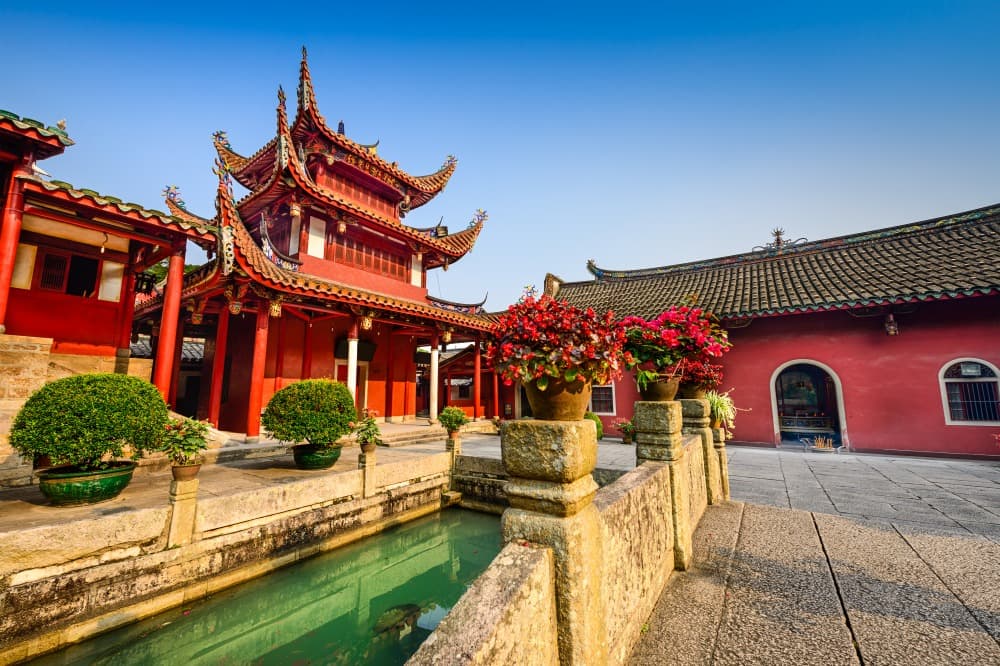
The complex is organized around several successive halls aligned along a central axis. The main hall houses large gilded Buddha statues. Two glazed ceramic pagodas, dating from the Song period, stand on either side of the courtyard — their varnished tiles remain remarkably well-preserved. The temple library holds thousands of ancient sutras.
Around the buildings, centuries-old camphor trees create a dense canopy. Pools and stone gardens punctuate the inner courtyards.
History and context
The temple was founded during the Tang Dynasty, around the 9th century, and takes its current name — Yongquan, meaning "surging spring" — from a source said to have emerged miraculously at the site. It was enlarged and renovated under the Song, Ming, and Qing dynasties. Affiliated with the Chan (Zen) school, it trained generations of monks and maintains historical connections with Japanese Buddhism, with several temple masters having traveled to Japan.
Ranked among the ten great Buddhist temples in Chine, it remains a living place of practice today.
Highlights of the visit
The two Song ceramic pagodas
Rising several meters high, these nine-story pagodas are covered in glazed ceramic tiles depicting Buddhist figures. They represent one of the best-preserved examples of this architectural style in Fujian.
The camphor forest
Several trees exceed a thousand years of age according to local tradition. Their massive trunks and exposed roots give the site an almost forest-like dimension, rare for an urban monastery.
Monastic life
Early in the morning, the liturgical chants of monks echo through the halls. Witnessing this morning prayer — while remaining discreet and at a distance — offers an authentic glimpse of daily Chan practice.
Etiquette and visiting rules
- Remove your shoes before entering certain prayer halls (signs posted on-site).
- Do not point at statues; do not sit on altars or sacred steps.
- Avoid noisy visits during services; monks pray at set times.
- Photography is generally permitted in outdoor courtyards; check for restrictions at the entrance to each hall.
Photography tips
Morning light filtering through the camphor tree canopy is ideal for photographing the inner courtyards. The ceramic pagodas show to best advantage on slightly overcast days, which reduces glare on the glazed tiles. Avoid using flash inside the halls.
Location and access
Yongquan Temple is located on Mount Gu (Gushan), east of Fuzhou. From downtown, public buses serve the base of the mountain. A cable car allows you to avoid the climb on foot, though the walk through the forest is pleasant. The site is not easily accessible by wheelchair due to stairs and elevation changes.
Local agencies offer guided tours combining the temple and hiking on Mount Gu.
Nearby
- Mount Gu (Gushan) — hiking trails through subtropical forest, with views of Fuzhou and the Min River estuary.
- Three Lanes and Seven Alleys district (Sanfang Qixiang) — historic ensemble of traditional Fujian residences in downtown Fuzhou.
- Wanshou Bridge — ancient stone bridge over the Min River, testament to Song-period civil architecture.
Frequently asked questions
Spring (March-April) and autumn (October-November) offer pleasant temperatures and lush vegetation. Summer is hot and humid; winter remains mild in Fujian.
Shoulders and knees covered are recommended out of respect for the active place of worship. Bring shoes that are easy to remove.
Yes, this is the most common combination. Plan for half a day to see the temple and the main trails on Mount Gu.
It is generally permitted in outdoor courtyards. Some interior halls may prohibit it; respect the signs and ask if in doubt.
Public buses connect downtown to the base of Mount Gu. A cable car is available to reach the temple without walking. By taxi or car, the journey from downtown takes approximately 30 to 40 minutes depending on traffic.

Interested in this visit?
We can include it in your personalised itinerary.