YUANTONG TEMPLE
YUANTONG TEMPLE
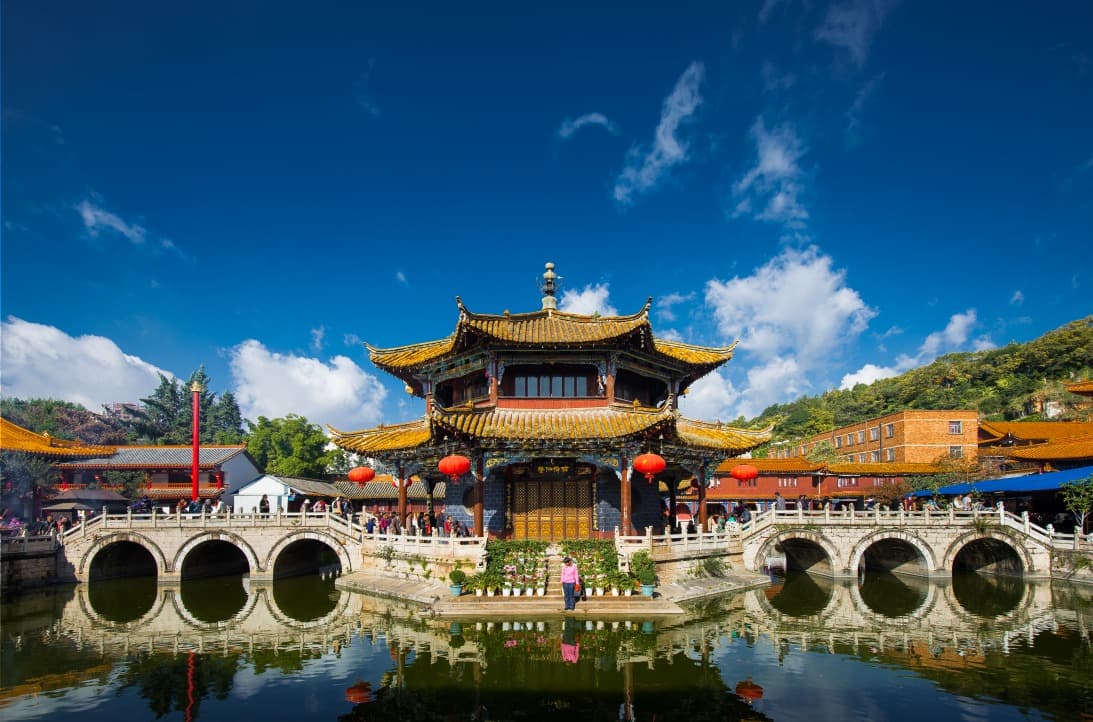
Founded during the Tang Dynasty at the foot of Yuantong Hill, Kunming's principal Buddhist temple combines a central pavilion set over a basin with Sino-Thai statuary.
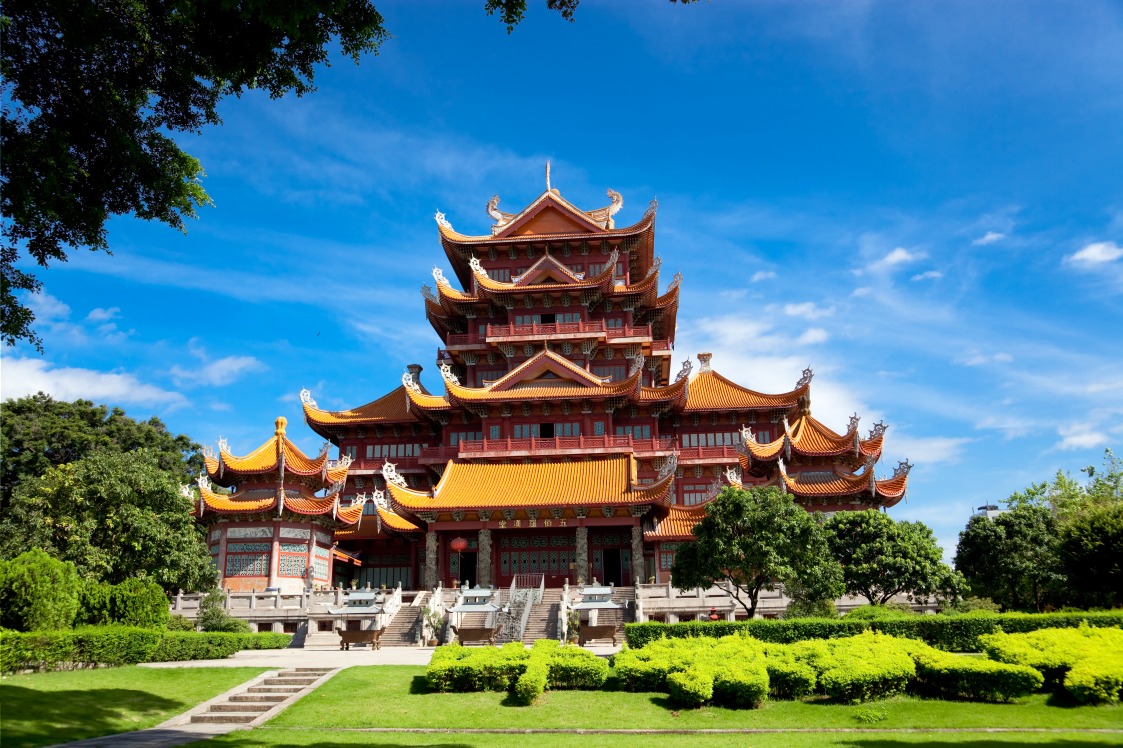
Yuantong Temple, nicknamed the "temple of understanding all things," is one of the main Buddhist sites in Kunming, capital of Yunnan Province. Nestled against Yuantong Hill from which it takes its name, it features polychrome wooden pavilions, a central basin, and Buddhist statuary set on sloping terrain descending toward the main pavilion.
Why visit Yuantong Temple
- One of Yunnan's oldest Buddhist complexes, founded during the Tang Dynasty.
- A rare architectural configuration in Chine: visitors enter from the top and descend toward the central pavilion, positioned in the middle of a basin.
- The coexistence of Chinese Buddhism (Mahayana) and Southeast Asian Theravada Buddhism, illustrated by the Tongfo Dian pavilion.
- A copper statue of Buddha Sakyamuni standing over 3 meters tall, donated as part of Sino-Thai cultural exchanges.
- A site in the heart of Kunming, easily combined with a day of urban exploration.
Temple history
The temple was founded during the Tang Dynasty (618-907) under the name Putuoluo Temple. It ranks among the earliest Buddhist centers established in Yunnan, then a frontier region where Chinese, Tibetan, and Southeast Asian influences converged.
The building subsequently underwent several major reconstructions that shaped its present appearance. A significant restoration campaign took place in the late 13th century under the Yuan Dynasty (around 1276), followed by a second major restoration in 1686 during the reign of Emperor Kangxi (Qing Dynasty). Most of the structures visible today date from these two periods.
The site's recent history is marked by the construction in 1985 of the Tongfo Dian pavilion at the rear of the complex. Blending Chinese and Thai elements, this pavilion houses a copper statue of Buddha Sakyamuni standing over 3 meters tall, a gift symbolizing Sino-Thai Buddhist friendship.
What to see
The main pavilion and basin
The central pavilion sits in the middle of a large basin and is connected to the shore by stone footbridges. It houses a statue of the goddess Guanyin (Avalokiteshvara). The pavilion's pillars are adorned with carvings of entwined dragons, recalling a local legend of a dragon that once dwelled in the basin.
The entrance and the Celestial Kings
Access to the temple is through a monumental gate decorated with a Buddha statue flanked by the Four Celestial Kings, guardians of the cardinal directions and protectors of Buddhist law. This arrangement is typical of major Chinese monasteries.
The Tongfo Dian pavilion
Located at the rear of the complex, this pavilion built in 1985 stands out for its Thai-inspired roof. It houses the great copper statue of Sakyamuni and represents one of the few places in Chine where two Buddhist traditions coexist side by side.
Gardens and galleries
The sloping terrain is developed as a garden with pathways, bridges, and covered galleries. You'll find engravings, murals, and commemorative stelae that complement visits to the pavilions.
Practical information
- Visit duration: allow 1 to 1.5 hours to explore the complex without hurrying.
- Admission: moderate entry fee, payable on site.
- Hours: open daily from morning to late afternoon.
- Good to know: modest dress recommended; the site remains an active place of worship frequented by devotees.
- Best time of day: early morning to enjoy the peaceful atmosphere before tour groups arrive.
How to get there
Yuantong Temple is located in central-north Kunming, at the foot of Yuantong Hill, a short distance from Cuihu Park (Green Lake). Several urban bus lines serve the "Yuantong Si" stop immediately near the entrance. From downtown, expect about ten minutes by taxi or ride-hailing service. The site is also accessible on foot from the Green Lake district, with a walk of approximately 15 to 20 minutes.
Worth combining in the region
Yuantong Temple fits naturally into a Kunming stop before exploring the rest of Yunnan. Several sites complement the visit well:
- Cangshan: the mountain range overlooking Dali, a few hours' drive to the northwest.
- Dongba Museum: to understand Naxi culture from Lijiang.
- Mingyong Glacier: in the far northwest of Yunnan, in the Deqin region.
- Baoguo Temple: another major Chinese Buddhist site, at the foot of Mount Emei (Sichuan).
Frequently asked questions
Frequently asked questions
Yes. It regularly welcomes monks and devotees who come to pray, burn incense, or make offerings. Visitors are welcome as long as they respect the peaceful atmosphere and refrain from photographing practitioners during rituals.
One to one and a half hours is sufficient to explore the entire complex: entrance, central pavilion, Tongfo Dian pavilion, gardens, and galleries.
The Tongfo Dian pavilion was built in 1985 to house a copper statue of Buddha Sakyamuni donated as part of cultural exchanges between Chinese and Thai Buddhist communities. Its architecture intentionally blends elements from both traditions.
Yes, several urban bus lines serve the stop near the entrance. Taxi and ride-hailing services remain the most convenient options from most Kunming hotels.
During the Tang Dynasty (618-907), originally under the name Putuoluo Temple. It has been rebuilt several times, notably in the late 13th century (Yuan) and in 1686 under Emperor Kangxi (Qing).
Include Yuantong Temple in your trip
A natural stop during a Kunming stay before exploring Dali, Lijiang, or Shangri-La, Yuantong Temple works well for a half-day of urban sightseeing. To build a custom itinerary in Yunnan, explore our Chine travel ideas.
Nearby


Interested in this visit?
We can include it in your personalised itinerary.