Ancient Beijing Observatory
Ancient Beijing Observatory
Built in 1442 near Jianguomen Bridge, the Ancient Beijing Observatory brings together eight bronze astronomical instruments and bears witness to Sino-Western scientific exchanges.
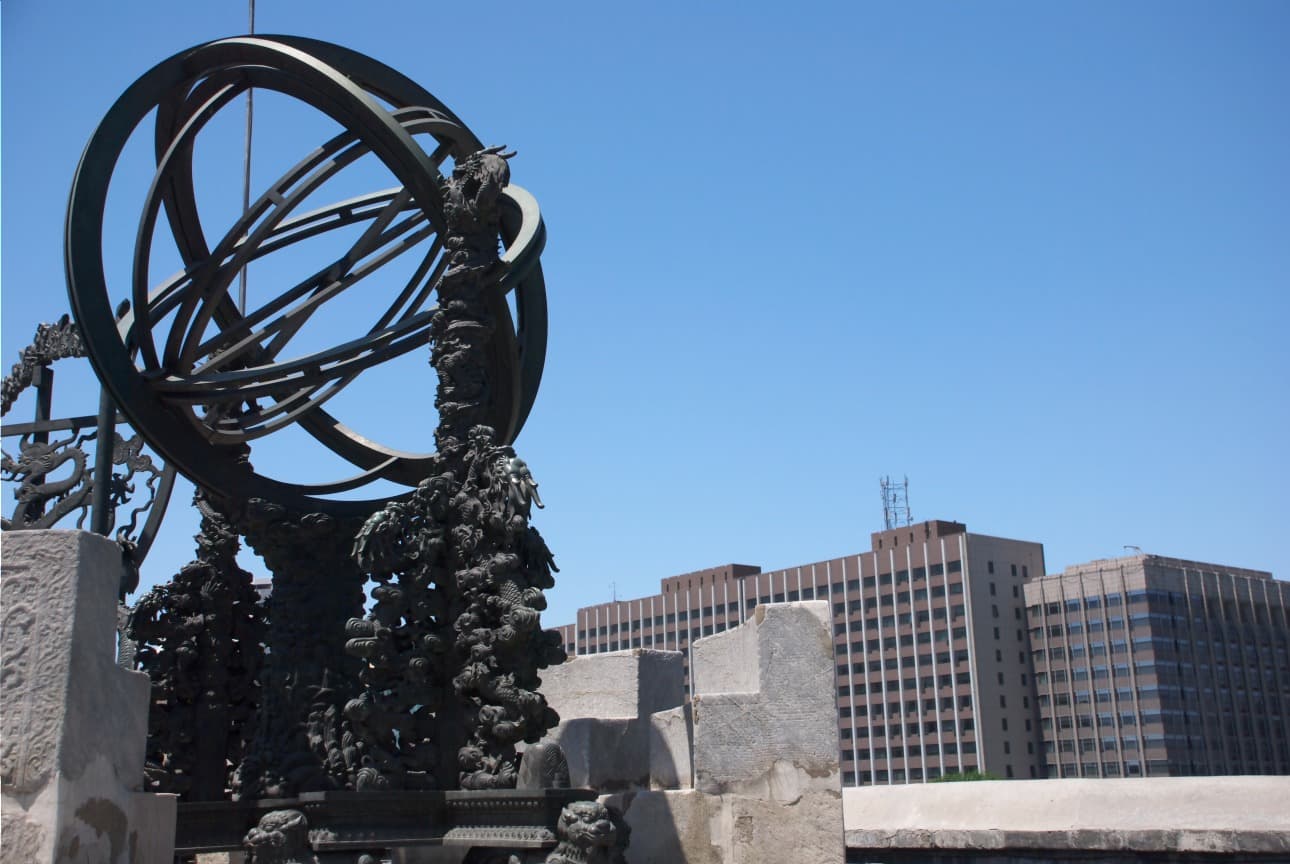
The Ancient Beijing Observatory is one of the rare imperial observatories preserved in the world. Built in 1442 under the Ming Dynasty, it operated for nearly five centuries and today preserves eight bronze astronomical instruments from the 17th and 18th centuries, testament to scientific exchanges between China and the West.
Why visit the Ancient Beijing Observatory
The site offers an unusual perspective on the history of science in China. Located in the heart of the capital, near the Jianguomen business district, it combines an elevated observation platform, collections of ancient instruments, and several traditional pavilions arranged around inner courtyards.
The visit is particularly interesting for travellers interested in the history of technology, pre-telescopic astronomy, or relations between imperial China and European Jesuit missions, which helped enrich the site's instrumental collection. Allow 1 to 1.5 hours to explore the entire complex.
History of the observatory
Built in 1442 during the reign of Emperor Zhengtong, the observatory was one of the first royal observatories in the world still preserved today. Under the Ming Dynasty, it was called the Platform for Observing Stars and served both for official astronomical measurements and as a centre for cultural exchanges between China and the West, particularly through the Jesuits present at the imperial court.
Around 1911, following the Xin Hai victory against the Qing, the site was transformed into a national observatory. In 1927, it became the Beijing Museum of Astronomical Instruments. At the turn of the 20th century, during the turmoil accompanying foreign forces' intervention in China, several astronomical instruments were removed by Allied powers; they were returned to China after the end of World War I.
The site today bears the name Exhibition Pavilion of Ancient Beijing Astronomical Instruments and remains managed as part of Chinese cultural heritage.
What to see on site
The complex covers an area of approximately 10,000 square metres. The great platform, ten metres high, supports the most emblematic pieces: eight bronze instruments dating from the 17th and 18th centuries, including the equatorial armillary sphere, the ecliptic sphere, the quadrant, the sextant, the astrolabe, the altazimuth, the theodolite, and the celestial globe.
The pieces visible on the platform are faithful replicas; the original instruments are preserved in Nanjing. The ground floor has been converted into a pre-telescopic astronomy museum, featuring a display of sun dials and moon dials used by Chinese astronomers before the arrival of telescope instruments.
The western courtyard brings together several traditional pavilions: the Ziwei Palace, the Dial Hall, and the Water Clock Hall, complemented by wing buildings dedicated to items of Oriental and Western origin, as well as a series of illustrated calendars from past dynasties.
Practical information
- Location: southwest of Jianguomen Bridge, Dongcheng District, Beijing.
- Admission: moderate entrance fee, payable on site or via official platforms.
- Hours: open during the day from Tuesday to Sunday, closed weekly on Monday. Hours vary by season; check before your visit.
- Recommended duration: 1 to 1.5 hours.
How to get there
The site is located southwest of Jianguomen Bridge, a short distance from Beijing Station and several major roads in the centre.
- Metro: lines 1 and 2, Jianguomen station, exit C. The observatory is visible from the exit.
- Taxi or ride-hailing: convenient option from city centre hotels by providing the Chinese name 北京古观象台 to the driver.
- On foot: accessible from Beijing Station in about ten minutes.
What to see nearby
The observatory is part of a cultural day trip to Beijing. Several sites usefully complement discovering the capital:
- The 798 Art Zone, a former industrial complex converted into a contemporary art district.
- The Beijing Botanical Garden, for a green break in the northwest of the city.
- The Baigongfang Handicraft Museum, focused on traditional crafts.
Frequently asked questions
Frequently asked questions
Plan your trip
The Ancient Observatory naturally finds its place in a cultural itinerary in Beijing, alongside the Forbidden City, the Temple of Heaven, and the hutongs. To build a bespoke stay incorporating this site, consult our trips to China.

Nearby


Interested in this visit?
We can include it in your personalised itinerary.