Beijing's Hutongs
Beijing's Hutongs
Traditional Beijing alleyways inherited from the Yuan, Ming and Qing dynasties: history, ten emblematic hutongs, siheyuans and visiting advice.
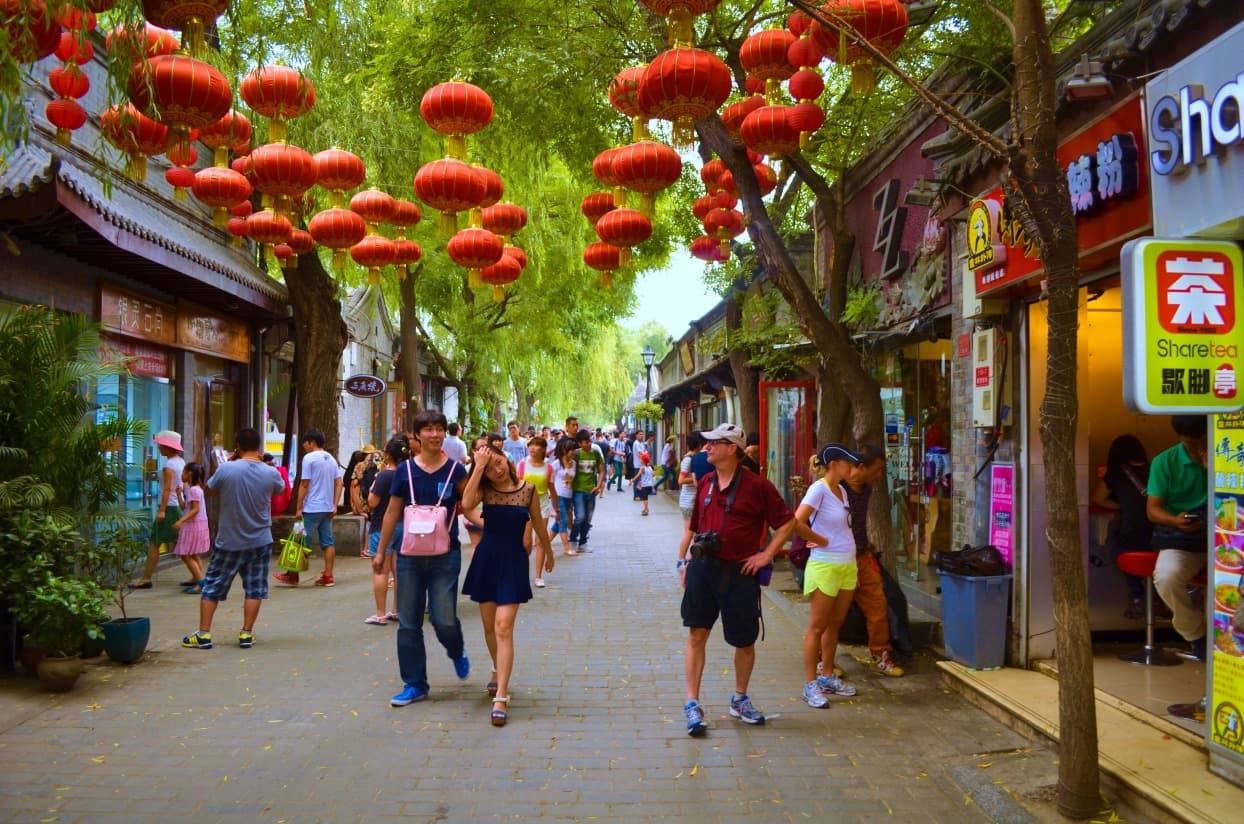
Hutongs are the traditional alleyways that crisscross the historic center of Beijing. Vestiges of over 700 years of imperial urban planning, they connect square courtyards called siheyuans and preserve a way of life that contrasts sharply with the modern capital. Architecture, history and scenes of daily life converge along approximately 4,500 alleyways still recorded in the early 2000s.
Why visit the hutongs
Hutongs offer a tangible window into pre-modern Beijing, when the city organized itself around wells and square-courtyard residences. Walking through these alleyways allows you to observe an urban fabric seven centuries old, inherited from the Yuan, Ming and Qing dynasties, and preserved in places despite contemporary real estate pressures. The contrast with modern avenues highlights the human scale of these neighborhoods, where neighborhood shops, workshops and family homes still survive.
The interest is not merely architectural: the hutongs also concentrate major sites in Chinese history, from the Imperial College to the Legation Quarter, and bear witness to more recent urban episodes, including the massive demolitions that preceded the 2008 Olympic Games.
History and etymology
Hutongs were developed under the Yuan dynasty (1271-1368), then densified under the Ming (1368-1644) and Qing (1644-1911). The word hutong derives from Mongolian hottog, which means "well." Since water was the structuring element of urban life, Beijingers would dig a well before building, and the city thus developed around these water sources.
By 2000, approximately 4,500 alleyways were still recorded. Many have disappeared to make way for shopping centers and large residential complexes, particularly during the modernization phase linked to the 2008 Olympic Games. Aware of the heritage and tourism value of this urban fabric, the municipal government implemented a preservation plan starting in 2004 that regulates demolitions and oversees renovation of several sectors.
What to see: hutongs to know
Hutongs are made up of paving stones and gray brick walls. Their width ranges from 40 cm to 9 m, and they generally follow an east-west or north-south axis. Two types are distinguished: dead-end alleyways and interlocking alleyways that form veritable labyrinths where facades resemble one another and where it's easy to get lost.
Hutong Nanluogu
Stretching 800 m in Dongcheng district, Nanluogu dates back to the Yuan dynasty. It's one of the most frequented hutongs, lined with renovated siheyuans housing shops, cafes and galleries. Access via metro at Nanluoguxiang station (lines 6 and 8).
Hutong Dongjiaomin
At 3 km, Dongjiaomin is Beijing's longest hutong. From 1861 to 1949, it constituted the Legation Quarter, the diplomatic center of the capital. Several structures of Western architecture still stand there, bearing witness to this singular period.
Hutong Lingjing
In Xicheng district, near Xidan, Lingjing measures about 600 m long by 32 m wide: it's the widest hutong in the city.
Hutong Qianshi
By contrast, Qianshi is believed to be Beijing's narrowest, at about 40 cm wide in places. It once housed an important financial center of the imperial capital.
Hutong Guozijian
Stretching 669 m, Guozijian serves two major monuments: the former Imperial College (1306) and the Temple of Confucius (1302). It's the only alleyway in China to preserve traditional archways (pailou) at both ends.
Hutong Jiuwan
Jiuwan is a 390 m labyrinth formed by 13 winding sections in Xuanwu district. Its configuration makes it one of the most disorienting hutongs to explore.
Liulichang Hutongs
Under the Yuan and Ming, Liulichang was the enamelware quarter. Today, its alleyways specialize in the sale of antiques, calligraphy and traditional stationery items.
Hutong Mao'er
Measuring 585 m in northwestern Dongcheng, Mao'er has housed several historical figures: the Dowager Empress Cixi, warlord Feng Guozhang and Ming general Hong Chengchou all resided there.
Hutong Yandai Xiejei
Over 250 m, Yandai Xiejei corresponds to the former tobacco and opium quarter. Today it's a lively commercial alleyway, dotted with bars, tea houses and souvenir shops.
Hutong Ju'er
Stretching 440 m, Ju'er lines up several historical monuments. Alleyways No. 3 and 5 have been protected since 1988; they contain the former residence of Rong Lu, a Qing dynasty minister, featuring his mansion, ancestral hall and garden.
The siheyuans, heart of the hutongs
Hutongs cannot be understood without the siheyuans, these square-courtyard houses they serve. The typical layout includes an enclosure, an interior garden, a multi-story dwelling and a central courtyard. Modest as seen from the alley, these complexes reveal a codified residential architecture within. The Xuanwu and Chongwen districts still concentrate a large number, and some owners open their courtyards to visitors.
Practical information
- Visit duration: allow 2 to 4 hours to explore a sector, half a day to combine several hutongs.
- Transportation modes: on foot for narrow alleyways, by bike or rickshaw for wider thoroughfares. Some alleyways are too narrow for two-wheelers.
- Bike rentals: several providers offer bikes near Shichahai Lake.
- Access: free entry to the alleyways; only certain associated monuments (Temple of Confucius, Imperial College) charge admission.
- Respect for residents: hutongs are living spaces. Avoid photographing residences without permission and remain discreet in private courtyards.
When to visit the hutongs
Visits take place outdoors: late spring (April-May) and autumn (September-October) offer the most favorable conditions, with dry and mild weather. Summer is hot and stormy, and Beijing's winter can be very cold and dry, sometimes windy. Commercial alleyways like Nanluogu or Yandai Xiejei are particularly lively in the evening, while a morning stroll allows you to observe daily life before the crowds arrive.
Nearby
The best-preserved hutongs are concentrated north of the Forbidden City, around the Drum Tower and Bell Tower and the Houhai and Shichahai lakes. This area lends itself to a full day: Forbidden City in the morning, hutong strolls and lakeside walks in the afternoon. To extend your journey beyond Beijing, you might consider a trip to the Great Wall at Juyongguan, one of the most accessible sections from the capital.
How to get there
Beijing's metro serves all hutong sectors. Useful stations include Nanluoguxiang (lines 6 and 8) for Nanluogu and Mao'er, Qianmen (line 2) for Dongjiaomin and Qianshi, Yonghegong (lines 2 and 5) for Guozijian, Shichahai (line 8) for Yandai Xiejei, and Hepingmen (line 2) for Liulichang. Numerous bus lines complement this network; precise routes should be verified on site as they change.
Frequently asked questions
Frequently asked questions
Approximately 4,500 alleyways were recorded in 2000. The number has since declined due to major real estate projects, but a municipal preservation plan has regulated demolitions since 2004.
Nanluogu is the most accessible and lively, with its shops and renovated siheyuans. For a more historical atmosphere, Guozijian, which serves the Temple of Confucius and the Imperial College, is an excellent choice.
Yes, biking is the traditional transportation mode in these alleyways. Rentals are available near Shichahai Lake. However, some very narrow alleyways, like Qianshi, remain pedestrian-only.
Allow 2 to 4 hours for one sector, or half a day to combine several hutongs with the Drum Tower and Houhai/Shichahai lakes.
April-May and September-October provide the most pleasant weather for walking or cycling.
Include hutongs in your trip
An exploration of hutongs fits naturally into a Beijing visit combining the Forbidden City, Drum Tower and Great Wall excursions. To build a custom-made itinerary in China, consult our China trips.
Nearby
Interested in this visit?
We can include it in your personalised itinerary.