Dujiangyan Irrigation System
Dujiangyan Irrigation System
Designed by Li Bing in 256 BCE, the Dujiangyan irrigation system has regulated the Minjiang River for over 2,200 years. A UNESCO site to visit from Chengdu.
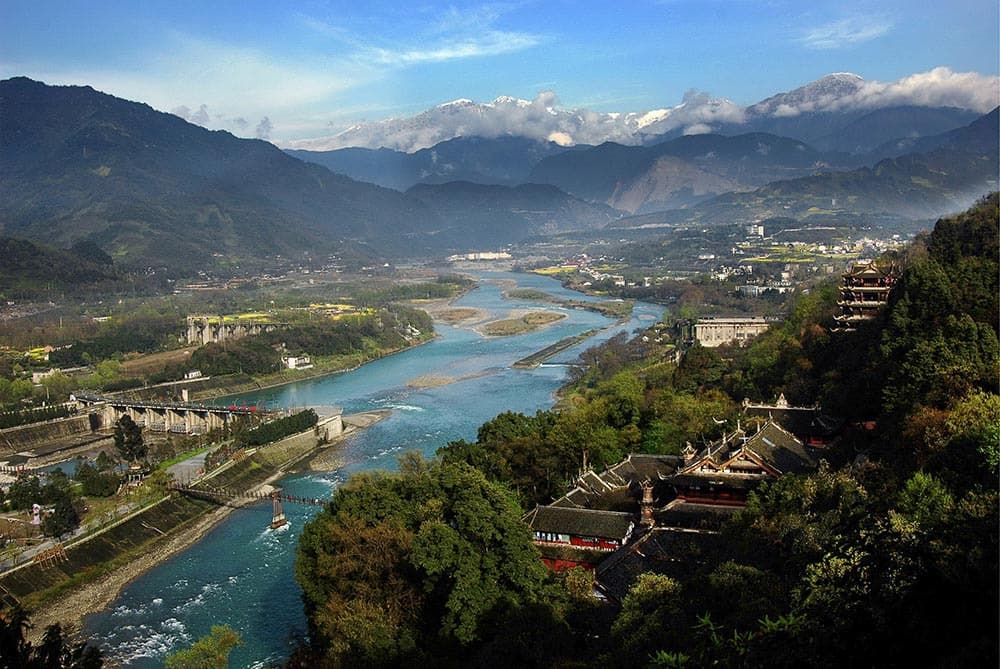
The Dujiangyan irrigation system is a hydraulic structure that has been active since the 3rd century BCE, regulating the waters of the Minjiang River and irrigating the Chengdu plain in Sichuan. Inscribed as a UNESCO World Heritage site in 2000, it combines ancient engineering, Confucian sanctuaries, and fluvial landscapes to the west of the city of Dujiangyan.
Why visit the Dujiangyan irrigation system
This site holds both technical and historical significance. Designed over 2,200 years ago, the structure still functions according to its original principles, without a retention dam: it diverts and distributes water through the river's geometry alone. The visit combines understanding a unique hydraulic mechanism, two temples dedicated to its creators, and viewpoints over the confluence from tree-lined riverbanks.
- UNESCO site jointly inscribed with Mount Qingcheng in 2000
- Three structures still active irrigating over 668,700 hectares
- Erwang and Fulong temples with sculptures and panoramic viewpoints
- Easy access from Chengdu, in less than two hours
History of the irrigation system
The system was designed by Li Bing, governor of Shu, and his son Er Lang. Its construction began in 256 BCE and the structure was enlarged in 141 BCE. The Sichuan region was then subject to violent monsoon floods alternating with severe dry-season droughts. Rather than building a dam to oppose the Minjiang River, Li Bing conceived a distribution device that diverted part of the flow toward agricultural lands while evacuating surpluses.
In its origins, the system made it possible to irrigate over 100,000 hectares of land and contributed to Sichuan's status as a major grain basin of imperial China. Today considered the oldest irrigation system in the world still in operation, it was designated a UNESCO World Heritage site in 2000, jointly with the nearby Mount Qingcheng.
What to see on site
The site is explored on foot along the Minjiang riverbanks, between the three hydraulic structures and the temples overlooking them. Plan half a day to cover the entire area without rushing.
The three hydraulic structures
The genius of the device lies in the complementarity of three elements:
- Yuzui ("fish mouth"): a wedge-shaped separation dam that divides the river in two. The western arm evacuates floods, the eastern arm directs water toward the lands to be irrigated.
- Feishayan (spillway): ensures flood discharge, eliminates sand and sediments through centrifugal action, and regulates the flow that continues downstream.
- Baopingkou ("bottle neck"): a diversion channel carved into the rock, functioning as a valve that precisely calibrates the amount of water distributed to the plain.
Today the system irrigates over 668,700 hectares spread across some thirty counties and cities around Chengdu.
Erwang Temple
On the right bank of the Minjiang, Erwang Temple covers 50,000 m². It is divided between an eastern section occupied by a garden and a western section reserved for religious buildings. Inside, you will find sculptures of Li Bing and his son. From its observation platform, the eye takes in the entire irrigation system, making it the best vantage point to understand the mechanics of the site.
Fulong Temple
Situated in the Lidui Park, Fulong Temple is dedicated to Li Bing. It houses his stone statue, carved during the Han Dynasty and excavated from the river in 1974, accompanied by statuettes representing the workers of the spillway. The main hall also displays miniature replicas explaining construction principles. From the watchtower pavilion, you enjoy a panoramic view of Feishayan and Yuzui.
Practical information
- Duration of visit: plan 3 to 4 hours to explore the three structures and two temples.
- Admission: paid entry, at a moderate rate for a Chinese UNESCO site. Check current conditions before your visit.
- Hours: daytime opening, with reduced hours in winter. Arrive in the morning to avoid groups.
- Accessibility: the site features elevation changes and stairs, particularly leading to the temples.
- Tip: a cable car connects the two banks to save time between Yuzui and Erwang Temple.
When to visit Dujiangyan
The site is worth visiting year-round, but the experience varies by season. In spring (April-May) and autumn (September-October), temperatures are mild and riverside vegetation offers the best panoramas. In summer, the monsoon season, you can see the structure at full capacity when the Minjiang swells; however, rains are frequent and humidity high. Winter is drier, low water levels make the dam structure more distinct, but opening hours are limited.
How to get there
From Chengdu, high-speed trains reach Dujiangyan station in approximately 30 to 40 minutes. From the city center of Dujiangyan, bus lines 1 and 4 serve the site entrance, and taxis are a quick alternative. Many travelers combine this visit with Mount Qingcheng, located about twenty kilometers away.
Nearby
- Mount Qingcheng: birthplace of Chinese Taoism, inscribed as UNESCO World Heritage alongside Dujiangyan, to be combined over one or two days.
- City of Dujiangyan: the old town and riverfront, restored after the 2008 earthquake, deserve an evening stroll.
- Chengdu: capital of Sichuan, the ideal logistical base to explore the region.
To further explore major Chinese historical sites, you can also consult our guide on the Great Wall at Juyongguan or the Great Goose Pagoda in Xi'an.
Frequently asked questions
Frequently asked questions
Plan 3 to 4 hours to explore the three hydraulic structures (Yuzui, Feishayan, Baopingkou) and Erwang and Fulong temples. A half-day is sufficient, but a full day allows you to combine the visit with nearby Mount Qingcheng.
Yes. It is one of the oldest hydraulic devices in the world still in operation, irrigating over 668,700 hectares across more than thirty counties and cities around Chengdu, according to the principles laid down by Li Bing in the 3rd century BCE.
The simplest way is by high-speed train from Chengdu, which reaches Dujiangyan in 30 to 40 minutes. From the station or city center, buses on lines 1 and 4, or a taxi, will take you to the site entrance.
Spring (April-May) and autumn (September-October) offer the best conditions, with mild temperatures and good visibility. Summer shows the structure at full capacity but with frequent rains.
Yes, and it's even recommended: the two sites are jointly inscribed on the UNESCO list and are about twenty kilometers apart. A full day allows you to see both; two days are more comfortable.
Include Dujiangyan in your journey
The Dujiangyan irrigation system naturally fits into an itinerary in Sichuan, between Chengdu, Mount Qingcheng, and the Tibetan landscapes of western Sichuan. To build a stay that combines UNESCO heritage, ancient engineering, and Sichuan culture, consult our custom journeys in China.
Interested in this visit?
We can include it in your personalised itinerary.