Elephant Trunk Hill
Elephant Trunk Hill
A karst emblem of Guilin, Elephant Trunk Hill shelters a traversable grotto, Song dynasty poetry, and a Ming pagoda at its summit.
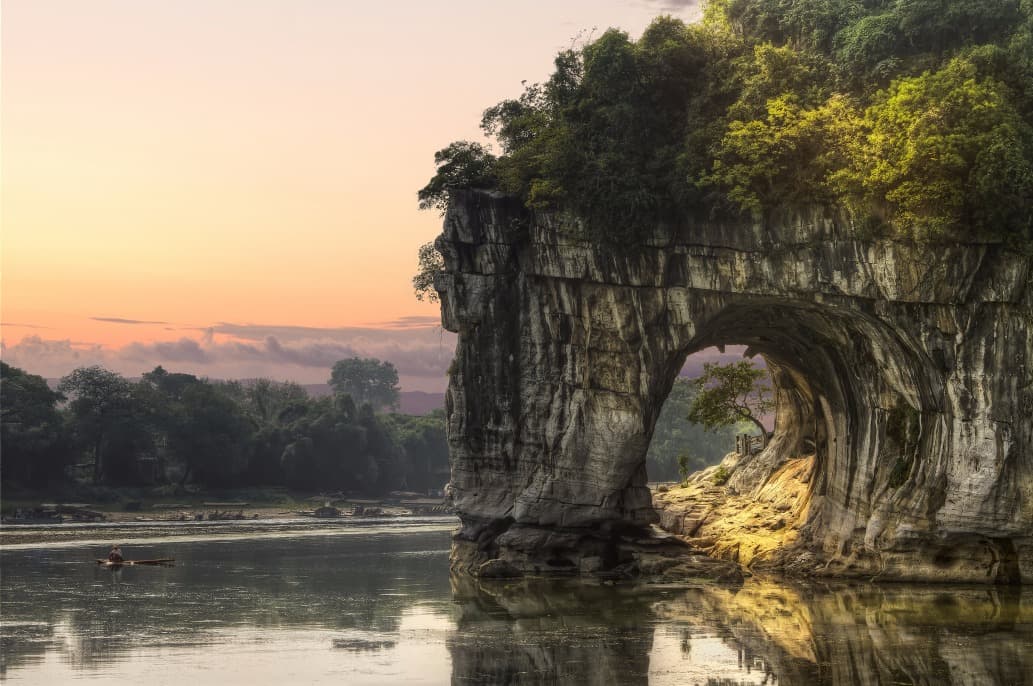
In the heart of Guilin, where the Li River meets the Peach Blossom River, a karst hill forms the silhouette of an elephant dipping its trunk into the water. This geological formation, now the city's iconic landmark, blends geology, local legend, and inscriptions left by ancient poets. Since 2006, it has been twinned with the Étretat site in France.
Why visit Elephant Trunk Hill
The site concentrates several attractions within a confined area: a distinctive karst formation, a traversable grotto carved by erosion, poems etched into the rock since the Song dynasty, and a Ming pagoda crowning the summit. It also offers a vantage point for understanding Guilin's geography—a city built amid karst peaks and the meanders of the Li River.
The visit is made on foot in 1 to 2 hours depending on your pace and desire to reach the summit. The park remains family-friendly and serves as a useful introduction to the landscapes you'll encounter later on a cruise down the Li River.
History and legend
Local legend tells of the Heavenly King who stopped in Guilin with his elephant. Captivated by the landscape, the animal refused to leave. Weakened by combat with the guardians sent to retrieve it, it plunged its trunk into the river to quench its thirst. Enraged, the king drove his sword into the elephant's back and transformed it into stone. Locals still call the pagoda at the summit the "pagoda of the sword hilt."
Beyond the tale, the hill is a place of literary memory. Over centuries, generations of scholars left inscriptions here, including verses attributed to Lu You and Fan Chengda, two poets of the Southern Song dynasty (12th century). These carvings, still visible on the rock faces, testify to the site's aesthetic standing long before the modern tourism era.
What to see
The trunk and the water arch
Viewed from the shore, the rock formation displays a circular opening that separates the "trunk" from the main body of the hill. Beneath this arch, the river flows, giving the formation its characteristic silhouette. This is the most recognizable photographic angle of the site.
The elephant eye grotto
Located approximately 100 meters high, this cave traverses the hill for 52 meters in length and 10 meters in width. Access is via a marked trail. The lateral openings offer panoramic views over the Li River and surrounding peaks.
The Song dynasty inscriptions
The exterior and interior rock faces preserve carved poems, including those of Lu You and Fan Chengda. A few interpretive panels on site provide minimal context; an English-speaking guide helps capture their significance.
The Puxian Pagoda
At the summit stands the Puxian Pagoda, built during the Ming period (1368–1644). Tradition identifies it with the sword hilt driven into the elephant's back. From its surroundings, the unobstructed view embraces the karst peaks and curves of the Li River.
Practical information
- Location: central Guilin, at the confluence of the Li River and the Peach Blossom River.
- Bus access: lines 2, 16, 23, 33, 57, 58, Elephant Trunk Hill Park stop.
- Visit duration: allow 1 to 2 hours to explore the park, the grotto, and ascend to the pagoda.
- Hours: open daily with extended hours from morning through early evening. Check current hours before your visit.
- Admission: paid entry with moderate rates. Prices may change; inquire locally or through a local guide.
When to visit
Guilin has a humid subtropical climate. Spring (April–May) and autumn (September–November) offer the most pleasant conditions: mild temperatures, often clear skies, and adequate water levels on the Li River. Summer is hot and rainy with the risk of storms but lush vegetation. Winter remains viable—cooler and misty, with fewer visitors. Early morning and late afternoon reduce crowds and provide better light for photos from the shore.
Nearby attractions
Elephant Trunk Hill fits naturally into a broader exploration of Guilin and its region. A few complementary stops:
- Guilin: downtown areas, markets, and urban parks of the Two Rivers and Four Lakes.
- Beishan Temple: a Buddhist complex worth discovering as part of a cultural itinerary in China.
- Baigongfang Craft Museum: useful for contextualizing Chinese folk art.
Frequently asked questions
Frequently asked questions
Plan for 1 to 2 hours to tour the park, view the formation from the shore, pass through the elephant eye grotto, and climb to the Puxian Pagoda.
The park perimeter and views from the shore are easily accessible. However, access to the grotto and pagoda requires a steep trail that demands good mobility.
Both approaches complement each other. From the shore or a boat, you grasp the elephant silhouette and the arch beneath the trunk. Climbing gives you access to the grotto, engraved poems, and panoramic views from the Ming pagoda.
Continue your journey
Elephant Trunk Hill naturally fits into an itinerary combining Guilin, a cruise on the Li River, and rice terraces in northern Guangxi. To build a custom journey incorporating these stages, explore our China trips.

Interested in this visit?
We can include it in your personalised itinerary.