Reed Flute Cave (Grotte de la Flûte de Roseau / 芦笛岩)
Reed Flute Cave (Grotte de la Flûte de Roseau / 芦笛岩)
Carved into the karst limestone northwest of Guilin, Reed Flute Cave reveals 240 meters of galleries adorned with stalactites, calcite columns and an underground lake with shimmering reflections.
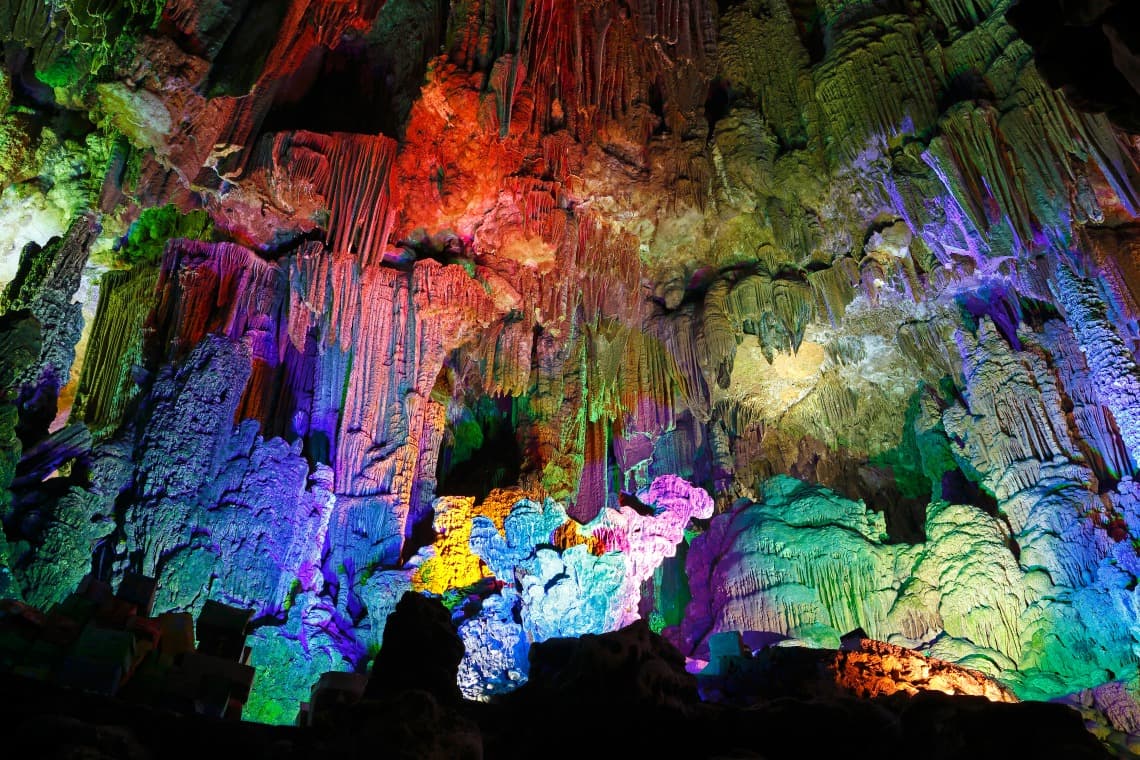
About ten kilometers from central Guilin, Reed Flute Cave opens into a limestone massif in Xiufeng District. Stretching approximately 240 meters of walkable galleries, it owes its name to the reeds that once grew at its entrance and were used to craft flutes. Its stalactites, stalagmites and calcite columns, enhanced by colorful lighting, make it one of the most visited caves in South China.
Practical information at a glance
- Entrance: paid admission (confirm rates with your agency or on-site)
- Recommended duration: 1 to 1.5 hours to complete the full circuit
- Access: city bus from central Guilin or taxi; parking available
- Attire: closed-toe shoes recommended (wet and sometimes slippery floor)
- Accessibility: partial wheelchair access; check on-site for details
What you'll see
The circuit follows a marked one-way path through several halls with spectacular formations. The limestone concretions take on evocative shapes — petrified forests, frozen cascades, translucent columns — which local guides have given imaginative names. The main hall, called the "Crystal Palace of the Dragon King," contains a shallow underground lake that mirrors the illuminated walls.
History and context
Inscriptions carved into the walls attest to human visits as far back as the Tang Dynasty (7th century). More than seventy such inscriptions, written in classical Chinese, have been documented. The cave was developed for tourism in the 1950s and has remained an emblematic site of Guilin's karst region, which is part of a UNESCO World Heritage site along with the Li River.
Highlights of the visit
The Crystal Palace of the Dragon King
The largest chamber in the cave. The underground lake creates a striking mirror effect: stalactites are reflected in the still water, visually doubling the height of the vaults. The colorful lighting here is most theatrical.
Calcite columns and draperies
Several galleries showcase columns formed by the junction of stalactites and stalagmites, as well as translucent "draperies" only a few centimeters thick. Some resonate slightly when touched — contributing to part of the site's musical legend.
Tang and Song Dynasty inscriptions
Scattered across the walls, these carvings are rare testimony to the site's ancient use. Several bilingual explanatory panels help you understand their meaning without reading classical Chinese.
Photography tips
The colored artificial lighting complicates white balance: set your camera to manual mode or choose a "tungsten" balance to minimize color casts. A compact tripod is useful in darker areas, but check if it's permitted at the entrance. Avoid direct flash on formations: it flattens relief and may disturb other visitors. Reflections in the underground lake photograph best from the side walkways.
Location and access
The cave is located in Xiufeng District, northwest of Guilin. From downtown, allow 20 to 30 minutes by taxi or city bus. It's easily visited as a half-day outing, combined with Seven Star Park or a cruise on the Li River. The site has parking for private vehicles and tour coaches.
Nearby attractions
- Li River — cruise between Guilin and Yangshuo through the karst landscape that has inspired Chinese painters for centuries.
- Elephant Trunk Hill — Guilin's iconic symbol, this rock formation on the riverside is visible from downtown.
- Seven Star Park — landscaped park with caves, pagodas and gardens, easily combined in a single day.
- Longji Rice Terraces — about two hours from Guilin, these mountain-sculpted terraces offer striking contrast to the surrounding plains karst.
Frequently asked questions
The cave is accessible year-round. The interior temperature remains stable (around 20°C), making it a pleasant visit even during sweltering summers or cold winters. Avoid Chinese public holidays (National Day in early October, Chinese New Year) when crowds are heaviest.
The marked circuit takes between 1 and 1.5 hours at a leisurely pace. Add travel time from central Guilin to plan your half-day outing.
Yes. The cave visit takes a half-day. It combines well with Seven Star Park or a stroll around Elephant Trunk Hill in the afternoon.
Personal photography is generally allowed. Flash and tripod use may be restricted in certain areas; check signage at the entrance to each hall.
Wear closed-toe shoes with non-slip soles: the floor is damp in places. A light layer is helpful, as the interior temperature is cool even in summer.
Local guides offer their services at the cave entrance, in Mandarin and sometimes English. Your Nomadays agency can also arrange a guided visit with an English-speaking guide.
Photos
Interested in this visit?
We can include it in your personalised itinerary.