Yungang Grottoes
Yungang Grottoes
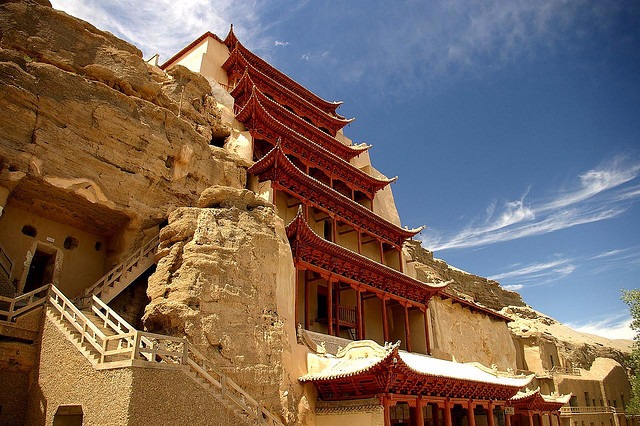
Near Datong, the Yungang Grottoes shelter 45 cavities and 50,000 Buddhist sculptures carved during the Northern Wei dynasty, listed as a UNESCO World Heritage Site since 2001.
The Yungang Grottoes comprise one of the most extensive collections of Buddhist sculpture in Chine, carved into the sandstone cliffs of Wuzhou Mountain, roughly fifteen kilometres west of Datong, in Shanxi Province. With their 45 surviving grottoes and nearly 50,000 statues, they have been part of the UNESCO World Heritage since 2001 and rank among the four major Buddhist rock-cut sites in Chine, alongside Mogao, Longmen and Maijishan.
Why visit the Yungang Grottoes
Yungang offers exceptional testimony to the meeting of Indian Buddhism, Central Asian art and Chinese traditions, in a place where monumental sculpture dialogues with meticulous craftsmanship on details. The site presents several highlights:
- A unique concentration of colossal statues, some standing 17 metres high, carved directly from the rock.
- A route of approximately one kilometre along the cliff face, visited in 2 to 3 hours.
- An iconography that traces the arrival of Buddhism in Chine via the Silk Road.
- Easy access from Datong, making it a natural stop on a circuit through Shanxi, complementing the suspended monastery of Xuankong Si and the timber temples of the region.
History of the grottoes
The grottoes were carved during the Northern Wei dynasty (386-533), between 453 and 493, over a period of roughly forty years. The project was commissioned by the Wei emperors, of Tuoba origin, who made Buddhism a state religion following a period of persecution. The monk Tanyao oversaw the first construction phase, including the famous "five grottoes of Tanyao" (numbered 16 to 20), where each giant statue symbolically represented an emperor of the dynasty.
Construction continued over several decades and intensified as the court of Pingcheng (ancient Datong) attracted craftsmen, scholars and missionaries from Gandhara, Central Asia and India. When the capital moved to Luoyang in 494, work slowed and eventually ceased, though the site remained a major pilgrimage destination.
Over the centuries, the grottoes suffered from sandstone erosion, political upheaval and several waves of anti-Buddhist persecution. Damage also occurred during troubled periods of the twentieth century. From the 2000s onwards, a conservation programme involving Chinese authorities and the Getty Conservation Institute enabled the stabilization of the walls, humidity control and restoration of some polychromatic paint.
What to see on site
The site extends over approximately 1,000 metres from east to west. Originally 53 grottoes, 45 remain today, accompanied by 250 carved niches. The route follows an official numbering system that helps you find your way.
Grotto no. 20, the site's iconic image
This is the photograph everyone takes away: a seated Buddha Sakyamuni 14 metres high, whose outer wall has collapsed, exposing the statue to the open sky. The elongated face, broad shoulders and fine drapery betray Gandhara influence.
Grottoes 5 and 6, the most developed
These two cavities, among the best preserved, house a seated Buddha of 17 metres (grotto 5) and a set of bas-reliefs recounting the life of the historical Buddha on a richly carved central pillar (grotto 6). Original colours are still visible in places.
The five grottoes of Tanyao (16 to 20)
The first to be carved, they feature the most monumental statues and the most archaic style, marked by Indo-Greek influences transmitted via the Silk Road.
The eastern grottoes and lateral niches
Numbers 1 to 4 and secondary niches reveal finer narrative scenes: celestial musicians, processions, floral motifs. They testify to the refinement achieved in the final phase of construction.
Practical information
- Duration of visit: allow 2 to 3 hours to tour the entire site at a leisurely pace.
- Opening hours: open during the day, with a wider timeframe in warm season than in winter. Check current hours on site or with your travel agency.
- Entrance fee: paid entry, reasonable for a UNESCO site of this scale; reduced rates for students.
- Tips: photography usually permitted without flash, to be confirmed in some painted grottoes; comfortable shoes recommended as the route includes stairs and outdoor passages.
When to go
Datong's climate is dry continental, marked by harsh winters (often sub-zero temperatures from November to March) and mild summers occasionally windy and dusty. The best times to visit Yungang are:
- May-June: mild temperatures, generally clear skies, little rainfall.
- September-October: warm light ideal for photographing the cliffs, moderate visitor numbers outside early October's golden week.
Summer (July-August) remains pleasant but coincides with peak Chinese visitor numbers. Winter allows for a quiet visit, provided you accept the dry cold and short days.
How to get there
Yungang is approximately 16 km west of central Datong. Several options:
- Public bus: regular routes connect Datong's centre to the site in 40 to 50 minutes, at very low cost.
- Taxi or ride-hailing: expect around twenty minutes from Datong railway station, a convenient solution for groups.
- Organized tour: most circuits in Shanxi combine Yungang with the suspended monastery of Xuankong Si and Yingxian's timber pagoda over one to two days.
Datong itself is connected to Beijing by high-speed rail in under two hours, making an excursion feasible over two days from the capital.
What to see in the surrounding area
- The suspended monastery of Xuankong Si, clinging to a cliff on Mount Heng, approximately 65 km to the southeast.
- Datong's old town, with restored ramparts, the Huayan Temple and Shanhua Temple.
- Yingxian's timber pagoda, the tallest ancient wooden pagoda in the world.
- To extend a Buddhist journey through Chine, the Great Buddha of Leshan in Sichuan or the Great Wild Goose Pagoda in Xi'an offer coherent extensions.
Frequently asked questions
Frequently asked questions
Including Yungang in your trip
The Yungang Grottoes naturally find their place in a circuit dedicated to Shanxi and northern Chine, between Beijing, Datong, Pingyao and Xi'an. To build a tailor-made itinerary incorporating this site and other temples in the region, consult our trips to Chine.
Interested in this visit?
We can include it in your personalised itinerary.