Hairui Tomb
Hairui Tomb
West of Haikou, the Hairui Tomb pays homage to a Ming official who became a symbol of integrity. Sculpture avenue, pavilions and relics.
The Hairui Tomb honours one of the most respected officials of the Ming dynasty, a native of Hainan and symbol of integrity against imperial corruption. Listed as a national cultural heritage site, it spans more than two hectares in Xiuying district, west of Haikou.
Why visit the Hairui Tomb
The site appeals as much for its historical significance as for its atmosphere. Hairui (1514-1587) remains a powerful moral figure in Chinese culture: a mandarin who dared to stand up to imperial authority under the reign of Wanli. His tomb, erected two years after his death, preserves a sculpture avenue, commemorative pavilions and an exhibition hall tracing his career. The visit unfolds in a park planted with palms, pines and cypresses, away from the urban bustle of Haikou.
The history of Hairui and his mausoleum
Hairui was born in 1514 on the island of Hainan. Having become an official under the Ming dynasty, he distinguished himself during the reign of Wanli through his rigour and his fight against corruption. His uncompromising stance led to his unjust imprisonment, before his rehabilitation late in life.
Upon his death in 1587, his body was returned to his native city. The present mausoleum was erected in 1589, two years after his death. The site suffered significant damage during the Cultural Revolution, before being restored and inscribed as a national cultural heritage site of Hainan, within the cultural protection zone of Xiuying district.
What to see on site
The tomb covers more than two hectares and is organized along a chronological axis that you traverse on foot, from the entrance towards the pavilions located at the rear.
The sculpture avenue
The main entrance opens onto a stone vault bearing the red inscription "Dong Yue Zheng Qi" ("Eastern justice"). Beyond stretches a granite-paved avenue some hundred metres long, lined with animal sculptures representing lions, horses, tortoises and sheep—traditional guardians of the sepulchres of high-ranking Chinese dignitaries.
The main tomb
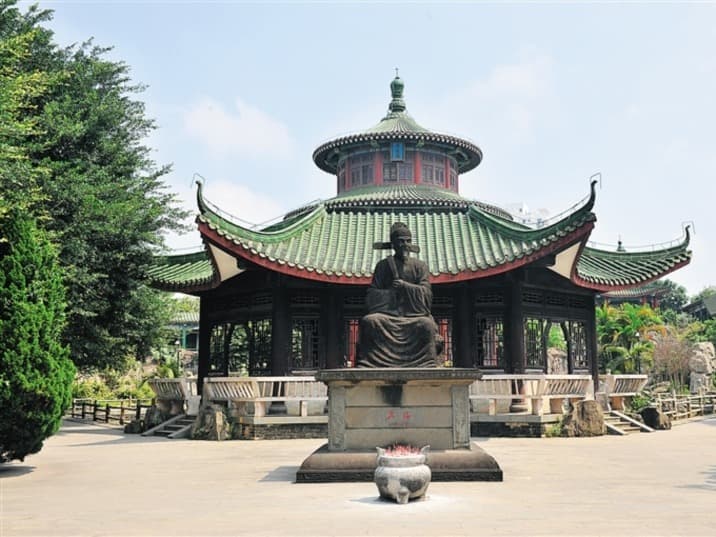
At the centre of the park stands the granite tomb, some three metres high, crowned with a rounded roof. Local devotees come to burn incense here in memory of Hairui.
The Yanglian Pavilion
Situated directly behind the tomb, this pavilion houses an exhibition hall dedicated to Hairui. Two couplets attributed to the mandarin himself adorn the entrance door and summarize his ethic of public service.
The Qingfeng Pavilion
Behind the Yanglian, the Qingfeng Pavilion rises over three storeys. It gathers relics, documents and objects tracing the different stages of the official's life, from his early administrative career through to his rehabilitation.
Practical information
- Allow approximately 1 to 1.5 hours to explore the entire site.
- Admission is moderate, sometimes free depending on the season—check on arrival.
- The site is open throughout the day, from morning to late afternoon.
- Bring water and sun protection: the main avenue offers little shade.
When to visit
Hainan enjoys a tropical climate, warm and humid year-round. November to April remain the most pleasant months to visit, with milder temperatures and less rainfall. The summer season can be challenging due to heat and occasional typhoons between July and September.
How to get there
The tomb is located approximately 5 km west of Haikou city centre, in Xiuying district. Urban buses on lines 2, 16 and 19 serve a stop close to the entrance. By taxi or ride-sharing from the city centre, allow around twenty minutes depending on traffic.
What to see nearby
The tomb fits into a broader exploration of Haikou and the island of Hainan. The provincial capital offers colonial quarters, temples and waterfront. To extend your journey through Chine, other major historical sites deserve a visit, such as the Great Pagoda of the Wild Goose in Xi'an or the Great Wall at Juyongguan near Beijing.
Frequently asked questions
Frequently asked questions
Hairui (1514-1587) was an official of the Ming dynasty, a native of Hainan. He remained famous for his fight against corruption under the reign of Wanli and symbolizes integrity in Chinese political culture.
A complete visit to the tomb, the sculpture avenue and both pavilions takes between one and one and a half hours.
Yes, buses on lines 2, 16 and 19 serve a stop in the immediate vicinity of the entrance from Haikou city centre.
From November to April, when Hainan's tropical climate is drier and less oppressive. If possible, avoid the typhoon season, which runs from July to September.
To incorporate the Hairui Tomb into a broader itinerary, explore our travel ideas in Chine.
Interested in this visit?
We can include it in your personalised itinerary.