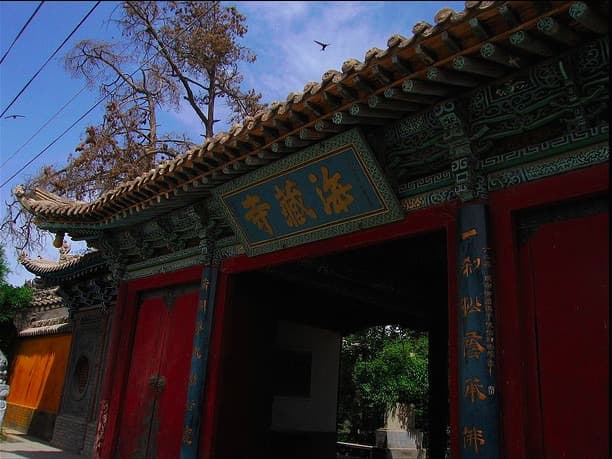
Haizang Temple in Wuwei
Haizang Temple in Wuwei
An ancient Tibetan Buddhist temple founded during the Jin dynasty, Haizang is now a heritage park spanning 11,600 m² northwest of Wuwei, on the Silk Road.
The Haizang Temple stands approximately 2 km northwest of the city of Wuwei, in Gansu Province. Once a Tibetan Buddhist monastery converted into a public park, it occupies 11,600 m² and forms the city's largest ancient complex. Its grey architecture from the Ming and Qing dynasties, its ponds, century-old poplars, and its connection to the Silk Road make it a composite site—both a cultural heritage and natural treasure.
Why visit Haizang Temple
The site combines three rarely found interests: an ancient Tibetan Buddhist foundation linked to Saban's passage, classical Chinese architecture remodeled across multiple dynasties, and a parkland setting with lakes and century-old trees. The visit remains accessible (moderate admission, accessible by urban bus) and offers insight into Wuwei's role as a major stop on the Silk Road. It also provides a useful counterpoint to major Buddhist sites in southwestern China, such as the Leshan Grand Buddha or the Wild Goose Pagoda.
History of the temple
Haizang Temple was erected during the Jin dynasty (1115–1234), making it a site several centuries old. It was subsequently rebuilt multiple times under the Yuan, Ming, and Qing dynasties, each leaving its mark on the overall complex.
The complex underwent major expansions linked to the passage of Saban, the fourth founder of the Sa-skya-pa school of Tibetan Buddhism. Under his influence, Haizang became a major Buddhist institution on the Silk Road, the vast commercial network connecting Asia to Europe and making Wuwei a strategic crossroads between the Chinese world and the Tibeto-Mongolian frontier.
The site was gradually transformed into a public park, opening its religious buildings to visitors and heritage appreciation.
What to see on site
The architectural complex
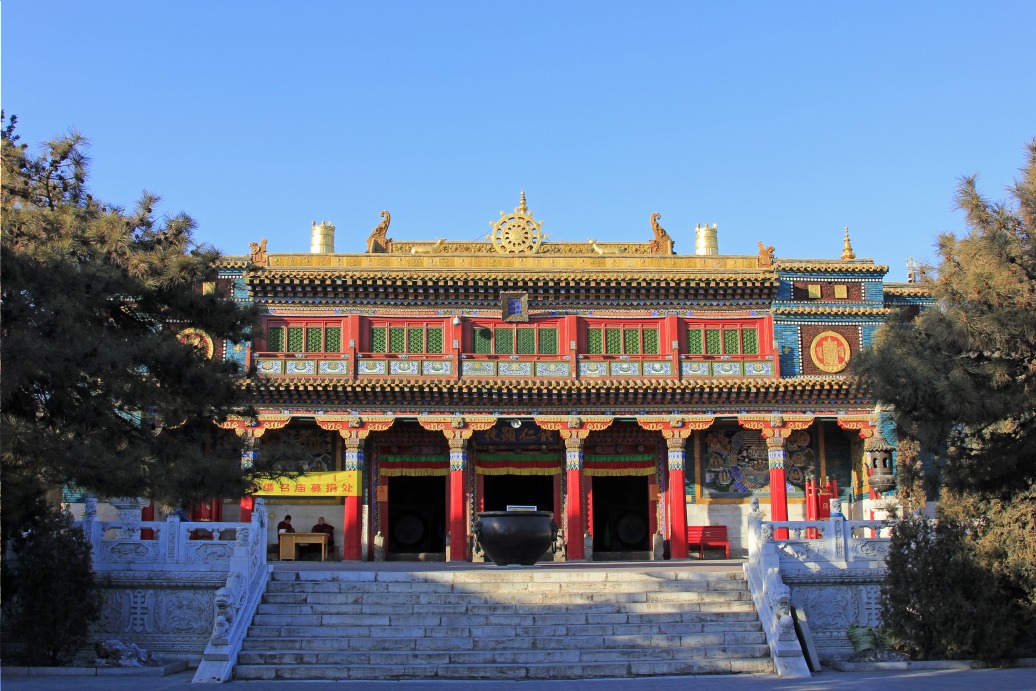
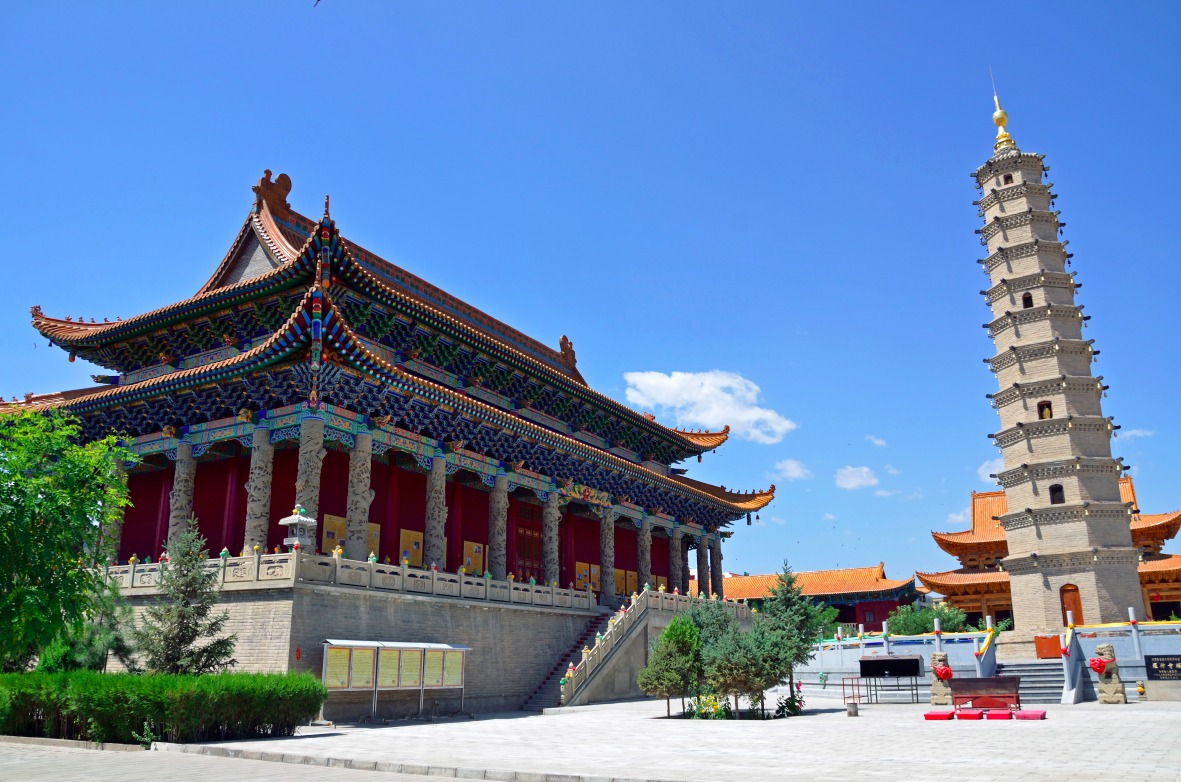
The complex spans 11,600 m² and stands as Wuwei's largest ancient ensemble. Principal buildings include:
- the great entrance arch and main hall;
- the Lingjun Tower;
- the Heavenly King Tower;
- the Wuliang Tower, also called the Hall of the Buddha of Light.
Most constructions date from the Ming and Qing dynasties and feature a distinctive grey tone. The ensemble is complemented by pedestrian bridges, arcades, and pavilions. The main entrance gate stands out with its three arches topped by classic Chinese roof tiles.
The Wuliang Tower and the well
Built during the Ming period, the Wuliang Tower houses a reclined Buddha statue protected behind glass—the most distinctive element of the visit. Nearby, a well fed by an underground stream is the subject of local belief: locals claim its waters have healing properties. This is a popular tradition, to be understood as such.
The park and its natural setting
Beyond the buildings, the site functions today as a park. Two natural lakes frame the complex to the north and south. Century-old white poplars punctuate the pathways, and a river lined with willows and reeds runs through the grounds. This natural dimension pleasantly extends the visit to the buildings themselves.
Practical information
Allow approximately 1.5 to 2 hours to explore the entire complex at a leisurely pace. Admission remains moderately priced, and the site is open daily during daylight hours. Specific opening times and prices may change: check locally or with your guide before your visit.
Modest dress is recommended in buildings with religious significance. The terrain is generally flat and accessible without particular difficulty.
When to visit
Wuwei is located in the Hexi corridor, which has a continental climate: hot summers, cold and dry winters. The most comfortable seasons to visit Haizang are spring (April–May) and autumn (September–October), when temperatures are mild and the park's vegetation is particularly striking. Summer remains feasible but can be hot midday. Winter brings sub-zero temperatures and a bare landscape, though it offers very few visitors.
How to get there
The temple is served by urban buses no. 3, 5, and 9. Get off at the stop at the park entrance. From central Wuwei, count on about ten minutes by taxi. Wuwei's railway station connects the city to Lanzhou, the capital of Gansu, making it a logical stop on a Silk Road itinerary.
Other attractions in the region
- Wuwei: continue exploring this Silk Road stop, rich in Buddhist sites and Han relics.
- Wild Goose Pagoda: another major center of ancient Chinese Buddhism, located in Xi'an.
- Leshan Grand Buddha: monumental statue carved into a cliff face, in Sichuan.
- Cangshan: iconic mountain range in Yunnan for those continuing south.
Frequently asked questions
Frequently asked questions
Its foundation dates back to the Jin dynasty (1115–1234). It was rebuilt and expanded under the Yuan, Ming, and Qing dynasties, with most of the buildings visible today originating from the Ming and Qing periods.
The site today functions primarily as a heritage park open to the public, while still preserving its original Tibetan Buddhist buildings.
A complete tour of the complex and park takes approximately 1.5 to 2 hours. Architecture enthusiasts or photographers may wish to spend longer.
Urban buses no. 3, 5, and 9 serve the park entrance. Taxis are also a convenient option from the city center.
Spring (April–May) and autumn (September–October) offer the most pleasant conditions, with mild temperatures and particularly lush park vegetation.
Including Haizang Temple in your trip
Haizang Temple fits naturally into an itinerary along the Hexi corridor, between Lanzhou and Dunhuang, following the Silk Road. To build a custom journey incorporating Wuwei and China's major Buddhist sites, explore our China voyages.
Interested in this visit?
We can include it in your personalised itinerary.