Labrang Monastery
Labrang Monastery
Founded in 1709 in Xiahe, Labrang is the largest Gelugpa monastery outside Tibet and the Tibetan religious center of Amdo.
The Labrang Monastery is the largest Gelugpa monastery of Tibetan Buddhism established outside the administrative province of Tibet. Located in Xiahe county in Gansu province, it stands as the religious and cultural center of Tibetan Amdo, at approximately 2,900 meters altitude.
Why visit Labrang Monastery
Nicknamed "the second Tibet," Labrang remains an active center of Buddhist learning. The visit combines several attractions:
- architecture blending Han and Tibetan traditions, spanning 866,000 m² with over 90 main buildings;
- observable daily monastic life, with ceremonies, debates and chanted prayers;
- a kora pilgrimage path of 3 km dotted with prayer wheels, walked by devotees;
- a location in Xiahe, a crossroads town of Tibetan, Mongolian, Han Chinese and Hui Muslim cultures, giving the place a singular atmosphere.
History of the monastery
The monastery was founded in 1709 by the first Jamyang Zhaypa, captivated by the location and landscapes of Xiahe during his passage. The institution developed rapidly as a school for spreading Tibetan Buddhism and as a center of art and culture in Amdo.
In the early 19th century, Labrang welcomed over 4,000 monks and exerted influence over Tibetan, Mongolian and Han populations. The monastery later endured troubled times: it was closed for twelve years during the Cultural Revolution, before being reopened in 1980 by the 10th Panchen Lama. In the early 1980s, it emerged as the principal religious and cultural center of Tibetan Amdo. Today, the monastic community numbers several hundred monks, with numbers regulated by the authorities.
What to see on site
The architectural ensemble
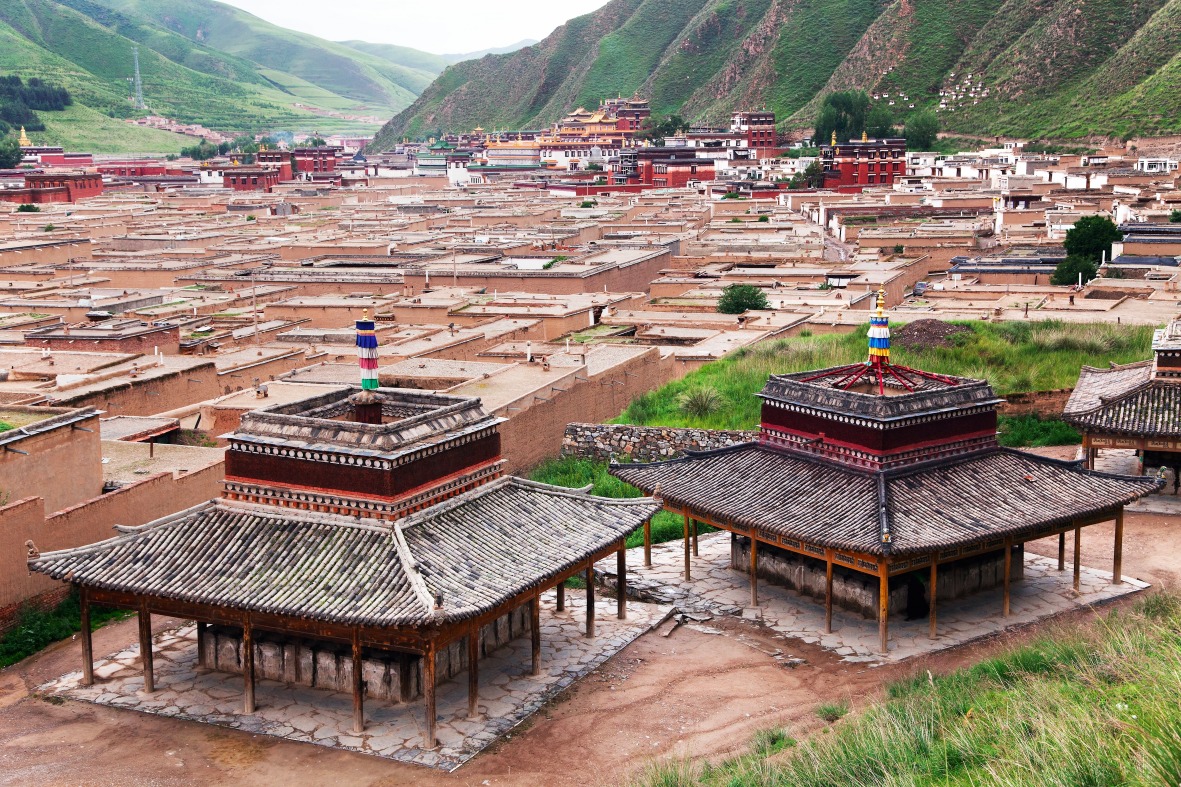
Built into the hillside of Xiahe, Labrang lines temples, colleges (datsang), residences of high lamas and monastic dwellings along whitewashed pathways. The interior of the main halls is immediately recognizable by the strong smell of yak butter, used for votive lamps. Ancient texts, statues and thangkas are preserved here.
Frescoes and illustrations
The temple walls feature Buddhist frescoes depicting the life of Buddha and his disciples, as well as Tibetan medical illustrations documenting traditional healing practices.
The golden stupa
The great stupa, distinguished by its gilded dome and white walls, occupies a central position within the complex and serves as a visual landmark of the monastery.
The kora and prayer wheels
The 3 km pilgrimage path encircling the monastery is traversed daily by devotees who spin the prayer wheels aligned along the route. Allow approximately 1 hour to complete the circuit on foot.
Daily monastic life
Visitors can observe, at a respectful distance, prayer ceremonies in the main temple and encounter monks moving between classrooms and places of worship.
Practical information
- Guided tour required: access to the temples is only possible accompanied by a monk. English-language tours are offered daily, mid-morning and early afternoon (verify hours on-site).
- Entrance fee: moderate cost, payable in cash.
- Recommended duration: plan 2 to 3 hours for the guided tour and kora.
- Dress code: cover your body, remove hats and sunglasses before entering temples; photography prohibited inside halls.
- Altitude: Xiahe sits around 2,900 m, pace yourself upon arrival.
When to visit
The best period runs from May through early October, when temperatures are comfortable and roads passable. Winters are long and harsh, with sub-zero temperatures from November to March and frequent snowfall.
For a more intense experience, the Monlam festival (Great Prayer), celebrated at the start of the lunar year (typically February-March), features spectacular ceremonies: unfurling of the great thangka on the hillside, masked cham dances and butter sculpture processions. Crowds are heavy during this time and accommodations should be booked well in advance.
How to get there
The monastery is located at the western edge of Xiahe, accessible on foot from the town center. To reach Xiahe:
- From Lanzhou, capital of Gansu: direct buses from the south bus station, approximately 4 to 5 hours via Linxia.
- From Linxia: regular bus connections, approximately 2 to 3 hours.
- By private car with driver: a more flexible option, recommended if combining Labrang with other regional sites.
Nearby attractions
- Sangke Grasslands: about twenty kilometers from Xiahe, vast Tibetan pastures where nomadic life can be observed and summer tent stays arranged.
- Valley caves and monasteries: several small hermitages and meditation caves dot the surrounding area.
- Langmusi: a monastic village on the border between Gansu and Sichuan, approximately 4 hours drive south.
To deepen your exploration of Chinese Buddhism, the Haizang Temple in Wuwei and the Giant Wild Goose Pagoda in Xi'an offer interesting Han Chinese counterpoints.
Frequently asked questions
Frequently asked questions
Yes, access to the main temples is only possible with a monk guide. English-language tours are offered daily; for visits in other languages, a private guide or travel agency is recommended.
Allow 1 to 1.5 hours for the guided temple tour, plus approximately 1 additional hour to walk the 3 km kora around the monastery.
No, photography is forbidden inside prayer halls and in front of statues. The exterior, the kora and the prayer wheels may however be photographed.
Xiahe sits at around 2,900 m. Most travelers acclimatize without difficulty, but it is recommended to limit exertion on the first day, hydrate well and avoid alcohol.
The festival takes place over the first days of the Tibetan new year, typically in February or March according to the lunar calendar. The unfurling of the great thangka and cham dances are the highlights.
Include Labrang in your journey
The monastery lends itself particularly to an itinerary combining Lanzhou, Tibetan Gansu and the Sichuan frontier. To build a customized itinerary incorporating Xiahe and Labrang, consult our China voyages.
Interested in this visit?
We can include it in your personalised itinerary.