Mawangdui Han Tombs
Mawangdui Han Tombs
Discovered in 1972 near Changsha, the Mawangdui Han Tombs yielded the mummy of Lady Dai and over 3,000 relics from the Han Dynasty.
The Mawangdui Han Tombs rank among the most significant archaeological discoveries of the twentieth century in Chine. Unearthed in the eastern suburbs of Changsha, in the Mawangdui district (Hunan province), this funerary site of the Han Dynasty yielded the remarkably well-preserved tomb of Lady Dai (Xin Zhui) along with more than 3,000 relics now displayed at the Hunan Provincial Museum.
Why Visit the Mawangdui Han Tombs
The site and the collections it produced offer a unique window into Chinese aristocratic life more than 2,100 years ago. The mummy of Lady Dai, found in an exceptional state of preservation, and the thousands of objects that accompanied her—textiles, silk manuscripts, musical instruments, lacquered vessels—form a coherent ensemble that illuminates the material, medical, and philosophical culture of the Western Han. For archaeology enthusiasts passing through Changsha, Mawangdui is an unmissable landmark of Chinese heritage.
History and Discovery of the Site
Excavations conducted between 1972 and 1974 revealed three tombs belonging to the family of Li Cang, Marquis of Dai and chancellor of the Kingdom of Changsha under the Western Han. The burial chambers contained the marquis himself (tomb no. 2), his wife Xin Zhui (tomb no. 1), and presumably their son (tomb no. 3).
Tomb no. 1, the largest, was reached at a depth of 16 meters. It contained the remains of a woman in a state of preservation never before observed for a mummy of such antiquity: supple skin, mobile joints, internal organs still identifiable. A seal bearing the inscription "Lady Xin Zhui" made it possible to formally identify her as the wife of Li Cang.
The preservation was due to the ingenuity of the funerary structure: the coffin rested on a layer of plaster and charcoal, all covered with bamboo mats and compacted white clay, creating a hermetic environment. During the excavation in the 1970s, workers noted the emanation of an inflammable toxic substance, evidence of the vault's preserved airtightness over more than two millennia.
What to See on Site and at the Hunan Provincial Museum
Note: the artifacts and remains of Xin Zhui are no longer stored at the site itself but are displayed at the Hunan Provincial Museum in Changsha, in galleries entirely dedicated to Mawangdui. The archaeological site itself presents the structures of the tombs and a smaller museum exhibition.
Highlights
- The mummy of Lady Dai, presented in a climate-controlled case, accompanied by a reconstruction of her appearance.
- The ultra-fine silk garment discovered in tomb no. 1: 1.30 meters long and weighing only 49 grams, a testament to Han textile mastery.
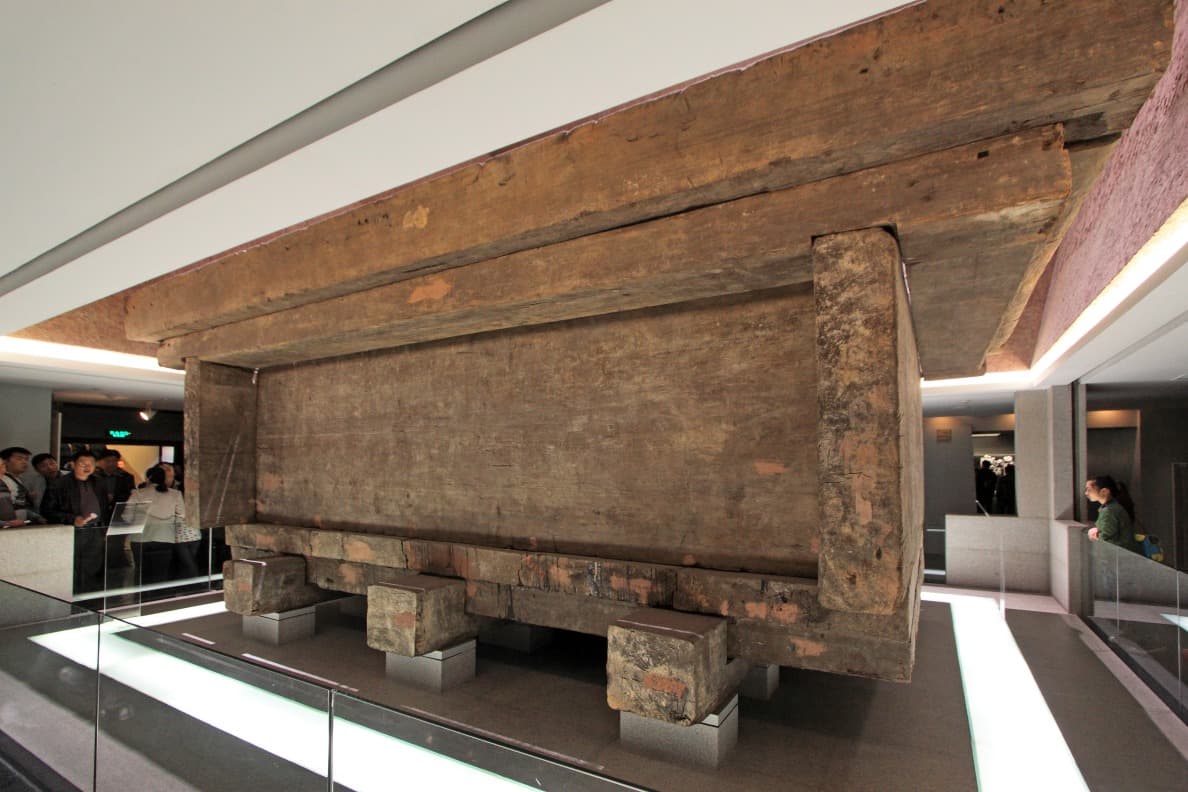
- Nested lacquered wooden coffins, adorned with engravings and painted scenes representing deities and mythological creatures.
- Silk manuscripts, covering Taoist philosophy, astronomy, medicine, military techniques, and cartography.
- The T-shaped funeral banner, painted on silk, depicting the Han cosmological universe in three registers (heaven, earth, underworld).
- Funerary furnishings: lacquerware, musical instruments, wooden figurines, identifiable food items.
Practical Information
- Location: Mawangdui district, eastern suburbs of Changsha, Hunan province.
- Duration of visit: allow 1 to 2 hours at the archaeological site, 2 to 3 additional hours at the Hunan Provincial Museum to explore the collections from the excavations.
- Admission: entry to the Hunan Provincial Museum is generally free with advance reservation (passport required). Check conditions before your visit, as procedures may change.
- Hours: open daytime Tuesday to Sunday, closed Monday. Verify current times before traveling.
- Tip: combine a visit to the site and the museum on the same day, starting with the museum to better understand the artifacts.
How to Get There
The site is accessible by public transport from central Changsha. Several bus lines serve the Mawangdui district, notably lines 110, 114, 10, 14, and 112. Line 110 connects Changsha Station to Hunan University, passing through Mawangdui; line 114 connects the station to Huanghua Airport. Taxi and ride-sharing remain a convenient option to reach the site directly or the Hunan Provincial Museum, located in another part of the city.
Nearby Attractions
Changsha deserves more than a quick stop: the birthplace of Mao Zedong concentrates museums, night markets, and the lively banks of the Xiang River. To extend your archaeological immersion in Chine, other sites elsewhere in the country are worth visiting.
- Changsha: complete guide to the city and its points of interest.
- Wild Goose Pagoda in Xi'an, another major stop on China's heritage circuit.
- Bezeklik Thousand Buddhas Caves, for lovers of ancient Buddhist art.
- Longgong Cave, a natural and cultural site in the southwest.
Frequently Asked Questions
Frequently asked questions
Xin Zhui was the wife of Li Cang, Marquis of Dai and chancellor of the Kingdom of Changsha under the Western Han. She died around 163 BCE, and her mummy is one of the best-preserved in the world for this period.
No, most of the objects and the mummy of Xin Zhui are preserved at the Hunan Provincial Museum in Changsha. The Mawangdui site primarily presents the structures of the tombs.
Plan for half a day to combine the archaeological site and the Mawangdui galleries at the Hunan Provincial Museum, including travel time.
Yes, the Hunan Provincial Museum uses a free online reservation system with passport presentation at entry. Book a few days before your visit.
Spring (April-May) and autumn (September-October) offer the most pleasant conditions in Changsha, with summer being hot and humid.
Plan Your Trip
Mawangdui fits naturally into a central Chine itinerary combining Changsha, Zhangjiajie, and Hunan's landscapes. To build a customized journey including this archaeological site, explore our trips to Chine.


Interested in this visit?
We can include it in your personalised itinerary.